I am a novice oblate of the Benedictine Monastery of the Holy Cross in Chicago, Illinois. My wife is, too. God willing, we will make our final oblation on Nov. 8, 2026. Benedictine oblates live the monastic way of life insofar as their state in life permits — they are, we might say, “everyday monks.”
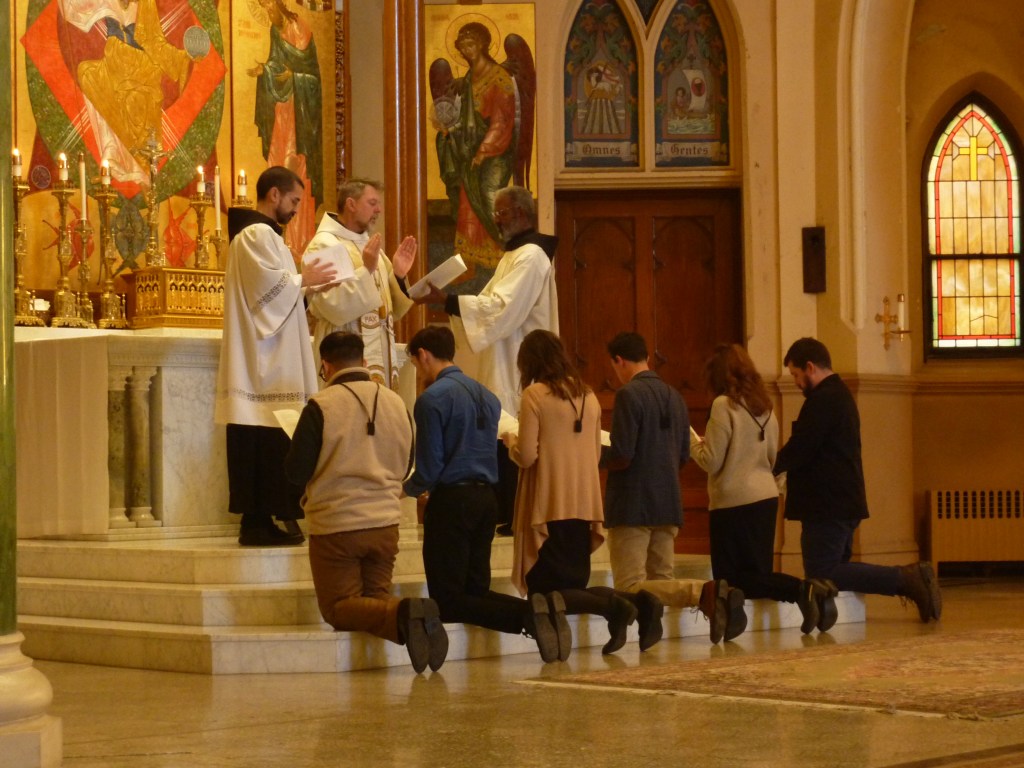
Becoming a Benedictine oblate is the culmination of at least two significant spiritual movements for me over the last several years.
The first movement consists of a desire for a more contemplative life — a more attentive life. As a husband and father of eight, with a very full-time job, it’s easy to lead a distracted life. It’s easy to miss what God is trying to do right in front of my face. So, this first desire boils down to a desire to seek God (cf. RB 58:7). I want to seek God in the ordinary circumstances of my life, and to do so in a way that’s been tried and proven true: the monastic way. To aid this search, we engage in certain spiritual practices, receive formation, and contribute to and receive from the spiritual good of the monastery.
The second movement is communal. I am not sure how to raise a Catholic family in these times. It can feel discouraging at times and quite often we feel we’re spinning out of control. In the Fall of 2024, we read John Mark Comer’s The Ruthless Elimination of Hurry. This surfaced a number of important insights for us, but when we finished the book, we weren’t exactly sure how to act on it. It seemed like we would just make up something else, another strategy we’d try that might work, but probably not. It was then that I stumbled upon a little book by Fr. Dwight Longenecker entitled St. Benedict for Busy Parents. Honestly, I don’t even know how I saw it. It was in one of the pamplet book racks in the back of the church that I’d flown by 100,000 times before. This little book explained the Benedictine charism according to the monastic vows of stability, obedience, and conversion of life, and the pillars of daily monastic living (prayer, study, and work). It did all of this with the family in mind — making simple connections from the monastery to the home — and pointing out how the home can become a “school of the Lord’s service.” Here’s the money paragraph from Fr. Longenecker that pulled together my desire for deeper contemplation along with a richer family life:
Benedict’s Rule gives us a foundation for the Christian home as well. The discipline in the home is established to form all who live there into more Christ-like people. The home, like the monastery, should be a school for the Lord’s service. It is the place where together, we learn how to come closer to God. Our relationships with one another, our schedules, the shape of our busy lives should all contribute to this one aim: that our home may be a place where we learn how to love God, and therefore become more like Him.
Or, this one from GA Simon’s Commentary for Benedictine Oblates:
The Benedictine spirit is essentially a family spirit. To be faithful to the spirit of the Rule, therefore, the Oblate to whom Providence has entrusted the care of a family should love his home and maintain there that profound union which can come only from supernatural charity, grouping all the souls, so to speak, in one and the same search for God.
Now, people have asked me why I need to pursue oblation in order to pray (honestly, many of the exact same prayer practices I had previously employed) or work on my family’s communal life. The honest answer to the honest question goes something like this: I’m tired of trying to figure things out on my own. I get tired of being anchored inside my own head, and thinking and re-thinking things. I need some sort of anchor outside of my head, a real tether to something concrete outside of my home, a bar or standard that won’t shift based upon how I’m feeling or what have you. I need to be linked to something more solid that me and my home in the midst of this world. The parish can provide this to a degree, but I wanted something even more intentional than parish life. I want a Rule of Life and something that won’t be subject to my own fickleness. St. Benedict’s Rule is this.
Really, I think there’s another, more mysterious third reason I’m pursuing this: St. Benedict himself. I think St. Benedict has been quietly pursuing me for a long time. I was introduced to the Liturgy of the Hours as a sophomore in college. I first visited one of his monasteries on a mountainside in Spain (Our Lady of Montserrat Abbey) as a junior, and I first wore his medal as a senior in college. Early in my time of youth ministry, a friend gave me a St. Benedict medal crucifix, which has been on my wall ever since. When my wife and I went on a makeshift honeymoon after our wedding, we ended up on property in northern Colorado that was adjacent to St. Walburga Abbey, which was where we celebrated the Solemnity of Mary Mother of God back on Jan. 1, 2009. Pope Benedict XVI has been a spiritual father to me throughout my entire time of trying to live as an intentional disciple, and I firmly believe he did more for the Church as a hermit than he would have had he not retired. I’ve always thought of our Christian home as something of a monastery — that somehow some principles from monastic life should be able to help us. Reading Rumer Godden’s In This House of Brede only solidified this conviction. I think Rod Dreher’s The Benedict Option is onto something, but I found the whole concept too idealistic so I didn’t know what to do with it. It needed to be tethered to something real (I think oblation does this in a unique way). My great uncle stole away from home as a young man and entered the Benedictine abbey of St. Meinrad in remote southern Indiana. His story has haunted me most of my life and I’ve prayed at his tomb. Yes. I think St. Benedict has been after me.
Monastery of the Holy Cross
One becomes an oblate of a particular monastery. The Order of St. Benedict is not a universal order like Franciscans, Dominicans, or Jesuits. It’s a collection of monasteries united by the Rule, but each with its own customs and Benedictine flair. Choosing to be a Benedictine oblate is one thing, of which monastery is another. We have discerned to pursue oblation at the Monastery of the Holy Cross in Chicago, and the monks there have mutually discerned to accept and support our pursuit. The whole process has been marked by mutual discernment and an attentiveness to a certain “spiritual affinity” — an affinity between the spirituality of the monastery and our spiritual journey. Michael Casey, OCSO describes this reality:
A monastic vocation cannot be forced. Will-power is not enough. There needs to be some pre-existing affinity that guarantees that growth in monasticity is also growth in authentic selfhood.
This connaturality means that often a candidate is attracted to a particular monastery without quite knowing why. It may be the scenic location, the sense of silence and calm, the quiet industry, the disciplined freedom, the generalized aura or contentment, the sound of the chant, or the understanding smile of a member of the community. Some trivial aspect of daily life awakes a deep inner resonance within that signals to inquirers that this is not only a place where they can seek and serve God, it is also the possibility for them to be and become themselves.
I think the connaturality with the Monastery of the Holy Cross, for us, comes from the following:
- The palpable Christocentricity of the community
- The seriousness with which they take prayer and the liturgy
- The location in the middle of a big city — silence in the city
- Their appreciation of the Eastern rites and spirituality
- The fact that the founders were very active missionaries in Latin America who realized the purely active life was empty to some degree, and desired a richer communal and liturgical life (Katie and I had a similar experience with very full-time ministry and realizing a need for a deeper family and prayer life)
Numerous times a day, I recall the monks at the Monastery.1 I recall our “family” in Chicago, and our “home” there. I think of what GA Simon says: “The thought of our monastery, with its vision of fervor and peace, contributes to [the sense of building a spiritual enclosure]. In the midst of the world we tell ourselves: I am the brother of the monks, I belong to the monastic Order; I am no longer of the world.”
We are novices. We have a long way to go and much to learn as we head down the well-trodden monastic path. Even after final oblation next November, we will still be novices and probably always be novices to some degree. I’m glad St. Benedict had me in mind when he wrote his little Rule for beginners (cf. RB 73:8).
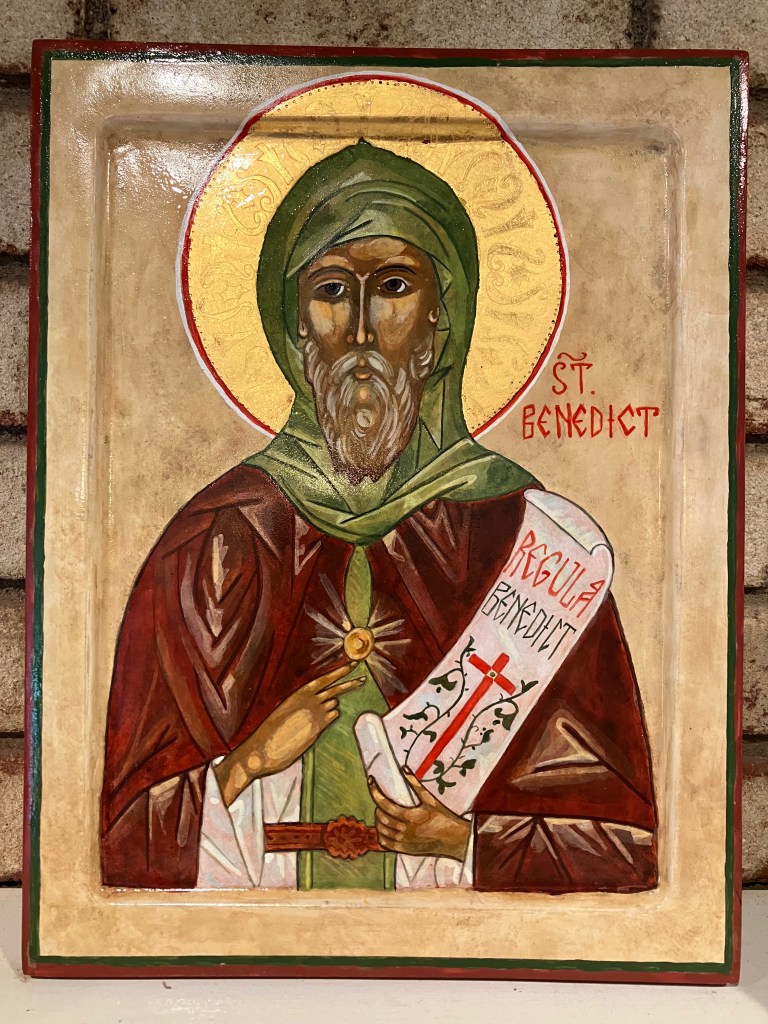
- We’ve added some incarnational elements to our home that help us remember the monastery. A beautiful pencil drawing of the Monastery, various symbols of the Benedictine order (e.g., Benedict medal), an icon of St. Benedict, mugs from the Monastery, and so forth. ↩︎

 Brad Bursa
Leave a comment