
Sometimes the silence says everything.
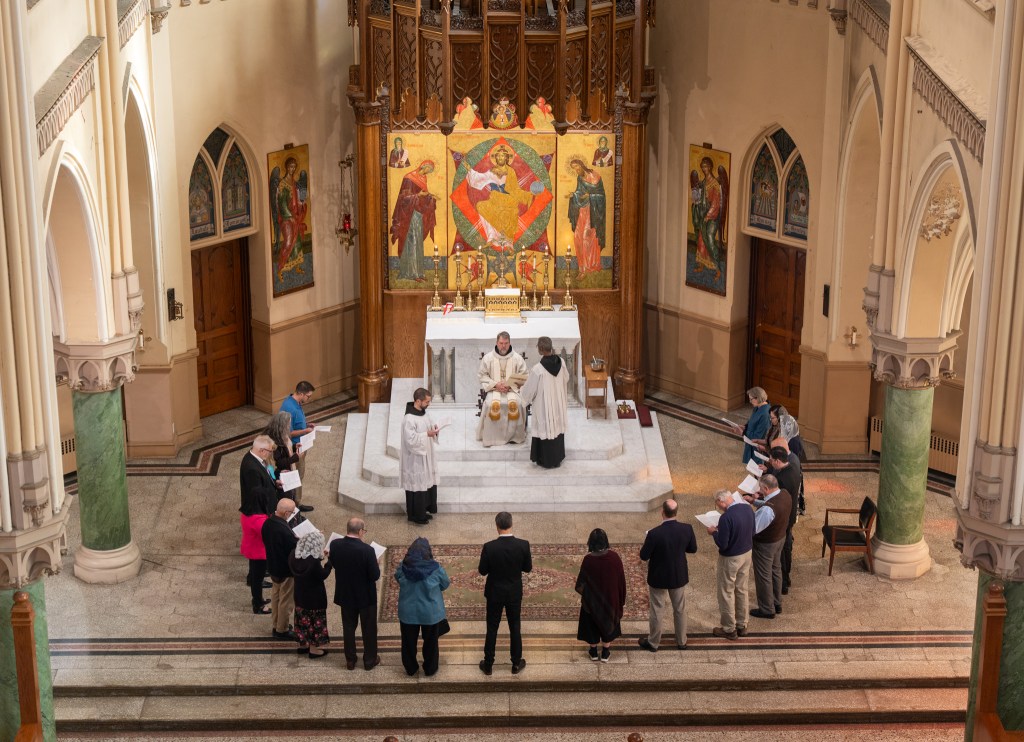
We had, each of us, just signed our names on our individual formulas of Oblation on the altar of God. My signature was a final stamp on this promise of “the conversion of my life, according to the spirit of the Rule of our Holy Father Benedict, in so far as my state in life permits.” I signed this on the altar only after kneeling before the Prior who sat before the tabernacle which sat under the massive, iconic Deisis depicting Christ Pantocrator (almighty or ruler) sitting on his throne of glory, and looking him in the eyes and responding to his questions:
Bradley, do you renounce the vanities and pomps of the world? I do.
Will you undertake to live your life according to the spirit of the Rule of our holy Father Benedict? I will.
Will you persevere in your holy resolution until death? With the help of God’s grace, I will.
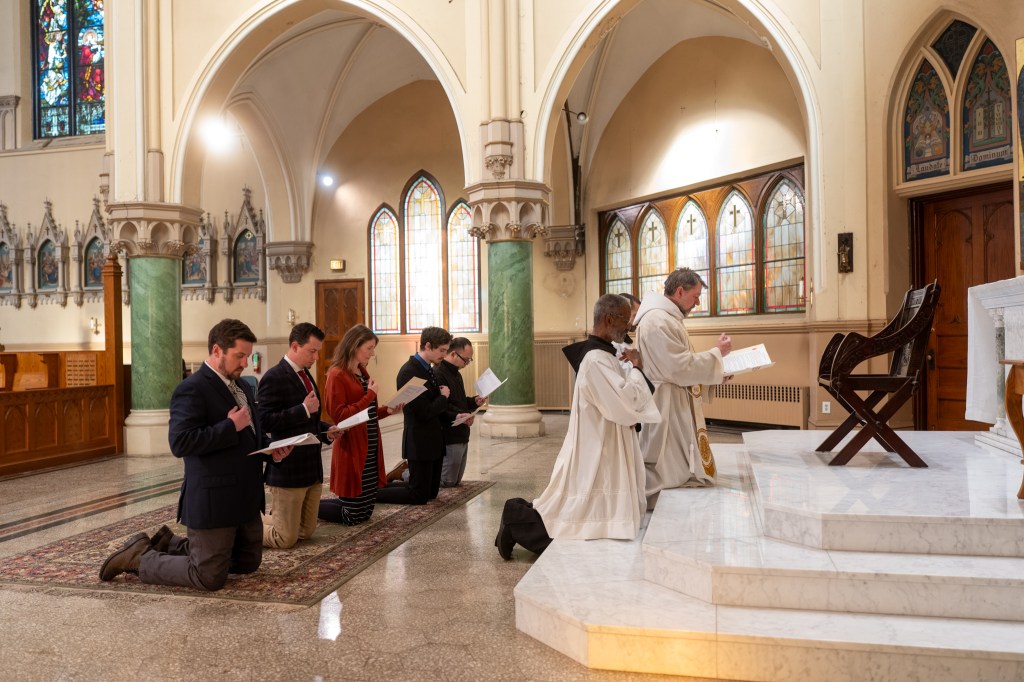
After signing and upon returning to our spots before the Prior, Tabernacle, and Pantocrator, we knelt again. In the ritual, we were to immediately begin the Suscipe from Psalm 119:116:
Receive me, Lord, as you have promised, and I shall live; do not disappoint
me in my hope.
But instead of speaking there was a collective silence. It was almost as if we all, all five of us, lost our breath for a second. Then, with a bit of a tremble, we began: Receive me, Lord…
In response to this prayer, this plea, God did receive us and this reception was mediated, incarnately, through the Prior as he said, “And I, as God’s representative, accept your Oblation and admit you into union and affiliation with our monastery as Oblates…”
Sometimes the silence says everything and the silence in that second on Sunday, November 8, that pregnant second of silence that felt like an eternity, said that this was a momentous spiritual occasion. It was an oblation, an offering sacrificial in nature, of the whole of one’s life for the whole of one’s life.
In recent weeks, I’ve had many people ask me about Benedictine oblation, so I thought I’d write more about it here. I will keep this fairly brief. First, I want to point out that Benedictine oblation is a profound renewal of one’s baptismal consecration. Here, I’d like to highlight two beautiful paragraphs from the Pluscarden Abbey Oblate Statutes that make this point clear:
Oblation is a free act of self-offering to God, recognized by the Church (cf. the Code of Canon Law, can. 303; 677 §2) whereby individual Christians establish a bond of intimate union with a particular Benedictine community. The act of oblation is a true offering, and brings about a true belonging, though it is different in nature from that bond which unites a monk to his community, and it does not bring about a change in the individual’s status in the Church.
Oblates are Christians, lay or ordained, who, committed to the living of their faith and while continuing to live their own state in life, desire to make their own the values expressed by Benedictine monastic life. With the monks or nuns, they therefore look to the Rule of St. Benedict as a pattern for their living of the Gospel message. They undertake to pursue the path of Benedictine spirituality, through the guidance of the Holy Rule (RB 3:7) and in the spirit of the community of their affiliation, so as constantly to renew their baptismal consecration.
In a nutshell, being a Benedictine oblate means attempting to live monastically in the world. Or, to live out the baptismal call to holiness as a lay person (in my case) in a Benedictine way. Put very simply, it means keeping St. Benedict’s Rule at the forefront of my mind and asking: What would be a Benedictine way of approaching this or that? How would St. Benedict carry out this task?
Benedictine monks and nuns make lifelong vows of stability, obedience, and conversatio morum (i.e., fidelity to the monastic way of life) (RB 58:17). Oblates don’t make formal religious vows, but they do make an offering of their lives and a promise of the conversion of their lives according to the spirit of the Rule of St. Benedict. Oblates make their offering for a particular monastery or abbey for life. This or that abbey, for life. For me and my wife, this is the Benedictine community of the Monastery of the Holy Cross in Chicago. We do not vow obedience to the superior of that community, yet the act of oblation reinforces our baptismal obedience to God, our mutual submission to each other as Catholic spouses, and it creates a certain spiritual bond with the Monastery guided by the oblate director to whom we willingly turn for guidance in Benedictine spirituality.
The particular commitments of an oblate can vary from monastery to monastery. For us at the Monastery of the Holy Cross, we have five duties:
- Liturgical Prayer — praying all or some part of the Liturgy of the Hours each day. For me, right now, this means Lauds and Compline.
- Lectio Divina — prayerful reading for some amount of time, daily. (Separately, please see my Substack lectioandlife.com for more on lectio).
- Reading, studying, and applying the Rule of St. Benedict according to my state in life. We do this daily by reading a small section of the Rule along with some a guidebook that provides commentary and ideas for application.
- Commitment to parish life — engagement in the sacramental life of the Church, plus sharing time, talent, and treasure within the parish community.
- Commitment to the Monastery of the Holy Cross — engagement in the life of the Monastery, plus sharing time, talent, and treasure.
Regarding these duties, we must remember our state in life and use discretion. The Benedictines believe in gradual conversion. This is simply what the conversatio morum does. Being faithful to the monastic way of life changes you over time. So we have to remember at all times that in establishing a “school for the Lord’s service,” and drawing up its regulations, St. Benedict hoped “to set down nothing harsh, nothing burdensome” (RB Prol 7). Oblate duties are not intended to be harsh and burdensome.
In a future post, I’ll share about our motives for pursuing oblation in the first place, our sense of spiritual affinity with the Benedictines in Chicago, and some of the fruits we’re already experiencing from entering into this way of life.
“Let them prefer nothing whatever to Christ, and may he bring us all together to everlasting life.” (RB 72:11-12)


Leave a Reply