• When we don’t really know someone, but we’ve heard a lot about him or her, our imaginations can take over. We paint a certain picture of who this person is. We’re often wrong. For many people, this experience is analogous to our experience of the Holy Family. We’ve heard a lot about Jesus, Mary, and Joseph, but we don’t really know their family life. We paint a picture of unattainable perfection in our heads and we can dismiss the Holy Family as being out of touch with our trials and tribulations. This is exactly why the Holy Family consecration matters. 

    What is a consecration? 

    The word “consecration” comes from the Latin con—“with, together” and sacrare—”to make or declare sacred.” Therefore, to consecrate something means you are making it sacred, you are setting it with sacred things. The Catholic Encyclopedia defines consecration as follows: “Consecration, in general, is an act by which a thing is separated from a common and profane to a sacred use, or by which a person or thing is dedicated to the service and worship of God by prayers, rites, and ceremonies.” 

    We can think of the holy vessels used only for the celebration of the Eucharist at Mass, for example. These golden vessels have been set apart for one purpose—for one, and only one meal. 

    The concept is quite scriptural. We see consecration throughout the Old Testament, from Abel (and his offering of first fruits) and Noah (and his family) to Moses (and the people of Israel) and David (as king of the people). In the New Testament, John the Baptist, Mary, Jesus, the Twelve, and so forth. If you’ve ever been to the ordination of a priest, you witnessed a consecration. This man is now set apart. Actually, this gets at the point. The “being set apart” is not for the sake of the person or thing set apart—like the preservation of a museum piece. The “being set apart” is for the sake of the whole, for the sake of serving the whole. The newly ordained priest isn’t just a priest for himself, but for the people of God. 

    If you were to engage in Holy Family consecration, you will have a great opportunity to teach your children about consecration and to have a conversation about what it means to be a Catholic Christian person/family in the world. 

    In fact, at the encouragement of our pastor, my family consecrated ourselves to the Holy Family a few weeks ago. The conversation leading up to saying the prayer together was rich (though not without a fair share of distractions) and we’re now making the prayer a regular part of our Sunday evening routine. 

    Who is the Holy Family? 

    Most readers know the Holy Family consists of Jesus, Mary, and Joseph. On the one hand it seems pointless to ask this question. On the other hand, we could do a deep dive into each of the members and write separate books on each. 

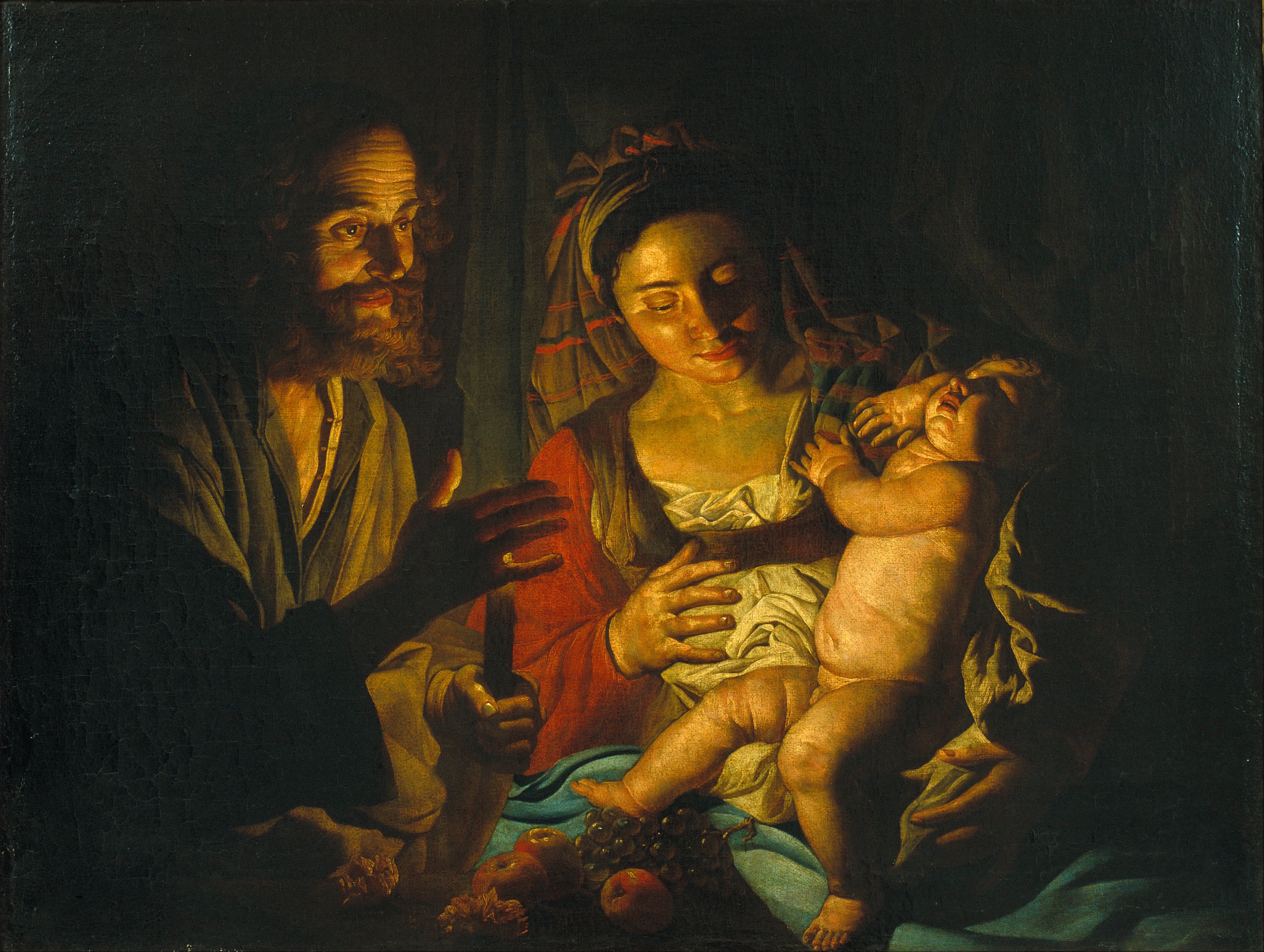
    For our purposes, it will suffice to say that the Holy Family is the icon of a holy and wholly ordinary life. Joseph and Mary were set apart in their unique relationship with Jesus, the Son of God, yet they were set right in the midst of their family and friends in Nazareth. They were not so removed as to be untouchable. Rather, they were both right there with God, and right there with others. They lived the richness of their Jewish religious life and the richness of ordinary life in society. Mary and Joseph were wholly devoted to their Son and to raising him in the Jewish faith and they were wholly devoted to teaching him the necessary skills for dealing with the ordinary affairs of life in Nazareth during the first century AD. 
    What is Holy Family consecration? 

    To consecrate yourself, or your family to the Holy Family is to set yourself apart with the Holy Family. As we set ourselves apart with the Holy Family, we draw near to the Holy Family and get to know its members. In other words, consecration is an opportunity to be disillusioned. All those images of the Holy Family so shrouded in mystery come into better and better focus. That sense of distance from the Holy Family and its situation starts to be overcome. 

    And, like the Holy Family was set apart for the sake of service to humanity—literally raising the redeemer of the world—when we consecrate ourselves and our family to the Holy Family, we are uniting ourselves, in a sense, to their service to the world. 

    Holy Family consecration is an act that places us with the Holy Family for the service of the many who are all around us and our families. 

    All of this reminds me of a few lines from a Christian letter that was circulated around 130 AD. In the “Letter to Diognetus,” we read a description of the Christian in the world, and it is a fitting description for the family striving to become a holy family: 

    To speak in general terms, we may say that the Christian is to the world what the soul is to the body. As the soul is present in every part of the body, while remaining distinct from it, so Christians are found in all the cities of the world, but cannot be identified with the world.

    The family consecrated to the Holy Family is set apart yet present in all aspects of ordinary societal life in the 21st century. In other words, we still participate in youth sports, school PTO, and going to the grocery store, but how we do these things should differ from the rest of “the world.” Youth sports now becomes about more than winning—it is a field of opportunity for learning virtue. School PTO is not a political jockeying, but a seeking of the common good for students, teachers, and families. And, the grocery store is more than checking things off a list, but an opportunity to encounter neighbors and, maybe, to serve someone in need. To be a family set apart, yet present to the needs of others, this is what consecration to the Holy Family means. 

    The Holy Family Consecration Prayer 

    Recently, the Knights of Columbus began promoting Holy Family consecration. Supreme Chaplain, Archbishop Lori of Baltimore, composed a beautiful prayer that can be accessed on the resource page of the Knights’ website. 

    The prayer is simple. It contains beautiful imagery. And, it could easily be prayed daily—as part of a family’s nightly prayers—or weekly, on Sundays, for example.

    As a family prays this consecration prayer, they are asking that their family be set apart with the Holy Family for the sake of the many other families we encounter on a daily basis. 

    Through Holy Family consecration, we can: 

    • Grow in our relationship with the Holy Family

    • Experience the conversion and transformation of our families—becoming more like the Holy Family

    • Find our footing as a family—as an example to others and in service to others

    The Holy Family need not remain so distant. Through a simple prayer incorporated into the fabric of your family’s prayer life, you can draw near to the Holy Family and join in its mission as you grow your own holy family. 

  • And how can I find it?

    Jesus promises peace the world cannot give (Jn. 14:27). The whole verse, which appears in John’s Last Supper discourse (Jn. 14–17), is as follows: “Peace I leave with you; my peace I give to you. Not as the world gives do I give it to you.” 

    Such a line raises many questions. What is peace in the first place? What kind of peace does the world offer and how does Jesus’ offering differ? And, can we still receive it today? 

    What is peace? 

    A brief history of the word “peace” in the English language reveals divergent paths. 

    In a first movement, we find the origins of the word “peace” in the common Hebrew greeting shalom. Shalom refers to being intact, complete, and whole, to soundness and welfare. Scripture scholar Bruce Vawter explains that shalom is “an expression of the harmony and communion with God that was the seal of the covenant.” For the Jewish people, shalom refers to communion with God that brings peace, and this communion has a covenantal form. 

    Translators of the Bible reinforced this emphasis on peace-as-communion as they utilized the Greek word eirēnē (harmony, concord, tranquility) for shalom, and opted for the Latin pacem (nominative pax) when the Bible was translated again. The root of pacem is pag-, which means “to fasten” — like forming a pact, contract, or, more profoundly, a covenant that forges peace. Here, we come to our English word “peace.”

    The second movement takes a distinctly modern turn, as “peace” gets caught up with the liberal concept of freedom. The Oxford English Dictionary, for example, offers these definitions: “freedom from civil unrest or disorder” and “freedom from quarrels or dissension between individuals.” To be at peace is to be free from certain troubles, cares, obligations, and societal bonds, and so to be free to pursue that which one wants. 

    What is the peace the world gives? 

    In many ways, the contemporary understanding of peace as freedom from constraint flows from what Jesus describes as the world’s offering of peace. 

    Every era, it seems, every political power or philosophical current makes a peace claim. At the time Jesus walked on the face of the earth, for example, the Pax Romana was in full effect — imperial peace that resulted from beating down all opponents. 

    More recently, the liberalism flowing from the Enlightenment attempts to free the individual from external constraint for the peaceful pursuit of happiness. Marxism promises peace as the result of social revolution. Postmodern thinking offers its own promise of peace based upon a sort of relativism and the universal tolerance of every position. 

    In each case, worldly peace — in particular, the modern and postmodern forms — is a man-made peace created by freeing man from any external or internal restraint. When these attempts fall apart, a certain nihilism results. Anxiety and depression become commonplace, a society seeks less abstract peacemakers, like medication, drugs, or the smartphone.

    The Peace the World Cannot Give

    If worldly peace emphasizes freedom from any cause of restraint, frustration, or pain, if worldly peace is some sort of cathartic experience to spite the circumstances, Jesus’ peace offering is the opposite. It is presence, communion, and fullness despite the circumstances. 

    There is an emblematic passage of Christian peace in John’s Gospel (Luke’s, too). News was spreading of an empty tomb, but Jesus had not yet appeared to the apostles as a whole. Being deathly afraid, they had locked themselves in the Upper Room. The rest of the account is too powerful to merely summarize, so I will quote it in full: 

    On the evening of that first day of the week, when the doors were locked, where the disciples were, for fear of the Jews, Jesus came and stood in their midst and said to them, “Peace be with you.”

    When he had said this, he showed them his hands and his side. The disciples rejoiced when they saw the Lord.

    [Jesus] said to them again, “Peace be with you.”  (Jn. 20:19–21)

    When Jesus enters into their circumstances, he enters as peace incarnate. He is, in his person, shalom, peace, because, as God and as man, in the one person of the Son, Jesus is communion with God. He is the peace the Jewish people had been longing for and that to which their offerings of peace when greeting or taking leave pointed. When Jesus says “peace be with you,” something more than well-wishes is happening. He is making a statement about his identity — peace is with you, peace is before you, I am God’s peace. 

    Luke’s account (Lk. 24:36–41) makes it clear that Jesus’ peace offering was not entirely convincing, for their fear clouded their minds. So, he shows them his wounds. Here, Christ’s transfigured wounds become the chief identifiers of his person, and they rejoice. A presence, Christ, peace incarnate, has entered into their loneliness, their emptiness, and their fear. A fullness is in their midst. All the external circumstances remain — their fear of being found out, their concern about other possible traitors in their midst, their shame at leaving Christ in the hour of his greatest need, and so forth. But a presence has entered into the midst of these circumstances, and they are at peace because they are in the midst of peace, they have encountered peace. 

    And they rejoice. 

    Rejoicing, it seems, is the proper response to the fullness of peace. In fact, the angel Gabriel addresses Mary in Luke 1:28 with the Greek word chairō instead of the customary Jewish shalom. We translate this word in English as “hail,” which is fair. However, a tighter translation might be “rejoice.” “Rejoice, favored one! The Lord is in your midst.” 

    Shalom is no expectation at this point, but a present reality. Peace is in your midst, Mary. Rejoice! 

    Encountering Peace Today

    Jesus promises a peace the world cannot give. This promise transcends the immediate moment of his utterance, for he is with us always, to the end of the age (cf. Mt. 28:20). He enters into our every circumstance as a presence, not a present absence. And, it is in binding ourselves to him, in communion, not in freeing ourselves from relationship with Christ, that true peace is found. 

    This presence meets us today, not in sentiment or sincerity, but in the concreteness of the Church — in her saints and in her sacraments, in her service and in her ministry of the Word. The Church, as a presence in our lives, makes it possible to encounter Jesus today with the same result as those fearful, depressed, and anxious apostles who rejoiced in seeing the Lord. 

    There’s a great image in Fr. Jacques Philippe’s book Searching for and Maintaining Peace that captures the essence of this entire post. Philippe argues that we often think peace results from changing our circumstances (i.e., a freedom from the constraint we feel or sense in our circumstances). We must change certain things in order to create a sense of peace for ourselves. A Christian perspective, he argues, is precisely the opposite. “It is not the exterior circumstances that must change,” Philippe says, “it is above all our hearts that must change.” In this case, one begins by discovering Christ within his circumstances and clinging to him there. Then, circumstances may well change. They also may not. In either case, one can be at peace because the peace Christ promises is himself, with us, as our all in all (cf. 1 Cor. 15:28).