• An Advent Reflection from a Mexican Restaurant

    She flipped the lid off her burger and stared at it. 

    “This is not what I was expecting. What is this?”

    She reached down, picked up the patty, and held it in front of her, limp. 

    “What is this?”

    “That’s a hamburger,” I replied. “From the moment you sat down, you asked for a hamburger. That’s what you ordered. This is a hamburger,” I said as I pointed to the meat. 

    “Well, it’s not what I was expecting,” she reiterated. 

    Eventually it came out that the five-year-old daughter of mine wanted a cheeseburger (or a grilled cheese sandwich — I’m not sure, but the common denominator was cheese). She was disappointed. Clearly. She went on to eat her fries and obliterated her hamburger with ketchup, only to poke around at the soggy mess and let it sit. 

    Enter Advent 

    The baby from a backwoods town, born a distance from Bethlehem in a shepherd’s cave — born in utter poverty, born as an outsider — and wrapped in swaddling clothes, he was not what we were expecting in the Messiah. 

    (See?! The burger story had a point. )

    That the Messiah would come in such a way was unthinkable. It was utterly unfathomable. This advent reveals the sign of God is his hiddenness. The sign of God is smallness. It is humility. 

    We were not expecting the lowliness of God in Jesus Christ. 

    Even John the Baptist seems baffled. John had announced that one mightier than he was coming, one who would baptize not with water, but with the Holy Spirit and fire (cf. Mt. 3:11). Then, Jesus begins his ministry and all of this is apparently not what John expected, because he sends his own disciples to ask Jesus if he’s the Messiah or if they should be looking for someone else (cf. Lk. 7:19). 

    The God who created the universe, the God who “with mighty hand and outstretched arm” led Israel out of Egypt, a pillar of cloud by day and fire by night, the God who routed Israel’s enemies on all sides, is the God who spoke in a still small voice to Elijah, and who remained silently present to the Jews in Babylonian captivity and all the other captivities. And, he is the God who takes flesh in the womb of a 14-year-old girl in Nazareth. The miraculous conception was a silent event, a coming far removed from any sort of flashy fanfare or mighty works (it was a mighty work, but not in the display of power we might have in mind). The birth nine months later was just as unremarkable as the Annunciation in worldly terms. In fact, it was subhuman in a sense — he was born in a stable of animals. The people in the town made no room for him. “Rather, he emptied himself, taking the form of a slave” (Phil. 2:7). 

    God took flesh in complete silence and was born in abject poverty. He willingly silenced himself before his persecutors and offered himself in abject poverty on the Cross. 

    Throughout the span of his life, he was not what we were expecting for the son of God who would rout the Romans and rule on David’s throne forever. 

    There are, then, two signs of the presence of God. The first is that of creation — a sign of greatness, of power, of might. The second consists of hiddenness, lowliness, humility. So many of the covenants we read about in the Old Testament bear the marks of the first sign of God — that of power. Smallness marks the New Covenant. We see this most clearly today, in the Eucharist, the sign of the New and Everlasting Covenant. 

    Peering into the Second Sign

    However, if we look hard enough, we can see in this second sign, that of lowliness, a mysterious greatness that is greater than all the power the powers of the world could muster. Here’s how Joseph Ratzinger puts it:

    In the end, the truly great does not lie in the size of the physical dimensions but in what is no longer measurable through them. In truth, what is great by physical quantities is only a preliminary form of magnitude. The real and the highest values ​​occur in this world precisely under the sign of lowliness, obscurity, silence. The great thing about which the destiny and the history of the world hangs is that which appears small in our eyes. In Bethlehem, God, who had chosen the small, forgotten people of Israel as His people, finally made the sign of littleness the decisive sign of His presence in this world. It is the decision of the holy night – the faith – that we accept it in this sign and trust it without grumbling; accept him – that is: to subject ourselves to these signs, the truth and the love, which are the highest, godlike values ​​and the most forgotten.

    The definitive sign of God is love — a love that spends itself to the point of giving himself away completely. Yet, in giving himself away so completely, Jesus Christ loves to the point of becoming all in all (cf. 1 Cor. 15:28), thus manifesting the greatest and highest truth tucked away in the lowliness of a wooden manger and, eventually, hanging from a wooden Cross. 

    No. This kind of closeness with God is not what we expect, but it’s exactly what we need, so long as we have the humility to lower ourselves and receive it.

  • One’s relationship with God is the most important thing. Prayer is the way to grow that relationship, because, simply put, prayer is conversation with God.

    In his little book, Appointment with God, Fr. Michael Scanlan says, “If we don’t pray I don’t think we can ever get our lives in order or accomplish all we are called upon to accomplish. Whether you are a father or mother, husband or wife…prayer is what brings your life together.” Prayer is what makes you whole, and holds all the pieces of life and parts of you together.

    Prayer is not some formulaic thing, some reality too lofty for most people to attain, something reserved for a pious few. For human beings, God’s creatures, prayer is the most natural thing, in a sense. We were made to pray —  to speak with God. We’re the only creatures on the face of the earth that converse with God. Peter Kreeft, in Prayer for Beginners, comments on the natural-ness of prayer, saying: 

    “Can you talk to a friend? Then you can talk to God, for he is your Friend. And that is what prayer is…Prayer is so simple that no method at all is needed.”

    Relationships rely on communication. Friendships fall apart without speaking with each other. A husband and a wife who don’t talk don’t last. Quality time and quality conversation matters. Relationships depend on communication, like the body depends on oxygen. So, too, prayer gives life to the soul and one’s relationship with God depends on it. 

    Most people don’t pray because they don’t have faith, don’t see the point, don’t know how, or don’t have time. This article will focus on the last of these reasons — not having time. To put it frankly, if prayer is as important as I’ve made it out to be since the first paragraph, not having time is not a good excuse. For most people, not praying is not so much a time-thing as it is a priority-thing. 

    If you look at your calendar, you will see what your priorities are — they take up blocks of time during your day. You write your priorities on your calendar or add them into your calendar app. We put appointments in calendars and we don’t want to miss them — we won’t miss them — because they’re priorities. 

    Building on this basic premise, Fr. Scanlan invites us to consider making an appointment with God. He asks, “What does it mean to have an appointment? It means you make some kind of commitment to be somewhere at such and such an hour, at such and such a place to meet with so and so.” Not surprisingly, these are the key elements of making a prayer appointment with God —  you know when you will meet, where you will meet, and with whom you will meet.

    After reading Fr. Scanlan’s book (and meeting my wife, who was an evangelist for Fr. Scanlan’s simple message), my prayer time, my appointment with God, now appears on my calendar. I have to carve out that time and space or it simply won’t happen. It has to be a priority and I can’t be trying to do anything else during that time. It doesn’t need to be super long, but it does need to be super focused. The Catechism talks about the importance of setting aside time for praying with a singular focus: 

    Prayer is the life of the new heart. It ought to animate us at every moment. But we tend to forget him who is our life and our all. This is why the Fathers of the spiritual life…insist that prayer is a remembrance of God often awakened by the memory of the heart: “We must remember God more often than we draw breath.” But we cannot pray “at all times” if we do not pray at specific times, consciously willing it. (CCC 2697)

    It is true. St. Paul tells us to “pray without ceasing” (1 Thess. 5:17). Pray “at all times,” he says. But, we can’t pray always if we don’t pray at specific times. I call these “prayer anchors.” You need certain fixed points that the thread of prayer throughout the day hangs upon.

    Again, when making an appointment/scheduling a meeting, you know who the appointment is with, when, where, and for approximately how long the appointment will last. You also typically know the content of the appointment — what you will be discussing, etc. Let’s apply this to prayer:

    • With whom?  I’ll give you the answer to this one: God.

    • When will you meet?  If God is most important, he should get the best time of day. In general, what is the best time for you to pray? (Be very specific)

    • Where will you meet? (Setting) What is a solitary place where you won’t be too distracted. Where will you pray each day?

    • How long will you meet?  Consider making a commitment that will bend, but not break you. What is a reasonable time commitment? (Consider 10 minutes at a minimum. Though, we should keep in mind what St. Francis de Sales once said to lay people: “Every one of us needs half an hour of prayer a day, except when we are busy – then we need an hour.”)

    It is worth noting that the appointment with God should be shrouded in silence. In silence, God speaks. As Robert Cardinal Sarah puts it in The Power of Silence, “At the heart of man there is an innate silence, for God abides in the innermost part of every person. God is silence, and this divine silence dwells in man.” We hear God speak to us in silence. For this appointment, whatever we can do to cultivate exterior quiet (like praying before the kids wake up, with cell phone off, etc.) and interior silence is well worth it. 

    If you are looking for more peace in your life, you would do well to start with prayer — your own daily prayer time. Prayer puts us into contact with Jesus Christ, the peace the world cannot give, the peace we are looking for, and the peace that can overflow into the whole of our lives in ways nothing else can.

    It all begins with a daily appointment with God.

  • A reflection on the importance of Advent in re-educating our culture.

    “It’s simply the way things are. We’re not really in control.”

    “What?”

    “We just think we’re in control,” my friend continued, “We’re not. Experiences like this remind us of the way things are.”

    He was commenting on my grumbling about how difficult it was to wait on our baby’s birth, with the “any day now” days dragging on. As the due date approached, there was nothing to do but wait — and get okay with waiting.

    I’m bad at waiting. 

    In our American society, most of us are bad at it.

    But, experiences like waiting on the birth of a child, waiting on nature to do its thing, shake us to the core if we let them. Such experiences remind us of reality as it is, like a sudden memory recall that reverberates through our amnesia. Reality is this: I’m not God.

    An Artificial World

    Ours is a virtual world, a world of representations — a hyperreality of images of images (like imitating the computer generated dance moves of a video game). It is an artificial world run by algorithms and engineered prompts that generate engineered responses. Screens dot the landscape and media dictates life. It’s a removal of cultural distance that creates distance from the real. We are how far from the food we eat? How far from the products we buy on Amazon? To such questions one might respond: Who cares?! As long as I can get what I want when I want it, who cares?!

    From climate control to birth control, we feel as though we’re in charge. And, when you’re so many layers removed from reality — from the really real — it’s comfortable to live an illusion. All of this allows one to more easily curate his brand and create his realest self online, as a virtual self. 

    Matthew Crawford, in The World Beyond Your Head, describes our vision of technology as “the great Mommy who will respond seamlessly to [our] will and keep [us] insulated from the frustrations of a contingent world.” That sounds about right. Consequently, Crawford concludes, “we find ourselves living in a highly mediated existence.” Technology mediates life for us. Rarely do we encounter its bare nakedness. Its hardness — and harshness.

    To top it off, we have no attention span. We can’t attend to much of anything that isn’t in-your-face entertainment. We’re all about experiences. And, if they aren’t titillating, they’re boring and we want nothing to do with them. You can’t even go to a baseball game without constant noise and some attention-grabbing media buffoonery sponsored by the official potato chip of your big league team between innings. 

    We are impatient. We think we know what we want, and once we believe it’s an authentic feeling of want, we get it. No waiting. No messing around. One click. Two day ship. (Or, even overnight.)

    There’s no waiting in our manmade wonderland.

    Enter Advent

    How much more countercultural can a liturgical season get than Advent?

    Advent invites waiting. It embraces it.

    It’s the epitome of a cultural antithesis.

    Advent is a season of longing, a season that abides in the painful tension between willing and getting. With Advent, we can surely say the Church is really showing her age. She’s antiquated. Waiting in an “age of instant?” She’s out of touch.

    To be sure, as human beings, we’ve been terrible at waiting for a long time (see Gen. 3). We hate it. We’re takers. The techno-utopianism of our present day is just the latest iteration of an ongoing problem.

    It’s no wonder we tend to blow right through Advent. Push past it. 

    Even as adults, we can’t wait for Christmas like kids can’t wait for presents. We have our premature Christmas parties, our Christmas music from November on, our tacky sweaters, and the like. Like everything else in our utilitarian and materialistic culture, we get Christmas-ed out. The marketing pressure around Christmas starts early and the commercialization suffocates such that it’s no wonder we chuck our trees on December 26. 

    In the face of this kind of culture, the Church invites all her members to embrace an Advent season of hopeful waiting — and to remain in that tension. The liturgy itself celebrates and “makes present this ancient expectancy of the Messiah” by “sharing in the long preparation for the Savior’s first coming” (CCC 524). Why? Does she want to torture us by making us even more aware of our ache for Christmas? We typically numb all our other aches with oh so many “drugs?” Is the Church a glutton for punishment? No. The Church’s liturgical celebration of “expectancy” and “preparation” is meant to move us interiorly, that we might “renew [our] ardent desire for [Christ’s] second coming” (CCC 524). Advent reminds us of reality — namely, that we don’t control it and that we have a longing for the infinite the finite cannot satisfy. It reminds us that manufactured, virtual reality is not the real thing. We have to wait for the real thing which will come in its own time — like the birth of a baby. Hmmm.

    Advent is the Church’s antidote to an artificial and impatient culture.

  • Happy Sad

    We prioritize family dinner. With kids in sports, play, student council, and so forth, this means we might eat at 4:30pm one day and 7:00pm the next. Though we make sacrifices to eat together, being at table tends to provide some of the craziest times in our house. 

    The early Christians connected an actual dinner to the celebration of the Eucharist. This meal expressed their deep communion. It was called the agape supper (agape is Greek for “love,” or “self-giving love”). Now, communion literally means “with oneness,” and it implies a deep sense of union amongst persons who are coming together or who are being drawn together in love (agape). With the seven kids, it often feels like dinner is the opposite of an agape supper — there’s a lot of self-taking (whether it’s taking seconds or vying for attention) And “with oneness” is out the window. Instead, it’s more like “with nine-ness.” 

    Small people are standing on chairs, walking across the table, getting up to dance, singing the same one line an annoying song over-and-over, spitting out food in the trash can, falling off chairs, laying on the floor, exclaiming that certain things are “gross!” (setting the dominos in motion with all the little kids who now also think it’s gross), spilling drinks, rubbing chicken on their cheeks, stealing food, depositing “gross” food on the plates of others, feeding baby dolls, and so on. One kid even hums the whole time she eats.

    Peaceful moments evaporate like trying to hold water in your hands. 

    I have said the most ridiculous things to human beings at the dinner table — things you’d think you’d never say to another human. For example: “Don’t rub your tortilla in your hair.” “Why are you trying to stab his face?” “Smarties don’t go in water. Why do you have Smarties anyway?” “We don’t wipe lunch meat on our cheeks.” “We’re not going to drink the soy sauce right now…errrr…ever.”

    I suspect these types of things only happen at my house, so I’m not sure why I’m wasting my time and yours to offer guidance on how to deal with it. But, I’ll offer some unsolicited advice anyway. 

    A few years ago, we tuned into the Happy Place Homestead on YouTube. Some family members and friends recommended it. Happy Place portrays the life of Chris and Linda Padgett and their nine kids. Chris is a national Catholic speaker and he’s absolutely ridiculous. Turns out Linda is too. So, it’s pretty entertaining and wholesome. 

    In one of the episodes, you get a glimpse of dinner in the Padgett house. In a lot of ways, it’s not worlds apart from what I experience on a daily basis. But, there was one moment during the meal that caught my attention. Chris muttered something like, “Alright, Happy, Sad.” (That’s not even a complete sentence, by the way.) Suddenly, everyone’s focused and one-by-one each member of the family reported one awesome thing about their day, and one not-so-awesome bit. Kids listened to each other, asked each other clarifying questions, and were delighted to have the spotlight for a few minutes during the meal. 

    We thought it was a good idea, so we put Happy Sads into play for our own meals. We’re not totally consistent in doing it, but several times each week we have some Happy Sads and it’s always good. In fact, we’ve been doing it now for about three years. Here’s what we’ve noticed:  

    • The kids love providing a report. 

    • We all like gaining some meaningful insight about each other. 

    • We’re establishing a culture of openness. 

    • Things actually calm down significantly during that time, which seems to spill over a bit into the rest of the meal. 

    • People are genuinely in a better mood during and after the meal. 

    In all seriousness, this is one of those little practices that establishes communion around the table and allows us to love on each other a bit as we grow as Christians in our own agape meal. 

    Happy Sads remind me why we prioritize family dinner. 

    In fact, those moments of being drawn together remind me of something else, too. Joseph Ratzinger (who would become Pope Benedict XVI), once commented that a meal is something like a “creation sacrament.” By this, he meant that something more than biological was happening, something mundane acquired a new dimension and became a fissure “through which the eternal look[ed] into the uniformity of the human routine.” “Human eating is something different from the food intake of an animal,” Ratzinger said. “Eating attains its human dimension by becoming a meal.” 

    Having a meal…means experiencing the delightfulness of those things whereby men are supplied with the gift of the earth’s fertility, and having a meal means to experience also, in such a reception of the choice things of the earth, the company of other[s]…a meal creates community…In a meal man discovers that he is not the founder of his own being but lives his existence in receptivity.

    In other words, being together at table and bonding over food reminds us that all of life is a gift to be received — and that we are given to each other — in all the happy and sad moments of family life. This fact is worth every second of family dinner. 

  • A deeper look at “The Creation of Adam.”

    God first admits that things were not good in Genesis 2:17.

    Now, God utters this “not good” before the original sin, before Adam and Eve damaged their relationships with God and with each other. Before the first sin, God says, “It is not good for the man to be alone. I will make a helper suited to him.” 

    The man’s loneliness and his lack of a helper is what is “not good.” 

    God vows to do something about it. You know the story: He makes animals and gives Adam the tremendous responsibility of naming them. “But none proved to be a helper suited to the man.” Everywhere he turned in God’s creation, there was no one like him. Adam was alone. 

    Michelangelo’s Genius

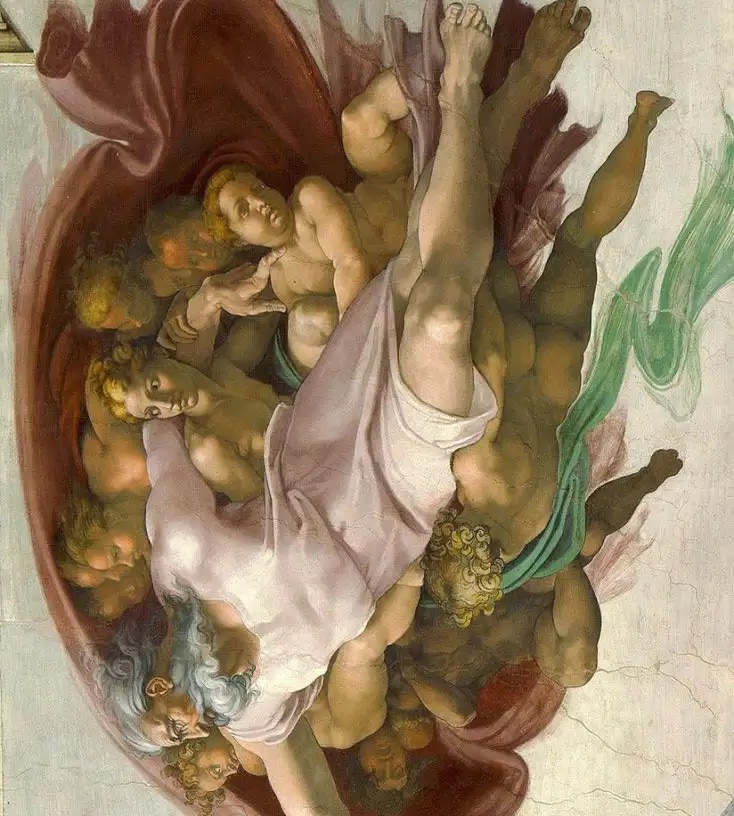
    Here, I’d like to introduce Michelangelo, the great Renaissance painter of the ceiling of the Sistine Chapel. Michelangelo offers his own reflection on this scene in Genesis 2.

    The first thing you notice in Michelangelo’s “The Creation of Adam,” is the striking closeness of God to Adam. Heaven brought so close to earth. God, full of vitality, reaches to touch the lifeless man, breathing into him the breath of life. 

    Now, it’s easy to miss a few details in this scene. But, they’re critical for what Michelangelo is attempting to portray about Adam’s solitude.

    On the right side of the painting, you’ll notice that God is surrounded by a number of figures — angels. But, there is a unique addition in this heavenly entourage. Notice Eve, there, under God’s left arm — under his protection.

    And, take note of the strange, pink cloud containing God, Eve, and the angels. If you look closely, you realize that it’s the outline of a transverse of a human brain. Then, if you rotate the image, what initially appeared to be the transverse of a brain is also the transverse of a heart. Like this…

    What does all this mean? 

    Well, it really means Adam was never really alone. For one, God was with him. And, God had Eve in his mind and in his heart for Adam from the beginning — from before he breathed life into the dust he had formed into the body of a man. 

    At just the right time, when Adam realizes his solitude and his unique relationship with God, God gives the woman to the man and the man to the woman. 

    So the LORD God cast a deep sleep on the man, and while he was asleep, he took out one of his ribs and closed up its place with flesh. The LORD God then built the rib that he had taken from the man into a woman. When he brought her to the man. (Gen. 2:21-22) 

    Eve is taken from Adam’s side. This shows that she is equal in dignity to the man. She is not taken from his head, indicating that she was above Adam. And, Eve is not taken from Adam’s feet, indicating that she is beneath him. She is Adam’s equal. 

    That Eve is taken, so to speak, from Adam shows us that she is to draw Adam out of himself. He is to love her, to make a gift of himself for her, to affirm her goodness. 

    Eve is given to Adam (God brings her to the man). She is God’s gift to Adam, to be received by Adam. Eve is given to Adam to mediate God’s love for Adam. Eve is given to somehow incarnate God’s love for Adam who, as a human being, needs to receive love in an incarnate way. 

    As Eve’s helpmate, Adam is to draw Eve out of herself and is to be accepted by her. 

    Michelangelo’s painting magnificently manifests God’s providence for Christian marriage. God cares about this son and this daughter such that he places each into the other’s life as an expression of his care and concern for them — to mediate his love, each for the other, in a concrete, incarnate way. 

  • At the bottom of it, prayer is a loving conversation with God.

    Helping children have such a conversation can be tricky. The combination of short attention spans, an new thing, and a parent’s own unfamiliarity with prayer can make it easy to simply avoid the whole thing altogether. I mean, isn’t saying an “Our Father” or “Grace before Meals” every once-in-a-while good enough anyway?

    Well, those are good prayers, even if we say them less frequently than we might wish. However, sometimes when we say rote prayers, words are coming out of our mouths, but our minds are somewhere else. We go through the motions only to ask afterwards, “did we pray?” We can hide behind memorized prayers and not really get the heart involved.

    It is possible to be more vulnerable in prayer — to get the mind and heart more involved — and it’s possible to give children a structure for this as well. With a few simple prompts, you can teach your kids to pray in a personal kind of way. I refer to this series of conversation starters as RAPT. This acronym stands for Repentance, Adoration, Petition, and Thanksgiving.

    RAPT Prompts

    You can use the RAPT prompts yourself for quiet prayer. You can also use them with your children (saying the prompt out loud and giving time for the children to fill in the blanks in the quiet of their hearts):

    Repentance — “Father/God/Jesus, I am sorry for _____. It was wrong. Please forgive me.” 

    Adoration — “Father/God/Jesus, you are ________.” (Examples: merciful, loving, forgiving, present to me, etc.)

    Petition (and Intercession) — “Father/God/Jesus, I need _____. Please help me _____. Please help (name of person) with ______.” 

    Thanksgiving — “Father/God/Jesus, thank you for ______.” 

    To explain further:

    • Repentance is obviously about apologizing. With this step, we are challenged to face up to our sins, to those thoughts, words, and actions that hurt our relationships with God and others — those deficiencies in our love.

    • Adoration comes from a posture of humility and lauds and praises God.

    • Petition is begging. When we petition God, we ask for what we need. Intercession is begging on behalf of another.

    • When someone gives you a gift, it is right and just to thank that person. We usually thank the giver of the gift through words spoken or written. Either way, we don’t just think about saying thanks. We actually have to do it. Prayer of thanksgiving is kind of like that — it is actually saying thanks to God for particular blessings received.

    Listening

    Listening is perhaps the most critical element of any good conversation. If there’s no listening, a dialogue devolves into a monologue. In prayer, we talk and listen to the Lord. And, the listening is critical:

    In a conversation, if you are the wisest, it makes sense for you to do most of the talking. If the other person is wiser, it makes sense for you to do most of the listening…Well, prayer is conversation with God, and it makes no sense for us to do most of the talking. We ought to be listening most of the time. — Peter Kreeft

    Therefore, it’s important to remember that RAPT is a series of conversation starters. The series of prompts implies a time of listening as well. When guiding a child through the RAPT steps, it’s worth taking your time and intentionally leaving extra silence after each prompt — to be quiet and listen. Maybe God has something to say in response. After all, he did invite the little children to come to him (cf. Mk. 10:14). Presumably, he has something to say to them.

  • The Morning Offering

    On the importance of parents sanctifying their time.

    The way we talk about time is telling. For the most part, we complain about it. There’s never enough time. Except those times when there was too much time and we got bored. It goes too slow, or too fast.

    We talk about time like it’s a commodity — something in our grasp. We say we’re making time for this or that. Or, we’re wasting time. Sometimes we lose time or lose track of it, only to try to get some back or make some up. We wish we could go back in time, sometimes.

    We even talk about killing time. 

    As parents, we know time with our kids is precious. We also wish bedtime would come just a bit quicker.

    Time is always on our minds. There’s no escaping time. We’re stuck in it.

    But, how we deal with time makes all the difference. When I was doing youth ministry, I used to have a group of appointed teen leaders (aka. peer ministers). I would interview the applicants for this leadership group and one of the questions I would ask went something like this: If I were to be stationed in some observation tower above your daily life, how would I be able to distinctly know that you were a Christian? 

    Admittedly, it’s the kind of question intended to get someone squirming a bit. And, it worked. It’s also a darn good question for my own examination of conscience. 

    But, what if we apply it to time? How does the way you handle time differ from the non-Christian? Does it? 

    God, as the Catechism puts it, is beyond space and time. In the beginning, he creates space and time. God is the maker of time. Did you catch that? Only God makes time. 

    This means that we don’t make time for anything or anyone. All time is a gift from the Creator. So, when we complain about time, we’re complaining about a gift. When we say there’s not enough of it, it’s like the little child whining that he doesn’t have enough ice cream while what he’s got melts down the cone, down his hand, and down his forearm — dripping on the floor. 

    And, what about wasting time? Or killing it? Isn’t that something?! It’s akin to taking a gift and throwing it out the window. 

    Most of the time, the way we handle time is tragic, because:

    In the fullness of time, God sent his Son, born of a woman, born under the law, to ransom those under the law, so that we might receive adoption. As proof that you are children, God sent the spirit of his Son into our hearts, crying out, “Abba, Father!” (Gal. 4:4-6)

    In other words, God didn’t only make time, God took the time for us. God has time — he has time for you and for me. In time, we can encounter he who is eternal — outside of time. 

    Time is a gift. Time is a mercy. 

    The Church knows this.

    In her treasury of prayers, she has something called a morning offering. The morning offering is a way of putting first things first. It acknowledges right off the bat that the time of this day is a gift — one worth living well and offering back to the Giver of every good and perfect gift. It’s not something I make for myself. It’s not something I should waste or kill. It’s not something I ought to willy-nilly lose track of, and whatnot.

    It’s a gift to be received, lived, and returned as an offering. 

    This is only fitting for we who are anointed in baptism as those ordinary priests participating in Christ’s priesthood — as those given time to make an offering of our lives to God. A morning offering calls this to mind and forms how we approach the day.

    It’s worth looking at a few morning offerings that come to us through the tradition.

    The first was composed in 1844 by Fr. François-Xavier Gautrelet (found in Catholic Household Blessings and Prayers, pg. 48)

    O Jesus, through the Immaculate Heart of Mary, I offer you my prayers, works, joys, and sufferings of this day for all the intentions of your Sacred Heart, in union with the Holy Sacrifice of the Mass throughout the world, for the salvation of souls, the reparation of sins, the reunion of all Christians, and in particular for the intentions of the Holy Father this month. Amen.

    This rich prayer enters into the hearts of Jesus and Mary, binding every part of the day to the beating of these hearts and the liturgical pulse of the Catholic Church. It’s a truly Catholic prayer — pushing beyond any privatized “me-and-Jesus” business, and into the fact that in God’s providence, we participate, so to speak, in the salvation of humanity.

    A second form appears in Liturgy of the Hours, Monday, Morning Prayer of Week 1: 

    Father, may everything we do begin with your inspiration and continue with your saving help. Let our work always find its origin in you, and through you reach completion.

    This straightforward prayer acknowledges that God is the source and destiny of the day’s work, and his inspiration and grace is the means by which anything fruitful gets done — because without him, we can do nothing (cf. Jn. 15:5).

    Finally, I want to highlight a raw, vulnerable morning offering — one in which you lay down your plan for the day, your agenda, and allow God to rearrange, prioritize, and cross things off the list. This one is a bit more extemporaneous. Fr. Michael Scanlan highlights this in his book Appointment with God:

    Every morning of my life I set my agenda before God. I ask Him first of all if the agenda makes sense and whether I should be attempting to do everything I have written down. Almost every day God knocks something off my list. As a result, I have more time to do what needs to be done. I am forever thinking that I need to do things that God doesn’t really want me to do. When I put my schedule before Him, it becomes clear that I don’t need such a full schedule. Either I don’t have to do everything, or it would be better to do it later, or it would be done best with a different combination of people. Ask God questions and He will give you the answers.

    God is the Lord of time, and he’s the Lord of “my time.” This method from Fr. Scanlan sets the record straight. It frees us from idolatry — from idolizing the list, our ideals, some achievements, etc. It simply frees us to do what God wants us to do, which is always the right thing to do.

    Busy people don’t have a lot of time (ha!). But, we all certainly have a minute upon waking to offer the whole of the day to God — and maybe even the courage to ask God to rearrange our priorities and expectations to align with his for our days. A small offering makes a big difference.

  • Up until a few years ago, it was quite common to hear this “trialogue” in our house:

    Parent: “You need to apologize to your sister.”

    Guilty kid: “Sorrrrr-rrrrryyy” (while contorting the face and looking away for the chance to run as soon as possible).

    Injured party: (head raises slightly from teary heap and in a nearly inaudible voice) “It’s…okay…” (before dropping back into mopey heap or slinking away while considering avenues for revenge).

    The bottom line: It’s actually not “okay.” It’s not “okay” that someone thrice your size colored on your forehead with a Sharpie. It’s not “okay” that someone pulled out your hair because you would not immediately heed that person’s request to read the book you were reading. It’s not “okay” that your toy car was smashed to smithereens for no apparent reason. Injustice is not an “okay,” just-sweep-it-under-the-rug kind of thing. Most of us have tried that and it does not work.

    Real problems need to really be dealt with, or else they fester and rot.

    As a boy, I remember learning quite viscerally about the problem of rotting things. A muskrat carcass floated downstream in the backyard creek of my childhood home. It got caught on some rocks and hung out for a while. My buddies and I would check it out every day, because that’s what boys do. Usually there was some sort of dare to touch it or something. One of us eventually did stab the bloated, dead flesh, unleashing the foulest odor that has ever meandered into my nostrils. Naturally, we pulverized it with as many big rocks as we could – burying the stench under the water and not returning to the spot for several weeks. Rot that remains locked up eventually comes out, and when it does, it ain’t pretty.

    The pseudo-apologies and acts of forgiveness were not working toward reconciliation in our house.

    From Forgiveness to Reconciliation

    Around this time, I came across some training materials from NET Ministries. NET trains and sends missionaries, usually between the ages of 18-25, all around the country to evangelize youth through dynamic retreat ministry. Because these young people are traveling around the country in close quarters, healthy team life is a must if ministry is going to be effective at all. One of their key training sessions has to do with conflict resolution (aka. reconciliation). The NET method (which is just the Bible’s method), moves from forgiveness to reconciliation. Let’s trace that movement here.

    Forgiveness

    We all know the most haunting line of the Our Father: “forgive us our trespasses as we forgive those who trespass against us.” The degree to which we forgive, well, that’s the degree to which we’ll be forgiven by God. In Matthew’s Gospel, Jesus says, “If you forgive others their transgressions, your heavenly Father will forgive you” (Mt 6:14). When Peter asks how often one must forgive, Jesus says, “Seventy-seven times” (Mt 18:22). This is a symbolic number representing a never-ending way that we ought to forgive.

    This rocks most jaded people (myself included), because harboring resentment is a key ingredient. If you want healing for jadedness, you most likely need to forgive others. 

    What is forgiveness? Forgiveness is basically my free decision — it cannot be forced — to see the other person as a person again. Instead of seeing the other as a non-person, the cause of my hurt, the sum of their faults, etc., I make an act of the will, a choice, to see the other first and foremost as another human person. Forgiving the other does not mean excusing or implicitly condoning the wrongful action as “okay.” Forgiving the other does not mean that the pain caused by the offense vanishes, nor does it mean one should stuff away feelings or suppress memories. Forgiveness justly acknowledges the truth by acknowledging the wrong as wrong. But, it does not stop there. Forgiveness is an act of mercy springing from the depths of one’s heart, the depths that have first been touched by God’s merciful initiative. Forgiveness means completely giving the other his or her personhood again, so to speak. In other words, forgiveness restores the possibility of a relationship where the relationship had been damaged or destroyed, and invites a path for ongoing healing, rebuilding trust, and so forth.

    Forgiveness is, obviously, difficult. It’s hard because it means exposing the heart. It tears down walls of resentment; it pierces hardness of heart and opens the heart to the risk of love once again. The arduousness of forgiveness cannot be denied. I once spoke with a priest about this and he invited me to turn acts of forgiveness into a prayer. Said another way, he challenged me to invoke God’s help in forgiving others. He gave me simple words to which I’ve had recourse countless times over the years. The prayer formula goes like this: 

    “I forgive ________ (name of person), for _______ (what the person did), in the name of the Father, and of the Son, and of the Holy Spirit.” Then, take a deep breath and listen. 

    I repeat this as often as necessary, which is pretty often. 

    Reconciliation

    Jesus asks us to forgive. This is a non-negotiable in the Christian life. He goes further, however, and calls for the restoration of the relationship whenever possible. Jesus says, “If you bring your gift to the altar, and there recall that your brother has anything against you, leave your gift there at the altar, go first and be reconciled with your brother, and then come and offer your gift” (Mt 5:23–24). Forgiveness opens the opportunity for relationship; reconciliation brings it about. Reconciliation heals relationships. 

    Now, in some cases, reconciliation may be impossible (e.g., with the deceased) or imprudent (e.g., in the case of abuse). However, in many cases, especially around the house, it is possible. Not only that, it’s necessary. But, this doesn’t mean it’s easy. In fact, it’s intensely humbling to admit fault or to correct someone else’s fault. And, as we know, most issues involve both parties, so both people need to humble themselves to be reconciled. And, in our digitized and distracted culture, most conflict gets brushed under the rug and people pick up their phones for a good doomscroll. In family life (and life in general), when we don’t confront conflict and seek resolution and reconciliation, resentment sets in quickly. Walls go up and persons suffer — no matter what the age.

    So, how can family members be reconciled with another? 

    Here, we turn to the NET method. Their process is so straightforward. If I perceive that I have wronged a person, I can simply take ownership of my fault and responsibility for reconciling by saying something like the following: “I _______ (whatever I did), and it was wrong, will you forgive me?” 

    Let’s examine these words for a moment. Notice the admission of fault renames the offense – it puts flesh back on the sin. I have to state, clearly, what I did. And, not only that, I must admit that it was wrong. I think this is the key. It’s not just saying “sorry” as in “excuse me.” This formula requires a clear statement of the offense and an admission that it was morally wrong. Then, and only then, do I ask for forgiveness. This process provokes the freedom of the injured party. Only that person can freely say “I forgive you.” From here, we can continue our path of reconciliation by talking through how we will approach similar situations in the future so as to not damage the relationship again. This works in all directions in the home: kids reconciling with each other, kids reconciling with parents, parents reconciling with each other, and even parents reconciling with kids.

    The Importance of Forgiveness in the Home

    Getting forgiveness and reconciliation right in the home is a huge deal. Pope Francis reiterated this point in a 2015 message to families:

    In many cultures today, these [family spaces that build community] are shrinking, these experiences of family are disappearing, and everything is slowly breaking up, growing apart. We have fewer moments in common, to stay together, to stay at home as a family. As a result, we don’t know how to be patient, we don’t know how to ask permission, we don’t know how to beg forgiveness, we don’t know how to say “thank you”, because our homes are growing empty.

    In other words, for Catholic parents, working on forgiveness with their kids is crucial for the culture of our homes and for culture in general.

    Noted above, the Our Father prayer reminds us of the importance of forgiving one another, lest our ability to receive God’s forgiveness be hampered. Jesus raises a high bar, telling us that we must “be merciful, even as your Father is merciful” (Lk. 6:36) and that we must forgive from the depths of our hearts in limitless fashion (cf. Mt. 18:23-35). The Christian family, home life, communal life, is the fundamental place where one learns how to ask for forgiveness and how to grant it. As the Catechism reminds us, “The home is the first school of the Christian life and ‘a school for human enrichment.’ Here one learns endurance and the joy of work, fraternal love, generous – even repeated – forgiveness” (1657).

    We introduced the reconciliation process from NET a few years ago. My wife and I practice it in our marriage and model it for our children. Most of the time, with regard to the kids, we still have to help them get started. It is neat, however, when we overhear them reconciling on their own. It’s a sign that while sin still abounds in our home, God’s grace operative in forgiveness abounds still more.


  • Weekly Family Meeting

    Cutting down on family chaos.

    Things were unraveling. We reached a point where too many people were going in too many different directions. Each person was fending for him or herself. One week was bleeding right into the next, with no relief in sight. The semi-disorganized way we had been living for so long was bordering on disaster. We needed to implement a weekly family meeting.

    What was going wrong? 

    My family had lost a basic sense of teamwork — that communal effort of working towards a goal. And, it all seemed to fall apart quickly. It’s worth looking back to name some of the elements that led to the chaos. 

    Work demands at the time were taking a toll on me (read: us). I was working too much and when I wasn’t, work was on my mind. Our kids were getting older and were starting to get involved in more extracurriculars. So, practices after school became a thing. School itself was becoming more demanding. Homework was taking longer to complete at night, and often required some parental guidance and motivation. Social demands changed. It used to be my wife and I driving our family’s socializing. Now, our kids had social lives of their own. 

    It’s clear such times that you have no real priorities or goals to help shape family life — to help you navigate the space and time of life in all its demands. And, we didn’t have time to collect ourselves and look at things together. It was like being swept along by a rushing river, with each person swimming for his or her life in this or that direction.

    Our culture that’s so focused on productivity and over-activity doesn’t help things. 

    We were drowning.

    waterfalls under grey sky

    Patrick Lencioni to the Rescue

    Around this time, I was introduced to the work of Amazing Parish. At the bottom of it, Amazing Parish aids pastors by helping them develop a leadership team. Many of the principles at play come from Patrick Lencioni, a Catholic businessman, consultant, and best-selling author. What does all of this have to do with family life? 

    Well…

    Lencioni has a book for families, too. It’s called The 3 Big Questions for a Frantic Family. I heard about it through Amazing Parish and immediately bought it. The book was a game changer for us. In a nutshell, family life doesn’t have to feel like you’re being swept along through a relentless series of rapids. Answering a few questions can get you started towards calmer waters. 

    The three big questions are as follows: 

    • What makes your family unique? Here, you list real things, not aspirational ones. It’s a fun exercise. Then, you start to see a few themes emerge and capture those in a few sentences. In the end, the 2-3 sentences should say something about what your family values and how you go about pursuing those values (i.e., strategy). This helps to pull your priorities back up to the surface. 

    • What is your family’s top priority — rallying cry — right now? Really, what’s something we’re all going to rally around for the next two to six months. Basically, you want to swarm a problem: getting the laundry disaster sorted out in our house, getting to school on time, etc. Our first one was: get our life in order. Then, you name “defining objectives” — those things you have to do to achieve the rallying cry and revisit “standard objectives” — those regular, ongoing responsibilities of life that have to be maintained for the good of the whole. 

    • How do you talk about and use the answers to these questions? The most important point here: meetings. You have to have good, productive meetings. They have to be a priority; they have to be on the calendar. You need an agenda, etc. Hence, we were introduced to the weekly family meeting. 

    While answering each of these questions helped us out, for the purposes of this post, I’d like to focus on that final bullet.

    The Basics of a Weekly Family Meeting

    A weekly family meeting needs to be brief, especially if you have small children running around. Parents need to be prepared to pull it off well. And, it requires the participation of every member of the family to be successful. 

    I’ll use my family as an example so you can see what a basic agenda of a weekly family meeting looks like: 

    • Rallying cry assessment: Use colors to help you evaluate. Green means this or that defining objective is being met. Yellow means the objective is being touched, but not with the necessary determination. Red means you’re behind and have to get working. Then, problem solve together by talking through the yellows and reds. (This brings up another good point. Be sure your answers to the big three questions are visibly listed somewhere in your house.) 

    • The week ahead: We give the kids a weather report so they have a basic idea of what things will be like outside. And, we talk through each day — who has what going on. We publish all of these events on a giant calendar we purchased and put in the kitchen. Now, this is not a one-and-done. We talk through each day the morning of. But, the weekly family meeting gives us a primary reference point for the whole week — it helps us to see the big picture and address potential scheduling pitfalls. 

    • Pray: Conclude the meeting with a special moment of prayer. In our house, we say Compline together each night before the kids head to bed. On Sundays, the night of our weekly family meeting, we add to this a Holy Family Consecration prayer.

    The Weekly Family Meeting at Our House 

    The weekly family meeting has been a game changer for my family. It doesn’t necessarily mean that life has slowed down. The river is moving just as fast, or faster. But, we don’t feel like we’re all swimming in different directions anymore. The meeting keeps our priorities in front of us and allows us to collectively catch our breath before heading into another week. It’s good when families function as healthy teams — it’s a reflection of a healthy communal life. 

  • When we don’t really know someone, but we’ve heard a lot about him or her, our imaginations can take over. We paint a certain picture of who this person is. We’re often wrong. For many people, this experience is analogous to our experience of the Holy Family. We’ve heard a lot about Jesus, Mary, and Joseph, but we don’t really know their family life. We paint a picture of unattainable perfection in our heads and we can dismiss the Holy Family as being out of touch with our trials and tribulations. This is exactly why the Holy Family consecration matters. 

    What is a consecration? 

    The word “consecration” comes from the Latin con—“with, together” and sacrare—”to make or declare sacred.” Therefore, to consecrate something means you are making it sacred, you are setting it with sacred things. The Catholic Encyclopedia defines consecration as follows: “Consecration, in general, is an act by which a thing is separated from a common and profane to a sacred use, or by which a person or thing is dedicated to the service and worship of God by prayers, rites, and ceremonies.” 

    We can think of the holy vessels used only for the celebration of the Eucharist at Mass, for example. These golden vessels have been set apart for one purpose—for one, and only one meal. 

    The concept is quite scriptural. We see consecration throughout the Old Testament, from Abel (and his offering of first fruits) and Noah (and his family) to Moses (and the people of Israel) and David (as king of the people). In the New Testament, John the Baptist, Mary, Jesus, the Twelve, and so forth. If you’ve ever been to the ordination of a priest, you witnessed a consecration. This man is now set apart. Actually, this gets at the point. The “being set apart” is not for the sake of the person or thing set apart—like the preservation of a museum piece. The “being set apart” is for the sake of the whole, for the sake of serving the whole. The newly ordained priest isn’t just a priest for himself, but for the people of God. 

    If you were to engage in Holy Family consecration, you will have a great opportunity to teach your children about consecration and to have a conversation about what it means to be a Catholic Christian person/family in the world. 

    In fact, at the encouragement of our pastor, my family consecrated ourselves to the Holy Family a few weeks ago. The conversation leading up to saying the prayer together was rich (though not without a fair share of distractions) and we’re now making the prayer a regular part of our Sunday evening routine. 

    Who is the Holy Family? 

    Most readers know the Holy Family consists of Jesus, Mary, and Joseph. On the one hand it seems pointless to ask this question. On the other hand, we could do a deep dive into each of the members and write separate books on each. 

    For our purposes, it will suffice to say that the Holy Family is the icon of a holy and wholly ordinary life. Joseph and Mary were set apart in their unique relationship with Jesus, the Son of God, yet they were set right in the midst of their family and friends in Nazareth. They were not so removed as to be untouchable. Rather, they were both right there with God, and right there with others. They lived the richness of their Jewish religious life and the richness of ordinary life in society. Mary and Joseph were wholly devoted to their Son and to raising him in the Jewish faith and they were wholly devoted to teaching him the necessary skills for dealing with the ordinary affairs of life in Nazareth during the first century AD. 

    What is Holy Family consecration? 

    To consecrate yourself, or your family to the Holy Family is to set yourself apart with the Holy Family. As we set ourselves apart with the Holy Family, we draw near to the Holy Family and get to know its members. In other words, consecration is an opportunity to be disillusioned. All those images of the Holy Family so shrouded in mystery come into better and better focus. That sense of distance from the Holy Family and its situation starts to be overcome. 

    And, like the Holy Family was set apart for the sake of service to humanity—literally raising the redeemer of the world—when we consecrate ourselves and our family to the Holy Family, we are uniting ourselves, in a sense, to their service to the world. 

    Holy Family consecration is an act that places us with the Holy Family for the service of the many who are all around us and our families. 

    All of this reminds me of a few lines from a Christian letter that was circulated around 130 AD. In the “Letter to Diognetus,” we read a description of the Christian in the world, and it is a fitting description for the family striving to become a holy family: 

    To speak in general terms, we may say that the Christian is to the world what the soul is to the body. As the soul is present in every part of the body, while remaining distinct from it, so Christians are found in all the cities of the world, but cannot be identified with the world.

    The family consecrated to the Holy Family is set apart yet present in all aspects of ordinary societal life in the 21st century. In other words, we still participate in youth sports, school PTO, and going to the grocery store, but how we do these things should differ from the rest of “the world.” Youth sports now becomes about more than winning—it is a field of opportunity for learning virtue. School PTO is not a political jockeying, but a seeking of the common good for students, teachers, and families. And, the grocery store is more than checking things off a list, but an opportunity to encounter neighbors and, maybe, to serve someone in need. To be a family set apart, yet present to the needs of others, this is what consecration to the Holy Family means. 

    The Holy Family Consecration Prayer 

    Recently, the Knights of Columbus began promoting Holy Family consecration. Supreme Chaplain, Archbishop Lori of Baltimore, composed a beautiful prayer that can be accessed on the resource page of the Knights’ website. 

    The prayer is simple. It contains beautiful imagery. And, it could easily be prayed daily—as part of a family’s nightly prayers—or weekly, on Sundays, for example.

    As a family prays this consecration prayer, they are asking that their family be set apart with the Holy Family for the sake of the many other families we encounter on a daily basis. 

    Through Holy Family consecration, we can: 

    • Grow in our relationship with the Holy Family

    • Experience the conversion and transformation of our families—becoming more like the Holy Family

    • Find our footing as a family—as an example to others and in service to others

    The Holy Family need not remain so distant. Through a simple prayer incorporated into the fabric of your family’s prayer life, you can draw near to the Holy Family and join in its mission as you grow your own holy family.