I was ready to deliver the line in my talk when he walked in. Just as I was talking about how God has taken flesh and how God has a face, the door that always gets stuck got stuck and started rattling. Someone was there. Someone wanted in. And, as I delivered the line, the line about how we can encounter Jesus today with the same effect as what we read about in the lives of Peter, James, John, Andrew, Zacchaeus, Mary Magdalene, the Samaritan woman and so forth in the Gospels, that’s when he entered. “When we read the Gospels we are reading our story.” He walked down the side aisle and sat at a table in the back of the room. He dwelt among us. And ate with us. And prayed with us.
Yes, this happened about a week ago at one of the parishes for which I serve. We were having a meeting and it included a meal. A poor man heard about this and showed up in his torn jacket, hungry and worn out. We welcomed him and cared for him that night.
Only afterwards did I reflect on the timing of the whole incident. In fact, I went back and listened to the audio. Right as I was are talking about God having a face and about encountering God today, this man shows up at the door. You can hear it in the recording. It’s uncanny. One has to think about the parable of the Judgement of Nations in Matthew 25. At the end of time, the Son of Man will sit on the throne and judge everyone, separating the sheep from the goats. The sheep were the ones who gave him food and drink, clothing and shelter. The goats did not. The righteous sheep are confused by this. “Lord, when did we see you hungry and feed you, or thirsty and give you drink?,” they ask. Jesus replies: “Amen, I say to you, whatever you did for one of these least brothers of mine, you did for me.”
As I reflect on this parable and consider the events of that night a week ago, I cannot help but think of Jesus and serving him in the “distressing disguise of the poor,” as Mother Teresa would always put it. That night, there was an encounter of two hungers — the man’s hunger for food and fellowship and our hunger to encounter Jesus. And so it happened right there in the church hall.
Christmas
This story provides a nice backdrop for a Christmas meditation. God’s hunger for human hearts led him to take flesh and to be born into poverty in a dank cave outside Bethlehem (which literally means “house of bread”), where he was laid in a feeding trough, the world’s first monstrance. His hunger for us was so great it led him to disguise his glory and manifest his power in the most surprising of all ways, in the helplessness of a baby. His hunger for us was so great that the God who created hunger itself became hungry and allowed us to feed him, so we might realize the dignity of our dependence and allow him to feed us — with himself.
Nobody expected the God of the universe to come in this way. Power and might and lightning and thunder, yes. Pillar of cloud and fire, yes. But disguised in a hiddenness for all to see? No way. Yet this is just what he did — and what he still does.
The Angel had said to the shepherds: “This will be a sign for you: you will find a babe wrapped in swaddling clothes and lying in a manger” (Lk 2:12; cf. 2:16). God’s sign, the sign given to the shepherds and to us, is not an astonishing miracle. God’s sign is his humility. God’s sign is that he makes himself small; he becomes a child; he lets us touch him and he asks for our love. How we would prefer a different sign, an imposing, irresistible sign of God’s power and greatness! But his sign summons us to faith and love, and thus it gives us hope: this is what God is like. He has power, he is Goodness itself. He invites us to become like him. Yes indeed, we become like God if we allow ourselves to be shaped by this sign; if we ourselves learn humility and hence true greatness.
— Benedict XVI, Homily for Midnight Mass, Dec. 24, 2009
Those who know me well know that Lectio Divina is part of my time of daily personal prayer and also part of the way I do ministry. Lectio Divina is a way to read and pray with the Bible. These two Latin words mean “Divine Reading.” The Bible is different from any other book you will ever read because it is God’s Word. When we read the Bible, we know that God has something to say to us. Lectio Divina is an ancient, monastic practice of praying with Scripture that helps our heart listen for God’s message and to meditate on it. For those of you who are interested in learning how to pray with Scripture, this simple guide can get you started.
Before you begin to work through the steps in a time of prayer, choose a relatively short Scripture passage to pray with. If you need some inspiration, you might consider John 15:1–5, or you can always pray with the Gospel of the day from Mass. (You can find the daily Mass readings on the USCCB website, or download iBreviary on your phone.)
The Four Steps of Lectio Divina
1. Lectio (Reading)
This step begins with a simple prayer to the Holy Spirit, such as, “Come, Holy Spirit.” Take a deep breath and become aware of God’s presence. Read the passage slowly, letting the words wash over you and sink in. Pause for a minute in silence, then read the passage again. Is there a word or phrase that tugs at your heart? Does something seem to jump off the page?
2. Meditatio (Meditation)
Now take some time to ponder that word or message in your heart. What does this word or passage mean? How does it challenge or inspire you? Why do you think that word or phrase sticks out? What thoughts, memories, desires, or emotions does this passage stir up in you? What do you think the Lord is saying to you?
3. Oratio (Prayer)
How does this passage lead you to pray? What do I say to the Lord in response to His word? Converse with God from your heart — what do you wish to say to Him or ask Him? Are you moved to tell God that you love Him? Are you moved to thank and praise Him? Do you need to pray for someone or something? What conversion of mind, heart, and life is the Lord asking of you? Take a few moments to lift up your heart to God in prayer.
4. Contemplatio (Contemplation)
Now be still. This step is very simple. It’s also very challenging for those of us immersed in a noisy and active culture. Begin by taking a few deep breaths. Quiet your mind and your heart. Try to stop thinking with your head. Instead, just listen with your heart. Receive the love and the healing which the Lord desires to give you. Take as long as you like to allow your heart to rest in God.
Finally, in your own words, thank Jesus for being present, for listening, and for speaking to your heart. For example, you could say:
Jesus, thank you for being present to me in your Word. Let it fill my mind and heart the rest of this day. Help me to always listen to you. Amen.
That’s the gist of it. Four steps and anywhere from 10–20 minutes on average (though, obviously you could pray for much longer). As we approach Christmas, consider making Lectio Divina part of your daily prayer time. You might even pray with each of the key passages containing the parts of the Christmas story:
Annunciation to Mary (Lk 1:26–38)
Annunciation to Joseph (Mt 1:18–24)
Birth of Jesus (Lk 2:1–7)
Announcement for the Shepherds (Lk 2:8–14)
Visit of the Shepherds (Lk 2:15–20)
Presentation (Lk 2:22–38)
Visit of the Magi (Mt 2:1–12)
Actio: A Fifth Step?
To the four traditional steps of Lectio, Pope Benedict XVI introduces a fifth one. He calls this actio (action). In all reality, it is less of a methodological step and more the living fruit of a life transformed by Lectio Divina. Benedict XVI insists that Lectio Divina reaches its goal in actio, a response to God’s word. He says, “The process of lectio divina is not concluded until it arrives at action, which moves the believer to make his or her life a gift for others in charity.”[1] In Lectio Divina, the believer receives the love of God, and this love invites the believer to respond by making a gift of him/herself in turn. Actio is the manifestation of charity in the life of the believer.
Given Benedict XVI’s emphasis on actio, I think it’s fitting to conclude with these words from Ven. Madeleine Delbrêl:
The Gospel is the Book of the Life of the Lord. It was made in order to become the book of our life. It was not made to be understood but to be approached as a threshold of mystery. It was not made to be read, but to be received in us. Each of its words is spirit and life…Alive, they are themselves like the initial leavening that will attack our dough and ferment it into a new way of life… The words of the Gospel knead us, modify us, assimilate us, so to speak, into themselves. The words of the Gospel are miraculous.
Reflections on the necessity of prayer and a few resources.
Why spend time praying?
Well, for one, we pray because Jesus told us to. In Mt 6:8, he says, “Your Father knows what you need before you ask him.” The Father, he knows everything. So the Psalmist declares, “Your eyes saw me unformed; in your book all are written down; my days were shaped, before one came to be” (Ps 139:16). At first glance, these passages seem to discount the necessity of prayer. Not so. Look at Jesus’ imperative in Mt 6:9: “This is how you are to pray: Our Father in heaven…” Still, Jesus commands us to pray, because in praying we acknowledge our dependence, we embrace humility, which is to say, we embrace who we really are as creatures. In praying, we come to our Father in need.
In the first place, we can say we pray because Jesus tells us to. Plus, as Christians, we’re to model our lives on Jesus’, and Jesus himself prayed. Jesus models prayer — all throughout the Gospels we see Jesus at prayer. But let’s go a bit deeper. However, before we do, we should get a basic definition of prayer on the table.
What is prayer?
In a nutshell, prayer is a loving conversation with God. It’s a conversation with the God who loves you. It’s a conversation with God in love. Peter Kreeft, author of Prayer for Beginners, explains how natural this should be: “Can you talk to a friend? Then you can talk to God, for he is your Friend. And that is what prayer is…Prayer is so simple that no method at all is needed.” It’s not a matter of a right formula or doing this to get that. It’s not mechanistic. It’s not a matter of technique. God is not a divine robot we are trying to program a certain way so as to get him to do something for us. Prayer is about love — a loving conversation.
Now, a conversation involves speaking and listening. Listening is perhaps the most critical element of any good conversation. If there’s no listening, a dialogue devolves into a monologue. In prayer, we talk and listen to the Lord. So, listening is most critical. Kreeft, puts it this way:
“In a conversation, if you are the wisest, it makes sense for you to do most of the talking. If the other person is wiser, it makes sense for you to do most of the listening…Well, prayer is conversation with God, and it makes no sense for us to do most of the talking. We ought to be listening most of the time.”
Why do we pray?
Theologically, we can say that we pray because prayer is what we were made from and what we’re made for.
In Genesis 1:26-27, we hear:
Then God said: Let us make human beings in our image, after our likeness. Let them have dominion over the fish of the sea, the birds of the air, the tame animals, all the wild animals, and all the creatures that crawl on the earth. God created mankind in his image; in the image of God he created them; male and female he created them.
The Persons of Trinity are in a kind of trialogue — they’re having a conversation as God. And, “God is love” (1 Jn 4:8). So, the persons of the Trinity are having a conversation in love. In short, they are praying.
And, what are they praying about? They’re praying about us. They’re praying about making human beings in their image and likeness. It’s worth stopping to think about what this means for a few minutes.
What does it mean that human beings are made in and are to be the image and likeness of God? Without going down a huge rabbit hole, we can get at a simple answer in at least two ways. First, we ought to note that after Genesis 1, we next see those words “image and likeness” in Genesis 5:3, which says, “Adam was one hundred and thirty years old when he begot a son in his likeness, after his image; and he named him Seth.” Based on contextual evidence, then, we see that here, “image and likeness” refers to filiation, to sonship — Adam and Eve were the created sons and daughters of God. As such, they were God-like. An image points to the model — it refers to it. An image reproduces its own prototype, as John Paul II says, like a child’s very being reproduces that of his or her parents. Our idiom that a child is a “splitting image” of the parents is indicative of this.
We should also note that ancient Hebrew — the language the Bible was first written in — is an active and non-abstract language. The word “image” denoted the reality as present. This is why the Israelites could not have images or statues. Crafting a statue was an act of idolatry because the statue would somehow contain the reality. We have no problem making the distinction between reality and statue. For example, I can say I’m not praying to the statue of Jesus, but to the one the statue represents. In ancient Israel, this was not possible.
Let’s get back to “image and likeness.” The Hebrew word for “image” is selem. This denotes “function.” It has to do with carrying out a function. The Greek word for “image” is ikon, which denotes presence. To be made in God’s “image” means the human being contains the function (what God does) and the reality/presence (who God is). So, if Genesis uses the word “image” for man, it is being decisive and precise. It’s to say God’s “function” (what God does) and his “presence” was in man. In other words: Man participates in the divine. He has within himself a divine “spark”, a divine “presence”. The human being mediates God’s presence in the created order and communicates with God on behalf of it.
Human beings are that part of God’s creation that stands in a unique relationship to him. We participate in creation as God’s presence within it. We are God’s children, borne from his prayer — who participate in his own conversation through our own conversation with him. In this way, we see prayer in both our origin and our destiny. We were made from prayer and for prayer.
Made for Prayer
We have been made to communicate, to be in communion with God for all eternity. So, prayer corresponds with my destiny. When I pray, I get a foretaste of eternity. Prayer propels me towards fulfilling my purpose or destiny: sainthood. Sainthood is simply eternal life with God. We are all called to be saints, so we are all called to pray. Kreeft echoes this, when he says:
“Prayer is necessary because without it we cannot attain the meaning of life, the end and purpose of our existence. Becoming saints is the meaning of life…It is why God created us…[All of God’s stupendous effort in salvation history] was for one end: to make saints, to make little Christs, to give his Son brothers and sisters. The whole universe is a saint-making machine. And prayer is the fuel that powers it…Prayer is the first step in becoming saints. The second step is charity, a life of love, the ecstasy of giving ourselves away over and over again forever, as each of the Persons of the Trinity do. But this is prayer too, or the extension of prayer.”
When we pray, we remember our origin and anticipate our destiny. When we pray, then, we really live. When we pray, right now, we abide with the God who is our origin and our destiny — we participate in God’s communication that he shares with us. We abide in God (cf. Jn 15:1–5) who wants us to have life and have it abundantly (cf. Jn 10:10).
Getting Started with Prayer
Prayer is a necessity for the Christian life. Despite this fact, many of us (myself included) struggle to as well or deeply as we should. Sometimes we don’t pray at all.
For any of my readers looking to commit (or recommit) to a daily practice of prayer, I encourage you to check out my post about making an appointment with God. Or, if you’re looking to pray more deeply with Scripture, I’m happy to share this guide to Lectio Divina.
In 1964, Joseph Ratzinger preached three sermons in the Cathedral at Münster in an effort to answer what being a Christian means today. It was Advent at the time, and this comes through in his reflections.
Advent does not celebrate the past alone, remembering the ages of darkness before the light of Christ broke on the horizon. It is not a liturgical recall of the time when fallen man longed for a savior. Instead, “Advent is our present, our reality…the reality of our Christian life.”[1] In celebrating Advent year after year, the Church makes us face the facts, she makes “us admit the extent of being unredeemed, which is not something that lay over the world at one time, and perhaps somewhere still does, but is a fact in our own lives and in the midst of the Church.”[2] Advent does not acknowledge some line of demarcation in history, a point of division between “before Christ” and anno domine, “in the year of the Lord,” as if all of time and space after the moment the Word became flesh are redeemed and we have nothing to worry about. “God has not divided history into a light half and a dark one,” Ratzinger says.[3] Rather, we all stand in need of redemption, even today. Advent is about dividing lines in our own lives. It is about those dark and hidden places in our own hearts that still, even 2000 years after the Word took flesh, still stand in need of his light.
So, we can say, it is Advent. It is always Advent. Advent is an enduring reality, as Ratzinger puts it, wherein we:
Begin to realize that the borderline between “before Christ” and “after Christ” does not run through historical time, in an outward sense, and cannot be drawn on any map; it runs through our own hearts. Insofar as we are living on a basis of selfishness, of egoism, then even today we are “before Christ.” But in this time of Advent, let us ask the Lord to grant that we may live less and less “before Christ,” and certainly not “after Christ,” but truly with Christ and in Christ: with him who is indeed Christ yesterday, today, and forever (Heb 13:8).[4]
Every time I read this passage, I’m struck by Ratzinger’s imperative that we certainly not live “after Christ.” But is not “after Christ” precisely where we are as a culture? After Christ. Post-Christian. Postmodern. The sheer volume of “nones,” and those who “used to be Catholic,” indicates this. Their individual lives have moved from before Christ to with Christ to after Christ, an age just as dark or darker than life before Christ — like the darkness that overpowers your sight when you look at something too bright for a time. It is a pervasive and penetrating darkness. Blinding darkness.
And this blindness does not only pervade the lives of individuals. Post-Christian darkness is a cultural reality. We are living in a dark age. From before Christ to with Christ (i.e., a Christendom culture) to after Christ. We live in a culture that believes it has grown up, matured, and shed its immature, imaginative myths about a God-man born to a virgin in a stable who died on a Cross and rose from the dead. Ours is a kind of teenage culture, a revolutionary one that rejects its upbringing and its roots, putting the axe to its roots and forgetting its origins, instead.
Dostoevsky on Life After Christ
The great Russian novelist, Fyodor Dostoevsky, captures this arrogant ethos, tinged as it is with a certain animus, when he asks, “Can one believe while being civilized [i.e., a modern, rational person]…believe without reservation in the divine nature of Jesus Christ, the Son of God?”[5] Is it reasonable to believe in the Incarnation today? How can an enlightened person possibly believe it? Is Christianity not some a vaporous dream from which postmodern men and women have woke?
I would respond to Dostoevsky’s question with a question: What kind of civilization has resulted from not believing in Christ? Is it more civilized than one that does? Is it reasonable to place so much stock in human reason alone?
Such questions would be justified, as we have now seen the terrible destruction of a culture of death over the span of several hundred years. From Cartesian skepticism and Kant’s cry to rely upon reason alone, to Locke’s empiricism and Comte’s faith in science alone. From Vico’s claim that human beings can only know what they themselves have made, to Marx’s emphasis on feasibility and creating a future for mankind. From the scientific revolution to the industrial revolution, and the sexual revolution to the technological revolution, modernity produced one totalizing myth after another, a series of successive revolutions that radically transformed life as we know it. All this progress blew up in grand fashion in the 20th century with dictatorships, two world wars, and the constant threat of nuclear war. Modernity’s grand plans resulted in a culture of death—one that continually denied dependence and repeatedly compensated for our fallen nature. Consequently, we live in a cemetery full of the tombstones of modern thoughts, myths, and lives—some still pristine and polished, while others are in disrepair. In the alleyways of this necropolis, modernity’s specter emerges from the grave as postmodernity, a haunting, nihilistic “condition” that bears striking resemblance to the bones lying in the graves beneath its feet, though seemingly more illusive.
Throughout the course of his life and his conversion, Dostoevsky became aware of the danger that faces men and women who forget God. He made two claims about what would result from modern atheism. First, “in place of the God-man appears the man-god, the ‘strong personality,’ who stands beyond morality, ‘beyond the confines of good and evil,’ to whom ‘everything is permitted and who can ‘transgress’ all laws,” the famed Dostoevsky biographer Konstantin Mochulsky says.[6] Modern man replaced God with himself, a revolutionary ploy that’s been on repeat from the garden of Eden to the tower of Babel, and from Mt. Sinai to Mt. Calvary. But, “when God is forgotten, however, the creature itself grows unintelligible.”[7]
Dostoevsky’s second claim has to do with “the herd.” If all that matters is matter, and the soul is not immaterial and immortal, then we can only live for the here and now. However, since human beings are so unruly and rebellious by their nature, “one must enslave and transform them into a submissive herd.”[8] In this vein, writing much more recently, Michael O’Brien observes, “The mighty of the earth are moving towards absolute power in an effort to establish control over what they perceive to be the chaos of the human condition.”[9] Sound like the silent and welcomed dictatorship of relativism, anyone? The totalitarian and tyrannical efforts of seemingly social justice saturated DEI and woke thinking? The massive invasion of nearly every aspect of life by big tech? Daily life for most people is controlled by forces and corporations far removed from the concrete communities and real relationships that used to constitute daily life and thriving, and yet we submit. To turn again to O’Brien:
The human community is never more endangered than when totalitarianism appears to be benevolent. The new totalitarian’s idealism, his “humanitarianism,” his public image, may all communicate to us many good things, and thus our imagination is captured to the detriment of real discernment.[10]
And so, by rejecting the Incarnation, after about 400 years or so, we, the people of the West, indeed find ourselves “after Christ,” in a modern graveyard haunted by postmodern ghouls. We live a kind of “zombie culture,” one marked by the living dead who have lost a sense of their origin and forgotten their destiny, traipsing about in a sort of half-life until they submit to the absolute nothingness of death or bring it about themselves. The human spirit has collapsed under the weight of its own pride and now wallows in its own false humility. We do all sorts of things without asking or knowing why. After all, the destruction of the modern metanarratives has proven that we thought we could know everything about everything, but in the end, it seems we know nothing for certain and nothing for all. Hence, the popular claim: there is no objective truth. No universal truth-claim. Postmodernity disbelieves certainty and renounces any claim of it.
Seeking Christ and Recalling the Gospel
What can be done about such a grim picture? Does the Incarnation have any place? For generations, now, it seems God has gone silent. Or, perhaps the problem lies in a human inability to hear from him, so we have blocked him out like an angry teen immersed in his noisy EMO and virtual reality. Perhaps we’re apathetic. In such a time, can the Gospel still resonate? Does it have any enduring value? Can it shake men and women from their nihilism?
In the midst of this cultural space, which he knew so well, Benedict XVI recalls the impulse behind the monastic movement that played such a big role in shaping Western culture. He says:
It must be frankly admitted straight away that it was not their intention to create a culture nor even to preserve a culture from the past. Their motivation was much more basic. Their goal was: quaerere Deum. Amid the confusion of the times, in which nothing seemed permanent, they wanted to do the essential — to make an effort to find what was perennially valid and lasting, life itself. They were searching for God. They wanted to go from the inessential to the essential, to the only truly important and reliable thing there is.[11]
Amid certain cultural decadence and depravity, monks sought God. This seeking led to finding Christ, it led to hearing the Gospel again. And this seeking and finding and listening and hearing resulted in a culture of life—the culture of the Incarnation emerged. If this kind of encounter with Christ was possible then, it is possible now.
Over the course of this liturgical year, through the span of this enduring Advent, I want to seek God through the thought of Benedict XVI. I dare to set out to seek God again by following Benedict XVI’s lead and unpacking his work. In short, I hope to present the Gospel afresh as we go out to meet the God who has spoken to us and who still speaks to us today. As Pope Benedict XVI says:
The great suffering of man — then, as now — is this: behind the silence of the universe, behind the clouds of history, is or isn’t there a God? And, if this God is there, does he know us, does he have anything to do with us? Is this God good, then does the reality of good have any power in the world or not? This question is as relevant today as it was then. Many people wonder: is God just a hypothesis or not? Is he a reality or not? Why do we not hear him? “Gospel” means: God has broken his silence, God has spoken, God exists. This fact in itself is salvation: God knows us, God loves us, he has entered into history. Jesus is his Word, God with us, God showing us that he loves us, that he suffers with us until death and rises again. This is the Gospel. God has spoken, he is no longer the great unknown, but has shown himself and this is salvation.[12]
An Enduring Advent
So, it is Advent. It is Advent yet again. It is always Advent. And Advent provokes us to set out again in our seeking the God who, even today, still comes to us. And we, the ones through whom the dividing line between iniquity and redemption runs straight down our hearts, we can go out to meet him with confidence. We can go with confidence to the merciful God who knows there is much in our lives, impacted as we are by the cultural attempt to live “after Christ,” that ends up once again “before Christ” and in desperate need of the coming Savior, Emmanuel, God with us. And this is just the kind of God he is, the one for us and with us.
Grant your faithful, we pray, almighty God, the resolve to run forth to meet your Christ with righteous deeds at his coming, so that, gathered at his right hand, they may be worthy to possess the heavenly kingdom.—From the Collect, First Sunday of Advent
[1] Ratzinger, What It Means to Be a Christian, 18.
[2] Ratzinger, What It Means to Be a Christian, 18–19.
[3] Ratzinger, What It Means to Be a Christian, 35.
[4] Ratzinger, What It Means to Be a Christian, 40.
[5] Dostoevsky, Notebooks for “The Possessed,” 237.
[6] Mochulsky, “Introductory Essay,” in The Brothers Karamazov, xv–xvi.
To be honest, I never did. Until I read an obscure line in Pope Benedict XVI’s Last Testament, which says:
As a young lad I wrote in pencil and then stayed with it. The pencil has an advantage in that one can erase things. If I write with ink, it is written.1
The pencil is a humble writing tool when you think about it. Its markings can always be erased, corrected, rewritten, or redrawn. With a pencil, everything can be formed and reformed. It has humility written into it, so to speak. So too, the human being, formed from humus (i.e., dust, earth) and given the breath of life from God himself (cf. Gen 2:7), is at home in humility. We are most ourselves when we are fully aware of our radical dependence. Fully aware of our proximity to nothingness and that life is sheer gift.
A pencil, like a candle, fulfills its purpose by giving itself away. As the pencil spends itself, it reaches the heights of its purpose. Similarly, as Gaudium et spes says, the human being “cannot fully find himself except through a sincere gift of himself” (§24). Jesus says, “Unless a grain of wheat falls to the ground and dies, it remains just a grain of wheat;but if it dies, it produces much fruit” (Jn 12:24). And “whoever wishes to save his life will lose it, but whoever loses his life for my sake will find it” (Mt 16:25).
To begin giving itself, the pencil must first be sharpened to a point. It needs to be cut deeply before it can give itself away. It must be given a gift, so to speak—a gift that hones it and prepares it to fulfill its purpose. And even then, as the pencil gives itself away, need for further refinement arises. It needs to be resharpened to overcome its dullness, thus making it capable of giving itself all over again. The need for initial and ongoing sharpening reminds me of the gift of Baptism and the constant conversion that comes about through Reconciliation, prayer, and penance.
Regardless of the degree to which a pencil needs to be sharpened, it cannot do so by itself. A pencil cannot sharpen itself. Sharpening necessitates outside assistance. The pencil needs its writer to turn it in the sharpener, with even force and care, to achieve the point necessary for etching pure lines on paper once again. Analogously, Christian conversion is no self-help effort, but a humble surrender to God’s help, to his grace that transforms.
Amid its lifetime of self-gift, the pencil’s length shortens—a sure sign of its finitude. It will not last forever, though its strokes will live on, if only for a time. Indeed, the life a pencil is temporary, as is each of ours. We only have so much time on the face of this earth, and we do better if we dispose ourselves to God’s providence in our lives and to participate in his mission.
Finally, all of this reminds me of a line from Mother Teresa. In a 1989 interview, Mother said that God shows his greatness by using our nothingness. When asked a clarifying question as to if she really has no special qualities, she said:
I don’t think so. I don’t claim anything of the work. It is his work. I am like a little pencil in his hand. That is all. He does the thinking. He does the writing. The pencil has nothing to do with it. The pencil has only to be allowed to be used.
The power of the pencil can be found precisely in its humility, in its weakness, in its finite nothingness. At this point, we can queue up St. Paul for a nice closing:
“The Lord said to me, ‘My grace is sufficient for you, for power is made perfect in weakness.’ I will rather boast most gladly of my weaknesses, in order that the power of Christ may dwell with me. Therefore, I am content with weaknesses, insults, hardships, persecutions, and constraints, for the sake of Christ; for when I am weak, then I am strong.” — 2 Cor 12:9–10
A Note: We are trying to celebrate sabbath as a family by cutting out screens for about 24 hours. Consequently, I can’t sit down at my laptop as I usually would. So, I’ve been putting the pencil to paper. It’s a throwback to my childhood. The sound of the pencil, the shavings of the sharpener, and the smell of the eraser got me thinking about Benedict XVI and deeper things.
My boys had pulled out the metal rod that controls our fireplace’s rotary damper.
Again.
When they tried to fix it on their own by shoving it back in with all their might, they managed to wedge it into the other parts and got it stuck. So I got my high-powered LED flashlight and folded my body awkwardly and craned my neck to see what was going on up there. As I tinkered with it, some ash fell on my face and my almost-two-year-old stole the flashlight, shone it here and there and directly into my eyes, then he tripped and fell over my legs. I couldn’t get the pieces of metal unstuck and the combination of the cramp forming in my back, the ash in my eye, and my almost-two-year-old’s light show caused a little bit of frustration to form somewhere deep inside.
Not surprisingly, little bit of frustration quickly grew to anger. I was angry with the boys that they messed the thing up again. I was angry that my attempted quick-fix wasn’t working. And I was angry because my body hurt.
After a brief time of complaining to my wife, I went back into the pit, groaning and trying to further contort my body to better reach the damper thing. This resulted in such bad neck pain I had to extricate myself quickly to stretch. As I was unfolding my body to get out, my almost-two-year-old knocked a wooden block on my head. I knew exactly what it was when it hit me. It was our “no grumbling” sign, a sign we made on an old hunk of wood during COVID-time. It still sits in our family room above the fireplace today. It sits there as a reminder that grumbling is bad for individuals and it’s bad for communities.
In his Rule, a rather short book, St. Benedict discourages grumbling eight times! Constant whining is destructive in the life of a community. It’s cancerous. Commenting on St. Benedict’s disdain for grumbling, Benedictine monk J. Augustine Wetta explains that “if you think about it, an outright fight is easier on a community than that ceaseless, cowardly, whining gossip that comes from a grumbler who ‘spreads strife’ and ‘separates close friends’ (Prov 16:28)…Grumbling makes everyone restless and angry—including the grumbler himself.”1
I need this constant “no grumbling” reminder, because, as a pessimist, I am prone to grumbling. And I can’t begin tell you how much my grumbling needs to stop.
I was young. Twenty-two, to be exact. And I was teaching high school sophomores. My baby-face was unhelpful in this situation, as I looked younger than some of my students. Before the year started, I got all fired up after watching Dead Poets Society and decided I would try to rouse my world literature students on day one with a Robin Williams-like speech. Instead of carpe diem, I chose a line from John 8:32: Veritas vos liberabit. The truth will set you free.
Everything with the exhortation was going well, until I stood on the chair and delivered the line in Latin. They looked at me like I had two heads. Some laughed. Some put their heads down. I definitely didn’t seize the day, or the moment. I lost it trying to be someone else. This, of course, is ironic given the line about the truth setting you free. Sometimes, I’m too idealistic, and, it turns out, a motivational scene from fictional movie set in a 1959 all-boys boarding school just didn’t resonate with these inner-city students.
Despite the failure of my dramatic effect, I do think the year was a success. I recovered and found myself in the role. We set out to discover the truth about things — as conveyed by literature over the course of the generations — and to see if it made us more free. And it did. Veritas vos liberabit. The truth will set you free.
This thesis, that is, the bond between freedom and truth, runs counter to the contemporary understanding of freedom. Today, we view freedom as license, license to do whatever I want whenever I want. Joseph Ratzinger describes modern freedom as “The right and the opportunity to do just what we wish and not have to do anything which we do not wish to do…our own will is the sole norm of our action and that the will not only can desire anything but also has the chance to carry out its desire.”1 Hence, in addition to license, we can also define freedom as “freedom from.” Societally, we view it as freedom from any authority outside the self. The human being is the engineer of history, which, according to Hegel and Marx, is a series of revolutions, a process of progressive liberations (e.g., free from bondage to authority, to the land, to geography, to sex, to gender). Freedom is an end unto itself and it’s beholden to none — not authority, tradition, or truth.
How did this develop, this divorce between freedom and truth? How did the concept of truth become the enemy of freedom, as opposed to its prerequisite?
A Brief Genealogy of the Modern Conception of Freedom
In what follows, here, I would like to trace the contours of thought over several hundred years that get us to where we are today. Obviously this risks gross over-simplification, as I have to paint with broad brushstrokes in an essay. Nevertheless, I think the general line of thought will become clear enough.
Martin Luther (1483–1546)
In 1520, Martin Luther published On the Freedom of a Christian. Here, Luther lays out his argument for justification by faith alone. No longer do works play a role in salvation. And, the Church doesn’t play one either. Instead, he emphasizes freedom of conscience as opposed to the authority of the Church. “It is not the order of the community that saves man,” Ratzinger explicates, “but his wholly personal faith in Christ.”2 Now the Church and ordered medieval society appeared as a burden for every Christian, who “is by faith so exalted above all things that, by virtue of a spiritual power, he is lord of all things without exception.”3 By faith alone, Luther says, “a Christian is a perfectly free lord of all, subject to none.”4 The implications are significant, as “Redemption now meant liberation, liberation from the yoke of a supra-individual order.”5 Luther intended for this liberation only in the religious sphere. So, it was to be separate from the political sphere and protected from the political sphere. Yet his thought had political ramifications. Philosophical ones as well, as it was the precursor to the Enlightenment.
John Locke (1632–1704)
If Luther took out the Church, John Locke, the English philosopher of the 17th century, began the process of setting up the individual in its place. Locke is considered the “father of liberalism.” He sought liberate the individual from political systems, ecclesial authority, and Scholastic-Aristotelian metaphysics (with its focus on essence, the nature of things).
Locke develops his thought the area of political theology. At the time, the common position held that the sovereign was God’s representative. There was a hierarchy: God, sovereign, citizens. To liberate the individual, Locke needed to find a way to justify revolution. He did this by saying there is God, and there is man, and no man can claim godlike power and authority over others. Matthew Crawford summarizes Locke’s position, saying, “We are all equal in our smallness before God…our natural estate is one of freedom in relation to one another.”6 In other words, there is no third party to arbitrate disputes, no authority outside the self — unless one consents to such an authority. So, what if you do consent to a government and then you want to alter it? How do you justify a revolution? Through the assertion of individual rights.
The basis of individual rights, for Locke, lies in his understanding that the individual is no longer a creature, but a person who belongs to itself. The “I” is not given in nature. Instead, it is made by the self. Since the self creates the “I” of the person, it is owned by its creator, the self. I make myself. Therefore, I own myself. The foundation of individual rights is ownership. My private property begins with the ownership of my self. What I have created, my “self,” is my private property. This is a radical exaltation of individual liberty and self-creation, and it is the basis for revolution. The role of the government is to protect and uphold my individual rights — what I’m entitled to — beginning with the fundamental right of private property. If it doesn’t, I can revolt.
Lockean thinking is everywhere these days. I can find it in the entitlement exuded by our culture, which my kids catch everywhere they go and bring spewing into my house. Consequently, they feel they have the right to whatever they think is going to make them happy and it’s my job to give it to them. Or, we can look at social media, which is built on self-creation and simultaneously fuels it. Next, we must note society’s way of thinking about abortion, which is built on Locke. As Msgr. Frank Lane puts it, “The entire abortion argument centers on the notion of a woman’s right over her own body. If you can argue that the unborn child is part of a woman’s body, the argument need go no further…because the woman has a right to own and dispose of her private property as she sees fit.”7 And we see this Lockean thinking coming out of Silicon Valley with all the techno-utopian visions of cyborgian (i.e., “chipped”) human beings, and artificial intelligence. Tara Isabella Burton, in her compelling work Strange Rites, captures the essence of what we might call “transhumanism” when she says:
In America today, this appears in our techno-utopianism that worships human potential and its technological manifestations, including artificial intelligence. Autonomous minds trapped in feeble bodies, yet smart enough to transcend the body via technology, free the human being from bodily limitations by creating an optimized self, a finely tuned machine.8
Perfect self-creation is a chimera. The concreteness of the body is the problem. We can overcome the body, indeed, we can overcome our own humanity, via technology. Technology becomes the way forward for self-created freedom.
Karl Marx (1818–1883)
Moving on from John Locke, we come to Karl Marx in the 19th century. Marx accepts Locke’s concept of self-creation, but expands it into a collectivist position (i.e., one that prioritizes the group over the individual) that impacts social, economic, and political theory. Marx says freedom is only freedom when it’s freedom for all. Not just me. Not just you. Both of us. All of us. So, freedom is tied to equity; equity is the prerequisite of freedom. And political activity, not the individual will as it is with Locke, is the instrument of liberation. For Marx, substructures must rise up and overthrow the superstructures in order to create a new equilibrium of equity. The proletariat must rise in revolt against the bourgeoisie to establish this equilibrium. Marxism fuels communism.
Marxism is still alive today in the social justice efforts of the diversity, equity, and inclusion movement (DEI). This movement appears in woke, social justice culture that seeks to free people, all of us, from our own hegemonic biases and to give voice to those individuals who have been underrepresented and discriminated against. Something interesting happens, then, in postmodernity. Marxism, a collectivist philosophy, comes to the revolutionary aid of liberalism’s individual rights. In America, we are witnessing a strange, powerful blending of Lockean and Marxist thinking, where the collective supports the individual, who finds his voice now within the whole and not apart from it. Revolutionary war is waged against any position (especially a traditional Christian one) that does not get on board with DEI.
Attempt at a Summary
To summarize, Luther’s revolt against the Church began the process of severing the tie between freedom and truth by severing the tie between the individual and the Church, the pillar and bulwark of the truth. From here, Locke built a political philosophy on progressive liberalism and individualism, with rights safeguarding freedom-as-license and justifying revolution. Marx builds on Locke, but he does so socially, arguing that this freedom-from-oppression, a freedom-as-license must be for all and it must be brought about through complete social revolution.
While Locke and Marx may disagree, their thoughts converge at many points as well. First of all, the Creator is no longer the possessor of what he creates. Self-creation is the new “given” — whether in the form of a self-creating person (Locke) or a self-creating society (Marx). For both, freedom is the highest good. And these strands come together in a strange way in postmodernity, where social justice advocates for the individual, where the body is the contemporary battleground in the revolt attempting to liberate freedom from truth. Today, our culture views freedom as completely unfettered from truth, the exercise of the autonomous individual — supported by a Marxist social justice movement that upholds individual liberty.
A Lesson from a Child
My kids lie. Not all of them. But, many of them. Usually, it’s a phase and it will begin somewhere around age four. It’s annoying, but it does give us a chance to talk about its destructive nature and the need for radical honesty within a community.
Lying is a form of self-creation. Our kids usually fib over a trifle thing, like brushing teeth or washing hair. Here’s a real dialogue, for example:
“You’ve been in the shower forever. Did you even wash your hair…with soap?”
“Yes.”
“Let me smell your hair. [Sniff.] You didn’t use soap.”
“I did! You just can’t smell it.”
“No you didn’t. Mom bought you new shampoo because you complained about the other one. It’s your shampoo and you like it. I don’t see it in the shower. You didn’t wash your hair.”
“I did. Once I finished, I put it in the closet.”
“Okay. So why don’t I see it in the closet?”
“It’s up there. Maybe back on one of the shelves.”
“Actually, I saw that shampoo in my bathroom before I walked in here to question you about it.”
“Oh. Yeah. Can you bring it to me?”
This example, however banal, perfectly illustrates the basic connection between freedom and truth. My son lied. He freely severed the tie between the truth of the matter and his disclosure of it. He created a new tale, a story that differed from the way things really were. With each iteration he found himself more and more bound by his own story — and one lie led to another. The self-creation we found so freeing at the start ends up as the source of our bondage somewhere down the road, because the truth (i.e., what is) comes out eventually. And it’s the truth that sets us free. Living within the truth of things sets us free. Without it, there is slavery, confusion, and distrust.
In truth, the whole modern genealogy of freedom that moves from Luther to Locke to Marx, that movement is a modern iteration of a struggle that has been around from the beginning. Its root is sin. And, as Joseph Ratzinger puts it:
At the very heart of sin lies human beings’ denial of their creatureliness, inasmuch as they refuse to accept the standard and the limitations that are implicit in it. They do not want to be creatures, do not want to be subject to a standard, do not want to be dependent . . . sin is, in its essence, a renunciation of the truth.9
Or, we can turn to St. John Paul II in Evangelium Vitae (which is worth quoting at length because it summarizes this entire essay):
Freedom negates and destroys itself, and becomes a factor leading to the destruction of others, when it no longer recognizes and respects its essential link with the truth. When freedom, out of a desire to emancipate itself from all forms of tradition and authority, shuts out even the most obvious evidence of an objective and universal truth, which is the foundation of personal and social life, then the person ends up by no longer taking as the sole and indisputable point of reference for his own choices the truth about good and evil, but only his subjective and changeable opinion or, indeed, his selfish interest and whim.
This view of freedom leads to a serious distortion of life in society. If the promotion of the self is understood in terms of absolute autonomy, people inevitably reach the point of rejecting one another. Everyone else is considered an enemy from whom one has to defend oneself. Thus soci- ety becomes a mass of individuals placed side by side, but without any mutual bonds. Each one wishes to assert himself independently of the other and in fact intends to make his own interests prevail. Still, in the face of other people’s analogous interests, some kind of compromise must be found, if one wants a society in which the maximum possible freedom is guaranteed to each individual. In this way, any reference to common values and to a truth absolutely binding on everyone is lost, and social life ventures on to the shifting sands of complete relativism. At that point, everything is negotiable, everything is open to bargaining: even the first of the fundamental rights, the right to life.10
At the bottom of it, freedom is not limited merely to choice. Yes, we do have the ability to choose, but unlimited license is an illusion for a creature — one who did not actually create himself (as indicated by his own belly button) — living in a meaningful world he did not create. The reduction of freedom to freedom from any outside authority leads to widespread individualism and subjectivism, as supported by a collective compromise that looks like social justice but is really another specter of Marxism — the dictator of relativism in disguise.
The Catholic position holds that the more we bind ourselves to the truth, the freer we become. It’s a paradox. Freedom is not only the ability to choose, it’s a state of being that results from choosing what is good in accordance with the truth of things. The more we choose what is good and true, the freer we become. Freedom is not fuel for self-creation, but a gift given by God, the Creator, to live in accord with the truth. And, the Truth is not an abstraction, but has a face — his name is Jesus.
The truth is that only in the mystery of the incarnate Word does the mystery of man take on light. — Gaudium et spes, §22
I run a catechetical program for the parishes at which I serve as director of evangelization. This week, I offered a lesson on that first line of the Apostles’ Creed: “I believe in God, the Father almighty, Creator of heaven and earth.” I opted to omit a section of the presentation on why there are creation accounts in Scripture in the first place. So, I will offer those thoughts here, instead.
All too often, people dismiss the creation accounts in Scripture as passé — myths from a time gone by, fairy tale-like stories we’re a bit embarrassed humanity believed for so long. Our contemporaries in the academy have convinced us that science has once and for all debunked the Genesis accounts as definitively unreal. In what follows, I do not intend to refute such claims. Others have done this quite well and this short post is not designed for dealing with such arguments.
Instead, I want to offer some early reflections in response to the question: Why are there creation accounts in Scripture? What value do they have now that the Word has become flesh? Are they not obsolete in our times marked by so much scientific discovery? Given that these originated within talk notes, they are rather abbreviated and do not claim to be exhaustive.
To offer perspective…
When most people think of the stories of creation, they think of Genesis 1 and 2. However, Scripture is laden with accounts of creation. Here’s a short list:
Gen 1
Gen 2
Ps 33
Ps 104
Prov 8
Job
John 1
Revelation (new creation)
Why so many accounts? Because the faith has to be worked out and communicated in every age, in every context. As Joseph Ratzinger says:
Scripture is not a meteorite from the sky…Certainly Scripture carries God’s thoughts within it; that makes it unique and constitutes its authority. Yet it is transmitted by a human history. It carries within it the life and thought of a historical society that we call the ‘People of God.’1
Notwithstanding the fact that Scripture is the divinely inspired word of God, it did not fall from the sky as an ahistorical reality. Rather, it contains a human element that develops within time, over time. Scripture is historical and it recounts history. Consequently:
The Bible itself constantly readapts the images it uses as ways of thinking continue to develop; we see how the Bible itself transforms them over and over so that it might testify more profoundly to the one thing that has truly come through in God’s Word — the message that he is Creator.2
Msgr. Frank Lane adds to this, saying, “The truths of the Faith remain but often the explanation of these truths, the vehicles of understanding and communication, change — and change radically.”3 Every age produces new questions, new ways of thinking, and new ways of speaking. The Faith needs to be re-articulated in every epoch, as new vistas of understanding unfold in front of it, each opening up new possibilities of understanding.
To address this question: Why is there something rather than nothing?
Ultimately, the creation accounts in Scripture deal with a metaphysical problem, not a physical one. They address themselves not as answers to questions about what exists or how it came to be, so much as to why there’s something rather than nothing in the first place. This is the fundamental question the accounts attempt to answer. Stephen Barr, an American physicist who is a professor emeritus of physics at the University of Delaware, articulates this with an analogy:
It is quite possible that the fundamental equations of physics correctly describe everything that happened at the beginning of the universe. Would that be the same as ‘explaining creation’? Would that mean that no Creator was necessary? No. That is confusing two ideas…The ‘beginning’ of the play Hamlet consists of its first words in Act I, Scene I. One may explain this beginning – i.e. why the play begins in a particular way, with particular words – by the laws of English grammar, by the principles that govern the proper writing of plays, by the way the opening scenes fit into the play’s overall plot, and by various other factors. But while all these things may explain why the play begins as it does, they do not explain why there is a play at all. The reason why there is a play at all is that William Shakespeare decided to write one and conceived it in his mind.4
Similarly, with creation and in response to the question about why there’s something rather than nothing, the scriptural accounts unanimously testify that God decided to create, he conceived of his creation in his mind, and he spoke it into being through his Word.
To remind us…
The creation accounts help us remember our origin so as to not lose sight of our destiny. Again, I turn to Msgr. Lane:
The greatest crisis for humanity is to forget that its beginning is always present. To forget is to not know who they are….A certain sense of amnesia about the beginnings of our existence sets us adrift in time and leaves us without self-knowledge and without a future….We become creatures adrift in the universe. We have no history and no destiny. All is illusory; all reality is confined to the limitations of human genius that is ultimately nothing for it dissolves and is swept away by time. Time becomes the enemy….The beginning must always be present or we do not know who we are or why we exist.5
This is one of the great dangers of the technological revolution, that we stand in front of the constant possibility of recreating ourselves and our world, thus forgetting our origins, forgetting the Creator. However, as Vatican II’s Gaudium et spes put in back in 1965, “When God is forgotten, however, the creature itself grows unintelligible.”6
This line from Gaudium et spes always reminds me of a striking conversation I had with my oldest child when she was about four. She was on the verge of reading, but not quite there yet. Her cousin had drawn a picture of her and her younger sister. It hung on the fridge. My daughter saw it and asked who was pictured.
“That’s you, and that’s your sister,” I said.
“Nope. Can’t be,” she replied.
“Well, it is, because I can read. Your name is under this girl, and your sister’s name is right here.”
“Can’t be me,” she said.
“Why?” I asked, growing impatient.
“Because you and mom aren’t in the picture,” she said, before walking away.
Her source and origin made her intelligible to herself. Devoid of that, devoid of her parents, she could not conceive of herself. The creation accounts draw God back into the picture we create — so often illusory — for ourselves. Without God in the picture, we become intelligible to ourselves and who knows what we will do as a result.
All of this gets at a need to recall a fact about humanity that is often overlooked: we are given and, as such, we depend. We are given life, we do not make it for ourselves, and as such, we depend on the Author of life for our existence. The word “depend” literally means to hang from, to be suspended by, to rely upon. To say “I depend,” means I rely completely upon another. There’s no such thing as being half-suspended. It’s completely suspended or it’s a free fall. To realize our dependence is, as Msgr. Luigi Giussani put it, a moment of maturation. Dependence means I acknowledge “I do not make myself . . . I do not give myself being . . . I am ‘given.’ This is the moment of maturity when I discover myself to be dependent on something else.”7Fr. John Nepil, a priest in the Archdiocese of Denver, puts it succinctly, “To be a creature is to be dependent, and to be dependent is to be limited.”8And, let’s bring in some words from Joseph Ratzinger for good measure: “Human beings are dependent. They cannot live except from others and by trust.”9
To bring the question of God to the fore
I believe most all the cultural challenges and the existential crises can be traced to how the human person deals with the question of God. Does God exist or not? How one answers this question impacts the whole of life — from the biggest decisions to the minutest details. I’m in good company on this one, as Benedict XVI also says:
Ultimately everything depends on the issue of God. Faith is belief in God or it does not exist. In the end it can be traced back to this simple profession of belief in God, the living God from whom everything else comes. For this reason the question of God must be central in catechesis. The mystery of God, creator and redeemer, has to appear in all its greatness. In addition we must put the myth of the modern worldview in its place.10
That last line is particularly striking. Every age has its own myths about the phenomenon of being. Ours is dominated by a scientific one. The creation accounts challenge this contemporary myth and introduce, yet again, an alternative perspective that throws open the horizon and allows human beings to catch a glimpse of both their origin and their destiny.
A Reflection on Psalm 73 and the Life of Discipleship
Joseph Ratzinger/Benedict XVI’s Coat of Arms contains three images — all of them somewhat strange. Take a look:
First, we see the Crowned Moor of Freising. Traditionally part of heraldry in Europe, and a longstanding image in the diocese, the actual origins of the Moor are unknown. Ratzinger views the image, that of a freed slave, as an image of the universal Church (Christ came for all and all have something to offer — a mutual enrichment). The second image is the scallop shell, which has always been associated with pilgrimage, and with Baptism, the point of origin for the pilgrimage of Christian life.
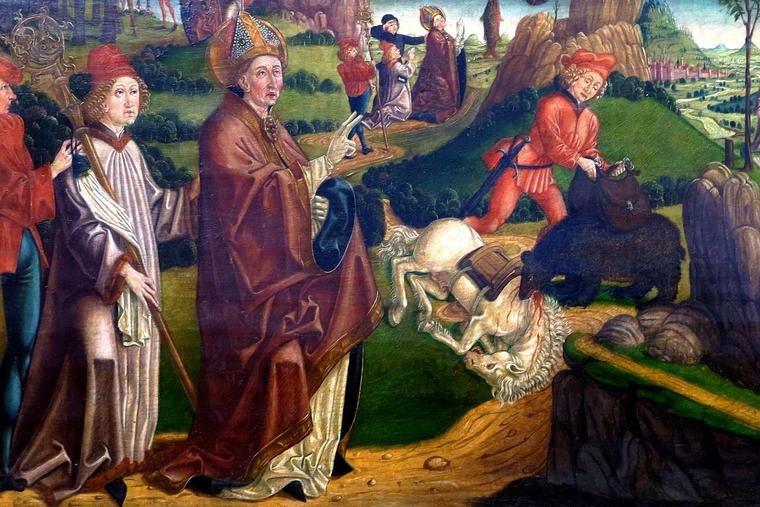
Finally, we come to the burdened bear. This image, again tied to the Diocese of Freising in Germany, is one of St. Corbinian’s bear. Tradition has it that as the hermit Corbinian traveled from his native France on pilgrimage to Rome, his horse was attacked by a bear. Corbinian ordered the bear to carry his load to Rome, which the bear did, before being released by Corbinian in Rome. Corbinian was then commissioned by the Pope to found a diocese in Bavaria, which would become the Diocese of Freising.
The Miracle of the Bear (1489) by Jan Polack.
An Allegory for Discipleship
Ratzinger finds his own life in the story of the bear. Recall that Ratzinger had set out on an academic trajectory before being “burdened” by the episcopacy, and then by being named Prefect of the Congregation of the Doctrine of the Faith (furthermore, he would be named to the See of Peter in 2005).
In Milestones, his early memoir, Ratzinger provides a striking treatment of Corbinian’s bear in light of his own life. He bases this on a self-reflection by St. Augustine, his theological hero. And it opens out into a beautiful meditation on what a life of humble service to the Lord looks like.
Augustine meditates on Psalm 73, which opens with the Psalmist’s lament for the apparent fortune of the cynics and non-believers, while his life, faithful-though-he-is, is laden with hardship and apparent failure.
Because I was envious of the arrogant
when I saw the prosperity of the wicked.
For they suffer no pain;
their bodies are healthy and sleek.
They are free of the burdens of life;
they are not afflicted like others.
Thus pride adorns them as a necklace;
violence clothes them as a robe.
Out of such blindness comes sin;
evil thoughts flood their hearts.
They scoff and spout their malice;
from on high they utter threats.
They set their mouths against the heavens,
their tongues roam the earth.
…
Is it in vain that I have kept my heart pure,
washed my hands in innocence?
For I am afflicted day after day,
chastised every morning.
Then the Psalmist enters the sanctuary and realizes his mistake. He understands the end of the wicked — he sees their slippery slope:
You set them, indeed, on a slippery road;
you hurl them down to ruin.
How suddenly they are devastated;
utterly undone by disaster!
They are like a dream after waking, Lord,
dismissed like shadows when you arise.
Next, we read about the Psalmist’s remorse at his own despair, and temptation to move from the ways of the Lord:
Since my heart was embittered
and my soul deeply wounded,
I was stupid and could not understand;
I was like a brute beast in your presence.
At the point of utter discouragement, the Psalmist finds himself again, while in the sanctuary, in the presence of God. Here, he understands the insignificance of material wealth and success, and recognizes what is truly necessary and what brings salvation: being in God’s presence. God’s presence pricks the Psalmist’s heart — and he is left stupid before him, like a beast.
The Psalmist concludes, that despite the many trials:
I am always with you;
you take hold of my right hand.
With your counsel you guide me,
and at the end receive me with honor.
Whom else have I in the heavens?
None beside you delights me on earth.
Though my flesh and my heart fail,
God is the rock of my heart, my portion forever.
But those who are far from you perish;
you destroy those unfaithful to you.
As for me, to be near God is my good,
to make the Lord GOD my refuge.
I shall declare all your works
in the gates of daughter Zion.
All I want is to be with you, and in being with you, I will become your beast of burden. The converse is also true: It is by becoming your beast of burden that I can be with you, remain with you.
Augustine notes that in Latin, the word “beast” refers primarily to a draft animal used for farm work. Augustine sees in this an image of the episcopacy, outfitted with its own burdens. So Augustine concludes the following about his own life: “A draft animal am I before you, for you, and this is precisely how I abide with you.” Augustine had chosen to be a scholar, but God had chosen for him a life in which Augustine would bear His burden, carry His load, carry His responsibility. Though he often protested, Augustine found in this psalm the antidote to all bitterness, as the draft animal is always with the master, serving him, and in this way is always in the master’s hand, is always near the master, performing a humble, yet essential, service. Ratzinger, reflecting on this, says, “He could not be closer to his Lord or be more important to him.”
The Burden of the Christian Life
To be a Christian is to follow Christ. To follow Christ is to share in his mission. Sharing in Christ’s work, his load, his thirst for souls, is a burden. It’s a beautiful one, to be sure, but it is a burden. Though different by order, every baptized person is invited, is called to share in the load.
Just as the bear took the place of Corbinian’s horse, or donkey, just as the bear became the donkey — so too this is what we have become, this is what we are called to be — and this is the way for us to always be with him. For this reason Ratzinger closes by saying, “I have become your donkey, and in just this way I am with you.” Though he was speaking specifically about the episcopacy and the eventual call to Rome, we might, in our own way, say, “We have become your donkeys, and in just this way we are with you.”
Friedrich Pacher, “St. Corbinian Altar,” ca. 1485 (photo: Public Domain)
My daughter, the one who is a freshman in high school, mentioned something about writing a paper using Magisterium AI as a resource. This tool, developed by Longbeard, an outfit dedicated to building Catholic AI, combs a database containing over 11,700 Vatican documents to respond to your engineered prompt. I poked around on it this morning. Admittedly, it is fast and easy. And, at least you know the data source is solid.
But, is fast and easy always best? Is there any value in the process? Perseverance? Struggle? Is there any value in searching for an answer? In other words, attaining the end matters. Achieving the goal is important. But how one gets there makes a difference for the human person and shapes the human person.
In the human question for knowledge, AI eliminates the struggle from the experience. With AI, the challenge lies in engineering the right prompt to get the answers you want, as opposed to struggling through your own research to get the answers you need. The person and the struggle of the quest both drop out of the equation.
Does this matter?
For our efficiency-driven culture, probably not. It seems that speed matters more. And, AI delivers in this regard.
But, what about for the human person? Does the process matter? Does the trial of the quest matter? Albeit limited, I will offer a few responses.
First, I’d like to draw from Matthew Crawford over at Archedelia. In his article, “AI as self-erasure,” Crawford relates the story of a father struggling to find the right words for the toast at his daughter’s wedding. At the end of his creative rope, he turned to ChatGPT for help. The man said:
He gave a few prompts to ChatGPT, facts about her life, and sure enough it came back with a pretty good wedding toast. Maybe better than what he would have written. But in the end he didn’t use it, and composed his own. This strikes me as telling, and the intuition that stopped him from deferring to the AI is worth bringing to the surface. To use the machine-generated speech would have been to absent himself from this significant moment in the life of his daughter, and in his own life. It would have been to not show up for her wedding,in some sense.
The father would not have shown up because he would not have been involved (yes, that painful reality) in a totally passive exercise of ChatGPT writing one of the most important public affirmations of his daughter’s life. Removing the person from the process, in this case, might have resulted in a more eloquent speech, but it would have stripped it of sincerity and emptied it of meaning somehow — drawing as it would from impersonal data and Internet niceties instead of from the living memory of a father.
Just one more example.
When I was preparing for doctoral work, Dr. Gerard O’Shea, my dissertation supervisor, informed me that if I already knew the answer to my question, there was no sense in going through the painful process of pursuing the doctorate. Right off the bat, then, the whole thing was framed up as a quest. This effectively purified it of any utilitarian purposes. The thing became a matter of the truth and pursuing it.
Next, he led me through one of the most painful mental processes I’ve ever endured. He called it “reading broadly.” This meant reading over 100 books, chapters, or articles in the general direction of my intellectual interest. The goal was to expand my mind (read: blow my mind to smithereens). I needed to taste how much was out there, how much had already been said. I needed to have my own questions expanded and reworked altogether. I needed to realize how little I knew and how small the human mind is in relation to the truth about things and the cultural inheritance of thought about such things. I needed to realize that my mind doesn’t exist on its own, but it is indebted to generations of human inquiry and struggle and insight.
As I persevered, I felt my mind expanding to the point of oblivion. Eventually, I wasn’t sure if I could speak well anymore or generate a coherent thought. I certainly felt as though I had nothing consequential to say. My head was like an oversaturated sponge. Wet and oozing.
After he broke my brain, Gerard set out to put it back together. This meant combing through my notes with me. It meant homing in on questions that emerged that mattered to me. It meant peering down fruitful tangents. It meant reading more. Reading authors who held contradictory opinions — antithetical ones. All of this amounted to identifying and articulating my “burning question.” The burning question the question I would attempt to answer with the dissertation. And, I do mean attempt. It was an attempt at best, and by no means definitive.
Once I could articulate the question, you know what that meant? Multiple iterations of additional broad reading. More and more mind-blowing research for each of the four chapters.
“A doctorate is a test of character,” Gerard would say. Another mentor of mine said there are two types of people with doctorates. The first are pure geniuses whose minds are like huge databases from which they can quickly and easily draw forth the necessary knowledge. The second type are those who simply work hard. “Most,” he said, “fall into the latter category.” I certainly do.
A test of character is just that, a test. It is a trial. It requires struggle and doing hard things. For me, the doctoral pursuit was humbling beyond what I could have imagined. It introduced me to authors I would have never encountered and fruitful mental tangents I would have likely never traversed if it wasn’t for the struggle. It generated questions I would have never asked, or thought to ask. It made me confront the idealism I have about myself and my mental capacities, and helped me realize my own limitations. It led me to converse with people, with experts across the globe, I would have never had reason to contact otherwise. It led me to receive critical feedback that, in the moment, seems completely crippling. The kind of feedback from another person that puts you in your place. (AI can’t do that for you. Only another human being with a perspective outside your own can.)
Perhaps most importantly, the struggle led me to prayer. And, in leading me to prayer, it led me to waiting. Waiting for God to respond. Waiting for wisdom. And, his voice came. It came after hours of struggling while I was taking a walk down the street. It came in a seemingly random conversation over coffee about a topic unrelated to my research interest. It came from observing my children. It came at Mass when I couldn’t help but be distracted by my thoughts and God came anyway.
“Your life will teach you,” Dr. Petroc Willey told me. “So, pay attention to your life.”
There’s no AI for life. You can’t engineer a prompt to get a desired response for real life. You can only enter into the mystery of it. At least that’s what seems to be the invitation at any moment — if we can lift our gaze from the glowing screen.
Yes, there’s no AI for life. You can only struggle through it and, on the other side, come out a different person. “A doctorate changes you,” my priest mentor and friend, Msgr. Frank Lane once told me. “You’re a different person now. You can’t go back.” It’s not the letters “PhD” after someone’s name that changes them. It’s not the end result. At least not exclusively. It’s the process that changes them. Or, at least it should, if we are still faithful to the quest and don’t avoid it altogether by engineering efficiencies to the point of stripping the human person of the value of struggle.
A personal process of engagement puts you in your place. AI, for all its benefits, can’t never be able to do that.