• Without a perfect human love, perfect joy remains out of reach.

    Prefatory Note: In a previous post, I announced that I was beginning a year-long effort to articulate the gospel according to Joseph Ratzinger/Benedict XVI. This is the fourth installment in that series.

    I was scooping up my children because I thought the graveside service was over. And it was over, till my cousin marched to the casket with a boombox. I didn’t know such an antique still existed — the battery-operated, CD-playing machine. Yet here it was.

    Apparently my grandmother had requested that “their song” be played before she was buried. “Their song,” the song that had accompanied them for 67 years of marriage, was Johnny Mathis’ “The Twelfth of Never.” My aunt made this announcement and everyone stopped to listen to the song. Somehow, in all of this, I ended up right next to the casket. There, I read my grandfather’s tombstone (he had already been dead for five years) and I could peer down the shaft next to my grandmother’s casket and stare into the pitch blackness of her tomb.

    “Until the twelfth of never, I’ll still be loving you…” Johnny’s voice sang out. It was a cry for some sort of eternal love, a never ending love. And this cry captured the longing of the hearts of my grandparents. Yet here I was staring at a tombstone and at the terrible finality of death. Apparently, Johnny’s was a false promise.

    The words from Song of Songs went through my head: “For Love is strong as Death, longing is fierce as Sheol” (8:6). Strong as death, but not stronger than death.

    “Hold me close. Never let me go,” Johnny’s voice rang out.

    I felt almost like I was being torn in half. Looking into my grandmother’s grave, I saw and heard the disparity between human longing and the dead end of death. I could feel it. It was anguish, in its purest form. The human heart longs for a love that is stronger than death, one that can conquer the loneliness of Sheol. Then, something snapped inside of me. In complete silence, I screamed. Confronted with the harshness of human love’s insufficiency before the power of death, let out a deep plea in the silence of my heart.

    Nobody There

    A few years before my grandmother passed, my grandfather was lying in a hospital in Toledo, Ohio. He had had a surgery and the recovery faltered. As time wore on, the WWII veteran who paratrooped into Normandy days after D-Day, the man who fought in the Battle of the Bulge, the manual laborer who assembled GE motors, the husband of 67 years, the father of five children, this man was losing hope. Embittered and tired, and probably scared, he knew the end was in sight. His life, filled with so much quiet suffering, likely stemming from his experience in the war, was ending in more suffering.

    On April 20, 2014, Easter Sunday, my parents visited him in the hospital. My mom recounts the story:

    When we went to leave, he asked “So, who will be here with me in the morning?” I told him that the nurses are always there, and that Jill [his daughter, my aunt] and Grandma would probably be there like they always did in the late morning or early afternoon. He repeated again, “No, but who will be here with me in the morning?” I repeated all of what I’d just said back to him, and he looked at me so intently and said, “I’ll call out each one of your names and nobody will be here with me.” I assured him that the nurses are always there with and for him, and he just said again, “Nobody will be here with me.”

    He died the next morning, April 21. None of us were there with him.

    Longing

    Both of these stories reveal something of the human heart. I would wager a bet it’s something common amongst all human beings who aren’t in a state of despair. It’s one of these ubiquitous human realities, not unlike birth and death.

    Birth and death are interesting to think about, even for a moment. Each of us was born. We were given. Not a single one of us is a truly self-creating reality. We depended on another, on others, for life, and, in fact, we still depend on others for so many things in our lives. Birth signifies givenness and dependence. It signifies humility. And death. Death confronts us all. Save for Jesus, the human death rate is 100%. It stands before us as the fear above and below all our other fears. I’m currently reading Flannery O’Connor’s Wise Blood. Early in the novel, the main character, Hazel Motes, recounts numerous experiences of seeing bodies in caskets, as he lay, rocking, in his train car bed that made him feel he was lying in his own coffin. Since reading this, I’ve thought of so many funerals I’ve attended. I pass by people on the road or in the grocery store and think about the fact that this person, too, will die and will be lying in a grave someday. I will, too. And this is something odd, something morbid, we have in common — a kind of common end, each of us laying in a tomb, stiff and still.

    Birth and death and longing for love, for communion — for a loving communion powerful enough to conquer the grave — these human realities, I argue, form a kind of backdrop for every human life. And that longing for human love to be present when it matters most, that’s what my grandparents wanted. Yet it seems the twelfth of never did come and pass. It passed after 67 years, leaving black nothingness in its wake. It seems nobody is there as one “crosses the bar,” as Tennyson describes death.

    Intensity

    The harsh contours of death bring the intensity of the longing for love into striking relief. It does the same for the shortcomings of human love. Death wins. And it sure seems that way when it slinks into a hospital room and snatches away a lonely old man, or laughs in the face of Johnny Mathis’ promise of unending love. Still we long for an eternal love. We long for a connection powerful enough to defeat death. Our hearts ache for it.

    Besides its finite nature, human love manifests plenty of other shortcomings, too. For example, it often admits of use. Beyond the times we find ourselves objectified by others — used and discarded in our throwaway culture — there’s a terrible admixture of motives in the fallen human heart. It is a mixture of gift and use. Ratzinger puts it this way: “Who among us can say that he truly, in all simplicity, carries out the service of being kind to others? Who among us would not have to admit that even in the acts of kindness he practices toward others, there is still an element of selfishness, something of self-satisfaction and looking back at ourselves?”

    Beyond use, love is inconsistent. A person seems to love me in one moment (e.g., is patient with me), and not in the next (e.g., loses patience). So often, conditional love (i.e., “I’ll love you if…”) is the norm. Plus, all human love bears within it a certain ignorance. The depths of the human heart remain impenetrable, so all love carries within it a degree of uncertainty.

    Despite such shortcomings, we long for a love that is pure gift, that does not admit of use. We long for consistent love and true love (i.e., a love that knows me to the bottom of my existence and accepts me still). We long for unconditional love. And above all, we long for love of an infinite variety — the kind that can satiate the infinite longings of the heart and burst the bonds of death.

    Without such love, we can never be (perfectly) joyful. You might recall from the previous post, that joy is the peace or harmony I experience within myself when I accept myself. The problem is, I cannot accept myself, I cannot love myself (perfectly) for so many reasons. I must be loved by another. Yet the other’s love falls short. We need to be loved (perfectly) to be (perfectly) joyful, yet none of us are loved perfectly. And, when we need it most, when we pass through the doorway of death, it seems nobody is there. And that, is hell.

  • Undulating Ululations

    Reflections on Brood XIV and my humanity.

    Around the time one of our kids turn two, I’ll start to have him or her join me for weekly lawn mowing ritual. This summer, Blaise is two. So he’s the one now perched on my lap. I realize in our sterile, sanitized suburban neighborhood, I’m sure the neighbors see this as risky and dangerous. But we do it anyway.

    As we snake about the yard, Dom glares at us, huffing and stomping and screaming. Dom is the four-year-old who has now grown such that mowing with him has become a clumsy affair. He is too big and tries to take the wheel. So, he graduated from his lap seat to watching from the deck and throwing the occasional tantrum — his rebellion against growing up.

    I appreciate Blaise’s company. I like sitting in silence with my boy week after week. But this week was different. A chorus of cicadas joined in the steady hum of the mower’s engine. As we coursed about the yard, interested cicadas of Brood XIV, a seventeen-year periodical variety, torpedoed us. “The females are attracted to the vibrations of machinery,” my older boy tells me. One dive-bombed at Blaise’s head and hooked onto his hair. He reached and grabbed the red-eyed crazy bug and held it in his hand. He looked up at me with a big smile.

    Seventeen years. These insects won’t appear again, above ground, on this land, for seventeen years. Who knows where Blaise will be then? Who knows where I will be? But right here, riding through the yard, the boy on my lap is happy to hold a bug that carries inside itself a story seventeen years in the making. And I am happy to be holding him.

    I have tried to immerse myself in the Brood XIV experience of 2025. It’s been interesting to watch the bugs and to observe my children’s fascination with them — and my own. My kids pluck them off trees and bushes and put them in buckets. They toss them to the chickens for a once-in-a-lifetime feast. They sneak them in the house or try to see how many they can hold in their hands. For my part, I’ve gone on more frequent jogs through the area to see the difference in cicada density from one neighborhood to the next. I’ve taken time away from the office (where the brood is barely present), so I could work from my back porch and feel the mystery of this thing. I’m not a bug enthusiast of any sort, just a curious human being. As I have spent time with these creatures, I’ve found myself reflecting on my own life and the drama of human experience. They have taken on a kind of symbolic, sacramental quality for me. By this, I mean the cicadas, God’s creatures, are capable of pointing beyond a buggy season in early summer — if we let them — to show us something of who we are, as God’s creatures, and who the Creator is.

    For seventeen years these bugs lived under the earth as nymphs burrowing and sucking on the sap of tree roots. The tree was their source of life, till the spring of the seventeenth year — late May, when the soil reaches the right temperature and signals time to be birthed from the earth. They come out in droves and start their ascent up the tree that provided their sustenance while they hid underground. They are slow, and they have to pause to molt, leaving the old self behind. Many don’t make it. They become the food of squirrels and birds, or something goes wrong while molting and they die there as if frozen while undressing. But many do make it, reaching the luscious leaves and growing in smarts and speed. They are as numerous as they are erratic, flying here and there and landing on anything that looks good.

    But it’s the undeniable volume of the loudest bugs on earth that I find most interesting. I am fascinated by the noise from the nearby bugs — or the one I hold in my hand as I watch the sound box in its midsection vibrate — but more intrigued by the din I hear coming from distant pockets of woods. It provides a backdrop to my day, a humming from sunup to sundown. The volume all around me intensifies in the afternoon heat. It is one of undulating ululations. A cacophony of shrills. Waves of electrified chirping. An incessant buzz riffling from the male abdomen, as they call out for a mate. Their time is running short. After seventeen years underground, they only have a few weeks to mate and live on in nymphs that hatch, fall to the ground, and burrow into the soil. There they will stay till its time to carry out the mating ritual once again.

    As I consider these creatures, I can’t help but think of my own origins. Origins that lie in deep pockets of God’s mind, and, in their own way, in the depths of the earth. Psalm 139:13–16 captures this beautifully:

    You formed my inmost being;

    you knit me in my mother’s womb.

    I praise you, because I am wonderfully made;

    wonderful are your works!

    My very self you know.

    My bones are not hidden from you,

    When I was being made in secret,

    fashioned in the depths of the earth.

    Your eyes saw me unformed;

    in your book all are written down;

    my days were shaped, before one came to be.

    I think of the cicada nymphs drawing the sustenance of life from the roots of the tree in which they hatched. This is Eucharistic imagery. The Eucharist makes the Church and the Church makes the Eucharist accessible to me. The Eucharist is the bread of life, the fruit of the new tree of life (see Gen 2–3; Jn 19:31–37). The Eucharist, Jesus, made me and sustains me. He gives of himself to give me life. God provides. Jesus is the giving tree and so long as the sap of his life, the Holy Spirit, courses through my being, so long as I am grafted onto him, I can live, and move, and have my being (see Jn 15:1–5; Acts 17:28).

    The cicadas emerging and molting, calls to mind Christian conversion, which allows us, if we cooperate with God’s grace, to soar to the heights of sanctity. “You should put away the old self of your former way of life,” St. Paul says, “corrupted through deceitful desires, and be renewed in the spirit of your minds, and put on the new self, created in God’s way in righteousness and holiness of truth” (Eph 4:22–24).

    When the cicadas take flight, they seem to have no flight pattern besides erratic. They’re unpredictable. Human beings, with our freedom, can be rather erratic as well. Despite contemporary attempts to track buying habits, analyze market data, and so forth, no data analyst (today’s interpreters of human behavior and contemporary myth-makers) will ever fully figure things out. We are too unpredictable ourselves, even as we establish a general direction for our lives.

    Finally, the undulating ululations. As the cicadas cry out in incessant waves, I get the sense of a kind of throbbing for existence. At this point in their life cycle, the end is near and mating is the only hope for living on. As their shrill sound encapsulates their ache for life, and communion. I think of God’s constant cry for his people, a voice in the desert crying out, calling for a repentant return to him. And I think of my own longings for the infinite, for the eternal, for a communion capable of overpowering the death that seems so immanent we can’t help but try to distract it away.

    A few weeks. That’s how long the cicadas live after clawing their way through the soil, up the tree, and into to the sky. A rather short span given the length of time underground. “Teach us to count our days aright, that we may gain wisdom of heart,” the Psalmist cries out (Ps 90:12). The cicadas drive this home. Momento Mori. Remember thy death. Live well. Live fully. Cry out for the God who calls out for you. Live a life of communion and you will live.

    Yes. As Blaise looked at me holding seventeen years in his two-year-old hand, as he looked in wonder at the red-eyed bug, and smiled with delight at the whole experience — looking at me, the co-creator of his own existence — all these thoughts of life and death and love and communion crawled through my head. There, on that mower, the mystery of life and the goodness of creation cried out to me full-force. I could hear it.

  • Four O'Clock

    A Meditation on John 1:35–39

    “It was about four in the afternoon” (Jn 1:39).

    This is my favorite line in all of Scripture. It is a line that tells the time. You ask: “Why? Why is it your favorite?” I was hoping you would inquire. Let’s look at the full passage:

    The next day John [the Baptist] was there again with two of his disciples, and as he watched Jesus walk by, he said, “Behold, the Lamb of God.” The two disciples heard what he said and followed Jesus. Jesus turned and saw them following him and said to them, “What are you looking for?” They said to him, “Rabbi” (which translated means Teacher), “where are you staying?” He said to them, “Come, and you will see.” So they went and saw where he was staying, and they stayed with him that day. It was about four in the afternoon.” — Jn. 1:35-39

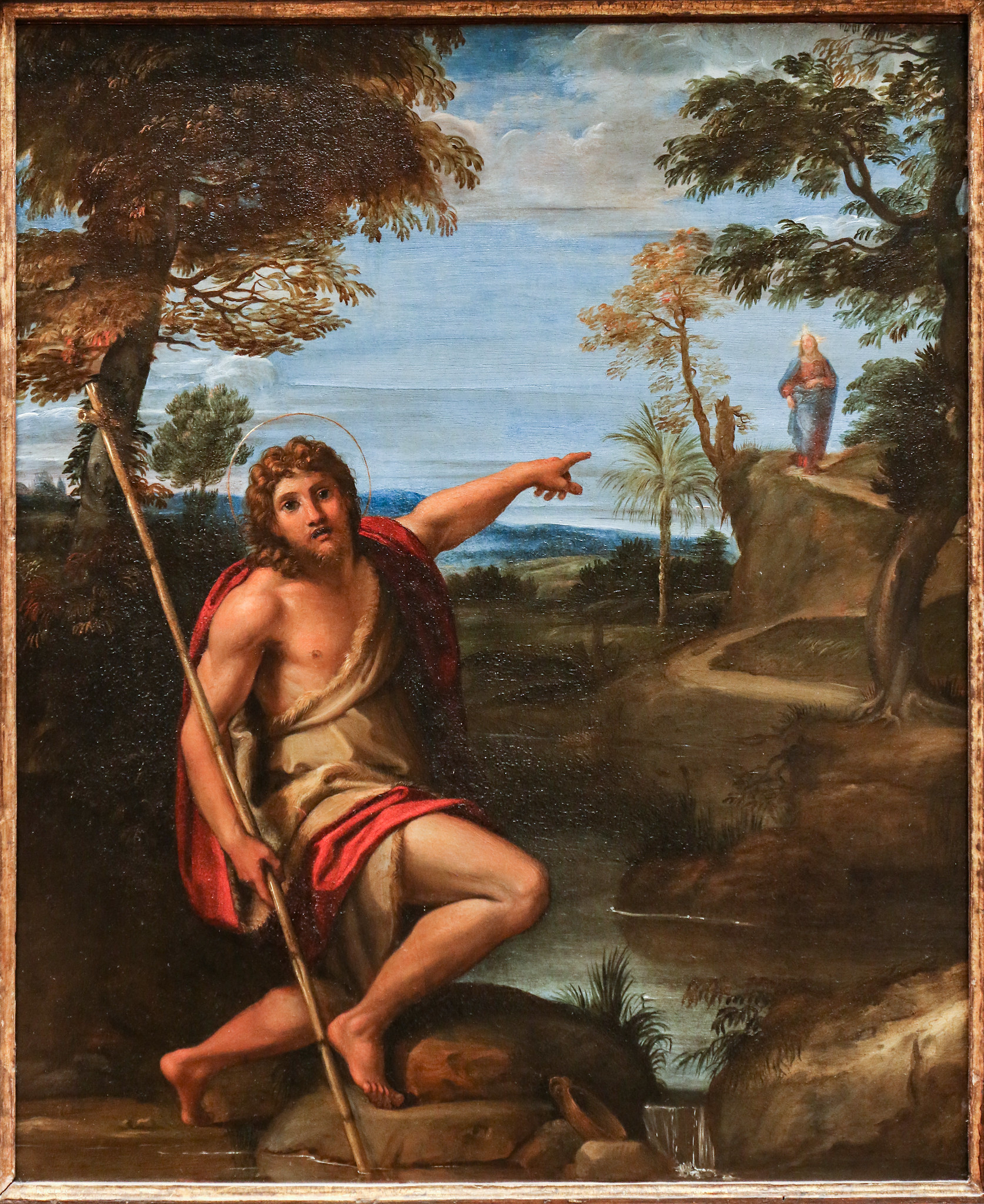
    The day before, John the Baptist had identified Jesus as the Lamb of God (see Jn 1:29). Now, for the second day in a row, John the Baptist points him out again. This time, two of his own disciples are primed and ready. They follow after this Lamb of God. I like to imagine what this kind of stalking would have looked like. Clearly, they were trying to be discreet, but discretion only goes so far when God is involved. So, Jesus turns and he sees them. He sees them. I like to imagine this, too. Jesus turning and seeing me. What is that gaze like? What does he see when he looks upon me? What is like to make eye contact with Christ?

    Next, we hear the first words out of the Word’s mouth in John’s Gospel in the form of a question: “What are you looking for?” These words, uttered nearly 2000 years ago, this question cuts across time and pierces our hearts today. It jumps off the page and demands an answer. Jesus’ inquiry reveals that God cares about our desires, that he takes them seriously. He wants to know what you want, what are you longing for, and what are you searching for?

    Seemingly caught off guard, the wannabe disciples issue a clumsy response: “where are you staying?” At first blush, they don’t seem to answer his question. And, that might be the case. Still, I have often wondered if their question rests on an implied answer: “you.”

    “What are you looking for?”

    “You, Jesus. We’ve been looking for this long-promised Lamb of God and you are that Lamb and we don’t want to leave you. Where are you staying?”

    The words of Scripture invite this kind of reflection. And they invite us to consider how we would respond, or if we would have taken off after Jesus in the first place. These two men did and they want to stay with Jesus.

    Where is Jesus staying? Where does he dwell? “Come and you will see,” he says. This, too, is interesting. It reveals something about the life of faith. By coming to Jesus, by staying with Jesus, this is how we can see. If you want to see, if you want to see things rightly, come with me. We get the sense that seeing requires conversion. True sight comes through faith — that is, through encountering Christ and abiding in him. So, by coming with him, we can see.

    “So they went and saw where he was staying, and they stayed with him that day.” But, where was Jesus staying? Here, our reflection entertains a certain duality. This comes out in two verses earlier in the chapter. On the one hand, Jesus, the Word of God taken flesh, “made his dwelling among us” (Jn 1:14). He made his abode right there in Nazareth. They went to a physical place, to a house, a home. Maybe his childhood home. Maybe Mary was there. On the other hand, Jesus dwells elsewhere. The NAB translates the line this way: “No one has ever seen God. The only Son, God, who is at the Father’s side, has revealed him” (Jn 1:18). Calling to mind the melancholy of Deuteronomy 34:10, John announces that Jesus is the one who has seen God face to face. In fact, his face is the face of God. His face reveals God. And this Son, God, dwells at the Father’s side. The RSV provides a tighter translation: “who is in the bosom of the Father.” The Son dwells in the kolpos, the chest, the bosom, the heart of the Father. Jesus is at home in the Father, resting in the heart of the Father and allowing that heartbeat to serve as the beat of his life. If this is true, then when Jesus invites the two disciples of John the Baptist to “come and see,” in some way, he shows them the heart of the Father. Jesus is both here and there, so to speak. He meets us here (i.e., in our concrete circumstances) so as to take us there (i.e., the Father’s heart), that by dwelling there, we might live here more fully (cf. Jn 10:10).

    Now, if you fast forward in John’s Gospel to the thirteenth chapter, we learn that after Jesus washed the disciples’ feet the Beloved Disciple rests his head on the kolpos of Jesus. In so many ways, the Beloved Disciple represents every disciple throughout the Gospel. Those who follow Christ are God’s beloved disciples. And, here, the Beloved Disciple models the proper posture for a disciple — abiding in, resting in the heart of Jesus. Our lives should move according to the beat of Jesus’ heart.

    If you use your imagination for a moment, I think we can drive all of this even deeper. If the Beloved Disciple (you!) rests his head on the heart of Jesus, and Jesus is rests his head on the heart of the Father, then where is the Beloved Disciple positioned? Between the hearts of the Father and the Son. Where are we at home? Where are we to abide? Between the hearts of the Father and the Son.

    Let me illustrate the point by pulling one of my children into the mix. For quite a while, it seemed that whenever I gave my wife a hug, our daughter Cécile would come out of nowhere and wedge herself between us. She’d look up at us with her big eyes and say: “My home.” There was something wonderfully endearing about this childlike act. There was also something insightful. When applied to the image of abiding between the hearts of the Father and Son from John’s Gospel, we, too, can spiritually say: “my home.” Jesus made his home with us, that we might make our home in God — and abide in it.

    Let’s get back to the original story. After the disciples go and stay with Jesus that day, we hear that it was about four in the afternoon. At the end of the Gospel, John tells us, “there are also many other things that Jesus did, but if these were to be described individually, I do not think the whole world would contain the books that would be written” (Jn 21:25). Yet, the Evangelist wastes a line to tell us the time: four o’clock. Why? Obviously, we can speculate all we want. All scholarly debate about authorship aside, my prayer has led me to consider that for John the Baptist’s unnamed disciple of the first chapter of John’s Gospel, the one who is the Beloved Disciple, the one who is the Evangelist himself, four o’clock was the moment of his encounter with Jesus. Four o’clock was the moment of transformation. It encapsulates an event that changed everything for him — opening the horizon of his life, while sending it in a new direction. “It was about four in the afternoon.”

    The God who created the universe, the Word who was in the beginning with God and who, indeed, is God (cf. Jn 1:1–3), this God who creates time, this God has time for me. He makes time for me. Then, he enters time and meets me with stunning proximity. He encounters me here. Now. And you, too. And we can be at home in the Father, if only we would come to Jesus so as to see. Why not now? It’s about four in the afternoon.

    Prayer of Abandon

    Father,

    I abandon myself into your hands;

    do with me what you will.

    Whatever you may do,

    I thank you.

    I am ready for all, I accept all.

    Let only your will be done in me,

    and in all your creatures.

    I wish no more than this, O Lord.

    Into your hands I commend my soul;

    I offer it to you

    with all the love of my heart,

    for I love you, Lord,

    and so need to give myself,

    to surrender myself into your hands,

    without reserve,

    and with boundless confidence,

    for you are my Father.

    — Prayer inspired by St. Charles de Foucauld

  • Why I write anyway.

    As a little boy, I’d wake up and slip downstairs. If I was first, I’d tiptoe across the creaky living room floor in route to the front door. From there, I could peer out the narrow glass pane and catch sight of the daily newspaper. If it was damp outside, the paper would be folded over and covered in an orange bag. But I liked it best when it was dry. Then, it was rubberbanded. I’d open the door. Just a crack, usually, and, confronted by the elements, I’d snatch the paper. Peeling the rubber band off the paper started the process of getting covered in some amount of ink. Very often I would hold the paper close to my nose as I unfolded it. There was something about the newsprint on that paper. It’s a bit like a new book, a fresh pack of baseball cards, or even a new plastic CD. I smelled my hands, too. The ink on my skin — a smudged tattoo — was a reminder of my fleshly humanity.

    Unfurling the paper, a world opened before my eyes — in color on the front page and black and white inside. Stories from far and near. Unusual and strange stories and some that made you feel good about being human. Odd classified ads and superstar high school athletes.

    As I got older, I picked up the neighborhood newspaper route. Rising at 4:45am each day had its drawbacks, as did the snow and soaking rain, but I did learn something about hard work and constancy. I came to know most everyone on the street, largely by knocking on their doors to collect their newspaper fees each month. The biggest perk of the route came in the form of scoping the news before anyone else on the street even thought about getting up.

    I’ve labored over these details to set up the fact that I studied journalism when I first got to college. At the time, the world of communications was being turned on its head. Web 2.0 had just arrived. During my freshman year of college, for example, John Carroll University managed to get enough student signatures to warrant a Facebook. I remember exuberant college kids buzzing around on campus, pumped about the new social media possibilities that popped out of our screens. Not only that, we had high speed internet access in each dorm room. The days of the daily newspaper were numbered. But not before I was somehow introduced to an ancient journalist from The Plain Dealer. To this day, I have no idea who the man was. He was kind to me and encouraged the my 18-year-old self to work hard and hone the craft of writing. That was 21 years ago. I’ve still remember that conversation, and I’ve still got a long way to go.

    He recommended I read On Writing Well by William Zinsser. I chased down the book and have read it cover-to-cover multiple times since then. Given that I’m a melancholic prone to melancholy, I’ve always appreciated the opening pages of the book. There, Zinsser explains how hard writing is, at least for him. He recounts an experience where a school in Connecticut offered a “day devoted to the arts,” where he (a professional writer) and a “Dr. Brock,” a surgeon who had recently taken up writing, were invited to speak. Dr. Brock explained that writing was easy, that it just flowed, and when it didn’t, he took a walk. He didn’t care much for editing, but for letting it be. Zinsser stated that writing was hard and that rewriting and rewriting the rewritten text was more important than writing it the first time. He expressed the pain of working through “stuckness” and that there wasn’t time for long walks or boat rides for the professional writer with deadlines.

    I tend to align with Zinsser. I think writing is hard, too. But, because it’s hard, it’s thrilling. Excellence evades my grasp. Writing reminds me of trying to master the left-handed layup (as a righty), stretching your fingers for a bar chord, or actually time up all the parts of a meal for once. It’s also thrilling because it’s difficult and I’m usually up for a good challenge. Some people love having run or having written. I like that feeling of accomplishment, too. But, I also appreciate the process, painful and tedious as it may be.

    Back to Zinsser. He relates that learned a great deal from the experience and concluded that there are probably as many methods and approaches for writing as there are people who write. But, all writers are, as Zinsser describes:

    Vulnerable and all of them are tense. They are driven by a compulsion to put some part of themselves on paper, and yet they don’t just write what comes naturally. They sit down to commit an act of literature, and the self who emerges on paper is far stiffer than the person who sat down to write. The problem is to find the real man or woman behind the tension. Ultimately the product that any writer has to sell is not the subject being written about, but who he or she is.1

    Here, I think Zinsser nails it. The humanity piece, perhaps more than the craft piece, makes writing hard. It makes writing what it is. Writing exposes and renders vulnerable the writer. Nothing ever comes out quite right. Nothing appears on paper as you imagined it would. The fundamental incommunicability of the human person confronts the writer. So it becomes a fight, really. An internal one. A desire to be heard and known and accepted, and the frightful prospect of being heard and known and rejected.

    Dorothy Day picks up on this element of writing, which she describes as a confession:

    Going to [the Sacrament of] confession is hard. Writing a book is hard, because you are “giving yourself away.” But if you love, you want to give yourself. You write as you are impelled to write, about man and his problems, his relation to God and his fellows. You write about yourself because in the long run all man’s problems are the same, his human needs of sustenance and love. “What is man that Thou art mindful of him?” the Psalmist asks, and he indicates man’s immense dignity when he says, “Thou hast made him a little less than the angels.” He is made in the image and likeness of God, he is a temple of the Holy Spirit. He is of tremendous importance. What is man, where is he going, what is his destiny? It is a mystery. We are sons of God, and “it is a terrible thing to fall into the hands of the living God.” I can write only of myself, what I know of myself.2

    Forget a book. Writing anything is hard. And it is hard because it demands something of you, the writer. It demands yourself. Nothing more. Nothing less. (Perhaps this is why I feel AI generated writing is such a travesty, like Daniel Tiger is to Mister Rogers. AI short circuits the human work involved in self-expression. On the flip side, it also strips away the other, another human being who is reaching out in some way to his reader, with the hope of communion. A computer cannot connect in this personal, relational way.)

    Writing is an interpersonal reality. St. Augustine picks up on the tension involved. He describes the dynamism of communication as follows:

    The sound of my voice brings the meaning of the word to you and then passes away. The word which the sound has brought to you is now in your heart, and yet it is still also in mine…The sound of the voice has made itself heard in the service of the word, and has gone away, as though it were saying: My joy is complete. Let us hold on to the word; we must not lose the word conceived inwardly in our hearts.3

    Speaking contains a certain immediacy. The listener is right there (generally), and the experience of resonance simultaneous. When I write, however, part of myself, my voice, hangs out there. It awaits a hearer, a listener, a reader, in whom my voice carrying the word will be received and cherished. Communication, communion, only happens when that happens. And most writers don’t know when and if that ever happens. Conversely, this is exactly what happens inside of me when another’s written voice carries the word into me, and there is connection and resonance. At the bottom of it, I think this fueled my fascination with the daily newspaper. It wasn’t so much whatever the news was or that I saw it first, but that through the miracle of mass media, writers reached out and I could receive what they had to say, and receive them in the process. Obviously this wasn’t something I consciously thought about, but something I felt. In fact, I still do, anytime I come across that antiquated thing called a newspaper inviting me to take up and read.

    Madeleine Delbrêl’s biographers explain that “writing was, for her, a harmony of prayer and action.” They note that “prayer was the main axis of her life, because she wanted to go constantly to the source of love who is Jesus Christ.” Consequently, “when she wrote,…it flowed from a conversation with God.”4 I think this observation gets at something true for me, though I don’t come close to writing from the depth of prayer we see in people like Delbrêl or Day, namely the relationship between writing and prayer. Pray and write. Ora et scribe. Ora et labora. Writing is work. Writing expresses prayer. I pray to make an attempt at loving God — and neighbor too. I suppose I write for similar reasons. Prayer binds God, neighbor, self. Writing does, too. Prayer sources writing with a love capable of carrying across the void and, perhaps, into the heart of my reader. I suppose I write because I pray, and I pray simply because I have to, or else something in me dries up and dies.

    1 Zinsser, On Writing Well, 5.
    2 Day, The Long Loneliness, 10.
    3 Augustine of Hippo: Sermo 293,3.
    4 François, Pitaud, and Jacobi, “Biography of Madeleine Delbrêl,” in The Dazzling Light of God, 16–17.
  • Practical Wisdom (Part IV)

    I struggle to pray the Liturgy of the Hours. My mind drifts and I become robotic, lifeless.

    Recently, I shared this with a Benedictine monk and asked for advice in response St. Benedict’s call for our minds to be in harmony with our voices as we pray the Divine Office (see RB 19:7). He offered some helpful tips. Then, he dropped this line on me: “How we pray is a reflection of how we live.” How I approach prayer reflects how I approach life. So, how do I approach it? Like a chore? Distracted? Mindless? Apathetic? Rushed? Hurried? Frustrated? Superficial? Duplicitous?

    In this season of Lent, may we repent of any such attitudes and ask the Lord to purify our desires. May he give us the grace of uniting our minds with our voices as we pray and as we live. May renewed prayer be reflected in newness of life. May we pray and live from a place of love, attention, affection, patience, generosity, depth, and fidelity. May we live and pray whole-heartedly.

  • Image and Likeness

    A Brief Catechesis on CCC, §§355–384

    Note: This is a slightly modified catechesis I wrote for the Stella Maris Become Catholic program.

    What does it mean that human beings are made in God’s “image and likeness?” We are dealing, here, with a question of anthropology. Who are we as human beings? What is a human being? What does God reveal about the truth of our being? To engage with such questions, Judeo-Christianity takes the Book of Genesis as a starting point. There, the tradition establishes the particular mode of being called “human being” in a relational fashion. To understand what I mean by this, we must go back to the beginning, where, in Genesis 1:26-27, we hear the following:

    God said: Let us make human beings in our image, after our likeness. Let them have dominion over the fish of the sea, the birds of the air, the tame animals, all the wild animals, and all the creatures that crawl on the earth. God created mankind in his image; in the image of God he created them; male and female he created them.

    It’s worth stopping to think about how the original readers of the book of Genesis would have understood the expression “image and likeness.” We only have to turn a few pages to get the first clue. After Genesis 1, we next see those words image and likeness in Genesis 5:3, which says, “When Adam had lived a hundred and thirty years, he became the father of a son in his own likeness, after his image, and named him Seth.” Based on contextual evidence, then, we see that here, “image and likeness” refers to filiation, to sonship—Adam and Eve were the created sons and daughters of God. As such, we can say they were God-like. Our idiom that a child is a “splitting image” of a parent gets at this. I have eight children and inevitably when people meet the newest baby, they try to figure out who that child looks like—”she has her mother’s eyes” or “he has his daddy’s stunning physique” and so on. (Okay, nobody has ever said the latter. Still, you get the point.) This is because the baby is an image of me and my wife. As such, the baby points back to us, his parents, in his very being. An image reproduces its own prototype, like a child’s very being reproduces that of his or her parents.

    This pushes into a second point: the Hebrew word selem (image) refers an exact copy or reproduction. An image reproduces the original, and as such, it points to and refers to it. An image re–presents the reality, like a photograph re-presenting an event, a moment in time. Joseph Ratzinger comments on this, saying “the essence of an image consists in the fact that it represents something…it points to something beyond itself…it goes beyond itself and manifests something that it itself is not.”1 Now, an image is a good image to the degree in which it approximates the original. Once, I watched my son paint the Bengals logo (our hometown team) on a canvas and then go up to his room and pull out his Burrow jersey to compare his work to the official logo. He was off in a few spots, but not bad. So too, human beings, made in the image of God, then, are good images the more God-like they are, the more they reproduce and re-present God-like actions on the face of the earth.

    Third, to be an image is to have relationality as the foundation of existence. An image only exists insofar as it stands in relation to the original, pointing to a reality beyond itself. Consequently, human beings “cannot be closed in on themselves,” as Ratzinger says. “To be the image of God implies relationality.”2 But human being is not an artificial and lifeless image, like a picture, for example, but a living one who thinks and prays and loves and communicates. As such, human images of God “are most profoundly themselves when they discover their relation to their Creator.”3 As God’s image, the human being discovers himself or herself only in relation to God, for “the truth is that only in the mystery of the incarnate Word does the mystery of man take on light.”4 With this awareness and through this relationship with God, the human being becomes capable of mediating God’s presence in the created order and communicating with God on behalf of it. With this, we’ve already anticipated the next point.

    And that point — the fourth one — has to do with human beings participating in the divine in some way, shape, or form, like a photo participates in some way in the event it captures. The human being has within himself a divine “spark,” a divine “presence.” This doesn’t mean we are God, that pieces of God are in everyone, or that God is everything, like pantheism, but that we participate in God’s being in such a way that we make him and his activity present somehow. We might think of photosynthesis, as an example. The plant needs sunlight to live and is designed to participate in the sun, so to speak, but at no point in that process do we mistake the plant for the sun.

    Fifth, and I’ve already alluded to this above, the human being is God’s representative on the face of the earth.5 Alexander Schmemann notes that the human being differs from all other beings on the face of the earth for a number of reasons, the most important of which is the fact that the human being is capable of adoring and worshiping God. “He stands in the center of the world and unifies it in his act of blessing God, of both receiving the world from God and offering it to God — and by filling the world with this eucharist [i.e., thanksgiving].”6

    Image of the Invisible God

    Let’s take this whole conversation about “image” one step further. In St. Paul’s Letter to the Colossians, we hear that Christ “is the image of the invisible God” (1:15). In other words, Jesus, the Incarnate Word is the Image of God. Jesus Christ, the eternally begotten Son, the Incarnate Word of God, he makes the Father known. He makes God visible to us. In Jesus, God has a face.

    Human beings, for their part, are made by God “in” the Image of God. And Jesus is the Image. In other words, Jesus is the prototype. We are images of the Image of God. And the Image of the invisible God is the Son of God. If we are made in the Image of the Son of God, then it means we are meant to become sons and daughters of God too. We are meant to become partakers in the divine nature (cf. CCC, §460).

    Composite Beings

    So far, I’ve spent a lot of time reflecting on Genesis 1. Let’s look briefly at Genesis 2. There, we see that human beings are both body and soul, corporeal and spiritual. Genesis 2 portrays this poetically with God forming the lifeless man from the dust of the earth, like a potter molding his clay. Then, God breathes life into the man — giving the man his spiritual soul. Soul is anima in Latin and this word means life-force. From this passage we can draw several conclusions: first, that human beings are willed by God, and second, that our spiritual souls come from God. The soul is immortal and not “produced” by our parents. I like to think about the soul like a homing device — it is that most interior part of our lives that constantly reaches out in search of God.

    Marriage as Icon of the Trinity

    Finally, it’s worth pointing out that if we are made in the “image and likeness” of God, then we are made in the image and likeness of the Trinity. God is a Trinity of persons. This means the essence of God, that is, who God is, is relationality, communion. For this reason, St. John Paul II exclaims, “Man becomes the image of God not so much in the moment of solitude as in the moment of communion.” We image God most profoundly, most fully, when we are in relationship with others, in communion with others. Genesis highlights this out with the most fundamental instance of human relationality: the relationship between male and female in marriage. Really, Scripture extolls marriage as the primordial icon of communion.

    In Genesis, we see that God creates human beings sexually differentiated as male or female. Sexual difference exists for the sake of complementarity and communion. So there are two ways of being human — male or female — yet there is equal dignity. We see this equality on display as Eve is created from Adam’s side. This shows that she is equal in dignity to the man. She is not taken from his head, indicating that she was above Adam. And, Eve is not taken from Adam’s feet, indicating that she is beneath him. She is Adam’s equal.

    Scripture says that Eve is taken, so to speak, from Adam. In its own way, this shows us what their love, their marriage is all about. She is to draw Adam out of himself. He is to love her, to make a gift of himself to her, to affirm her goodness. At the same time, Eve is given to Adam. God himself brings her to the man. She is God’s gift to Adam, to be received by Adam. Eve is given to Adam to mediate God’s love for Adam. Eve is given to somehow incarnate God’s love for Adam who, as a human being, needs to receive love in an incarnate way. But the converse is also true. As Eve’s helpmate, Adam is to draw Eve out of herself and is to be accepted by her. This reciprocal relationship of being drawn out of oneself and given to another while simultaneously receiving the gift of the other, this communion we see in marriage, has the potential to be fruitful — participating in the creative act of God and thus we see the family as a kind of icon, and image, of the Trinity.

    Human beings are the only part of God’s creation that is created in God’s “image and likeness.” This means we stand in a unique relationship to him. We participate in creation as God’s presence within it and as his co-creators. This also means God, and his creative act, is the source of our dignity and worth. We have dignity because he created us, because we are his sons and daughters, not because of what we have done or have failed to do. And this makes all the difference.

    1 Joseph Ratzinger, ‘In the Beginning…’, trans. Boniface Ramsey, O.P. (Grand Rapids, Michigan: William B. Eerdmans Publishing Company, 1995), 47.
    2 Ratzinger, ‘In the Beginning…’, 47.
    3 Ratzinger, ‘In the Beginning…’, 48.
    4 Gaudium et spes (Citta del Vaticano: Libreria Editrice Vaticana, 1965), §22.
    5 See Eugene Maly, “Genesis,” in The Jerome Biblical Commentary, eds. Raymond Brown, et. al. (Englewood Cliffs, New Jersey: Prentice-Hall, 1968), 11.
    6 Alexander Schmemann, For the Life of the World (Crestwood, NY: St. Vladimir’s Seminary Press, 1973), 15.
  • No Margin

    No space between load and limit = no time for divine appointments.

    “I have no margin.”

    The thought flickered through my mind.

    Ironically, I was rushing through John Mark Comer’s The Ruthless Elimination of Hurry when I came across this passage:

    It’s been said that margin is “the space between our load and our limits.” For many of us there is no space between our loads and limits. We’re not at 80 percent with room to breathe; we’re at 100 all the time.

    I’m one of these margin-less people. Zero margin. I jam-pack my schedule with little-to-no room for error. One conversation goes long, one meeting expands its bounds on my blocked out calendar, and the whole thing cascades — one meeting, one appointment, one kid pick-up, slams into the next and into the next. I live a full and often frenetic life.

    Hence, why I picked up Comer’s book back in the Fall.

    Fast forward (haha) to our recent Lenten Mission at Stella Maris. My life is still moving at light speed and with no margin, but at least I’m aware of it. (“Name it to tame it,” they say.) On Night 3 of the Mission, Jim Beckman dug into sharing the faith and launched into what he calls “divine appointments.” A divine appointment happens when God puts someone in your path he wants you to meet today. This is a providential, graced encounter with another. It’s an interruption meant to get you out of yourself. It’s an opportunity to introduce someone to Jesus, your best friend. Note that at the bottom of it, this is what evangelization is: introducing someone to your friend, Jesus. And this is why I often refer to our evangelization “strategy” at Stella Maris as “friendship evangelization.”

    In any case, I was listening to Jim and I remembered that I have no margin. I don’t have time for divine appointments. I blow through my day like I blow past people in the grocery store. That’s a problem! So, what do I do about it? Thanks be to God that Jim gave me some help, here. Jim invited us to pray for divine appointments. But not only that. He encouraged us to pray for the grace to recognize them when they happen, to respond to them in the right way, and that me and the other person would receive what God is wants us to receive from it.

    This is my biggest takeaway from the Mission: I need more margin in my life, and praying for and having divine appointments can educate this need.

  • What is joy, anyway?

    Considerations on the Topic by Ratzinger, Pieper, Baars, and Schmemann

    Prefatory Note: In a previous post, I announced that I was beginning a year-long effort to articulate the gospel according to Joseph Ratzinger/Benedict XVI. This is the third installment in that series.

    The Gospel supposedly brings joy, but what is joy, anyway? What does this word mean? To what reality does it point? I concluded the preceding article by raising such questions. These are pressing, urgent questions, because they lay a foundation for Christianity. In fact, Fr. Alexander Schmemann says Christianity proclaims “the only joy possible on earth.” And, “without the proclamation of this joy Christianity is incomprehensible.” And, again, “It is only as joy that the Church was victorious in the world, and it lost the world when it lost that joy, and ceased to be a credible witness to it. Of all accusations against Christians, the most terrible one was uttered by Nietzsche when he said that Christians had no joy.”1 To say Christianity has no joy is to say it is dead and we have killed it. To kill joy is to kill off Christianity.

    Before speaking of Christian joy, the teasing-out of which will be done in successive articles, I would like to address a more foundational question: What is joy? I will briefly trace the considerations of four thinkers on this topic, before noting the points of convergence that will inevitably surface for readers.

    Joseph Ratzinger

    According to Ratzinger, joy is a certain peace or harmony one has, or enjoys, when he acquiesces with his or her own being. Joy is that resting in the “yes” that one utters towards his or her own existence — a sign of affection toward oneself that says, “It is good that I exist.” It is self-acceptance, and, as such it is peace and inner harmony. Ratzinger says:

    The harmony [man] enjoys with himself. He lives in this affirmation. And only one who can accept himself can also accept the thou, can accept the world. The reason why an individual cannot accept the thou, cannot come to terms with him, is that he does not like his own I and, for that reason, cannot accept a thou.2

    Quickly, then, we see that the kind of self-acceptance Ratzinger has in mind has nothing to do with the sickness of egoism. Instead, it has everything to do with love. For the one who loves himself or herself and who abides in this affirmation, this one can love others—love the neighbor as self. The command to love neighbor “as yourself,” means, as Ratzinger puts it, “that self-love, the affirmation of one’s own being, provides the form and measure for love of one’s neighbor.”3

    The terrible reality, however, is that one cannot accept him or herself due to an awareness of one’s own fault in breaking down relationality with others through the failure to love. In other words, the reflective person sees his or her sin, sees him or herself as one who does not love others as one ought, and, as such, sees him or herself as who is unacceptable or unworthy of self-love. To say this again in simple terms, for Ratzinger, joy is the peace or harmony I experience when I accept myself. The problem is, he says, I cannot accept myself as I am. I, that is, the whole of me is wholly unacceptable. Incapable of self-love, one finds perfectly accepting others difficult or altogether impossible.

    Is there any way out? Is there an exit from this ubiquitously lonely and maddening situation?

    Ratzinger responds, saying, “Of ourselves, we cannot come to terms with ourselves. Our I becomes acceptable to us only if it has first become acceptable to another I. We can love ourselves [and others] only if we have first been loved by someone else.”4 He adds, “Man is that strange creature that needs not just physical birth but also appreciation if he is to subsist.”5 For Ratzinger, joy is only possible for the one who has been loved. It is a relational reality, then. Beyond mere feelings, it is a byproduct of love — an accepting of myself in light of the acceptance of another.

    Let us leave the world of theology for a moment and cross over into philosophy (a line that does not have to be so black and white, and, indeed, has not always been so black and white). Ratzinger owes much in his treatment on joy, to his philosophy professor, Josef Pieper.

    Josef Pieper

    For Pieper, too, the basis of joy is love. Joy is something of a byproduct of love, of being loved. Here, Pieper quotes Sartre, who notes that we must “feel that our existence is justified” in order to be joyful and in order to love others. This is the way out of the conundrum Ratzinger notes above (i.e., joy resulting from self-acceptance, yet I cannot accept myself). The way out is love — being loved. Pieper elaborates, saying:

    It does not suffice us simply to exist; we can do that “anyhow.” What matters to us, beyond mere existence, is the explicit confirmation: It is good that you exist; how wonderful that you are! In other words, what we need over and above sheer existence is:to be loved by another person. . . . Being created by God actually does not suffice, it would seem; the fact of creation needs continuation and perfection by the creative power of human love.6

    To illustrate the point, Pieper offers the study of René Spitz, the Austrian-American psychoanalyst. Spitz studied babies born in prisons and raised by their mothers there, in those harsh confines. He compared these with other children who were raised without their mothers, but by nurses in impeccable children’s homes. The results were stunning: the babies raised by their own mothers fared far better than those without. While the nurses met the institutionalized babies’ basic needs, they were missing the sweetness of the mother’s smile.7 Georges Bernanos put this beautifully, when he says, “That very sense of powerlessness is the mainspring of a child’s joy. He just leaves it all to his mother…Present, past, future — his whole life is caught up in one look, and that look is a smile.”8 A mother gives her child not only physical life, but also love, appreciation, and acceptance. A mother gives her child a smile, and that smile says it all. And that smile is the source of the child’s joy.

    With Pieper’s philosophizing, we’ve already crossed into the area of psychology. So, let’s officially head there next.

    Conrad Baars

    Conrad Baars, a Catholic psychologist writing in the mid-twentieth century, explains that our ability to perceive ourselves as good, lovable, desirable, and worthwhile is necessary to possess ourselves strongly and firmly. This sense of “firmness” results from having been affirmed. Consequently, it depends upon another human being’s gift of af-firm-ation. Affirmation offers what Baars calls a “psychic re-birth” — a becoming aware of oneself as good. “The earlier in life one receives this gift,” Baars says, “the sooner one’s growing interior sense of firmness and strength enable one to cope with the world, to contribute to the world one’s own strength, and to share one’s happiness with others.”9

    Affirmation must be received as a gift given by another. It cannot be strong-armed out of the other, begged for, or striven for. You cannot go fishing for affirmation. Fishing for affirmation is the surest way to kill the chance of genuine affirmation because it eliminates the gratuity and initiative of the other. Instead, as Baars puts it, affirmation is a gift offered by one who:

    1. is aware of, attentive, and present to your unique goodness and worth, separate from and prior to any good and worthwhile thing you may do or can do, and

    2. is moved by, feels attracted to, and finds delight in your goodness and worth, but without desiring to possess you, or use you, or change you, and

    3. permits his or her being moved by and attracted to you to be revealed simply and primarily by the psychomotor reactions—visible, sensible, physical changes—which are part of “being moved.”10

    For Baars, one’s ability to stand in himself, to love himself, results from his own self-revelation (i.e., his being itself revealing its goodness to another), the reception and affirmation of that goodness (by simply receiving the goodness of my being and delighting in it), and the resulting peace and security that comes from being able to accept and delight in myself in light of the other’s delight. He explains:

    What I am can only be received by the other who gives me his or her full attention, who is present to me and becomes aware of what I am, and knows that I am good and worthwhile. The other who wills his awareness of me opens his consciousness to my being and comes to know, that is, possess my goodness. The other’s evident finding delight in my goodness will be perceived by me. I am revealed to myself as good. I have received from the other what I am. I am no longer alone. I have been linked to another human being in this process of affirmation: not by communication of what I have, but by the revelation, the communion of what I am. In friendship, the greatest gift my friend can give me is himself. In affirmation, I receive an even greater gift: myself.11

    For Baars, then, joy results from affirmation. It is a byproduct of another’s loving acceptance and affirmation of the goodness of my being. Joy is a sense of security in oneself that depends upon the security of relationship.

    Alexander Schmemann

    Orthodox priest, Fr. Alexander Schmemann speaks of joy as a kind of “fullness.”12 He calls it “a ‘jolt of happiness,’ of fullness of life.”13 For Schmemann, joy is a mystery. It is not something one can “define or analyze. One enters into joy.”14 It happens when something happens. When something bigger and more whole confronts man and invites him into it. Think, for example, of the Sabbath, “the participation by man in, and his affirmation of, the goodness of God’s creation.”15 The Sabbath celebrates God’s seeing that his creation was good and his blessing of it, and only then, his rest. “The seventh day,” Schmemann says, “is thus the joyful acceptance of the world created by God as good. The rest prescribed on that day, and which was somehow obscured later by petty and legalistic prescriptions and taboos, is not at all our modern ‘relaxation,’ an absence of work. It is the active participation in the ‘Sabbath delight,’ in the sacredness and fullness of divine peace as the fruit of all work, as the crowning of all time.”16 Sabbath joy, like all joy, comes from receiving something as gift, as good. Ultimately, it is the delight that results from God’s cosmic affirmation of the goodness of creation. And with this, we’re already sliding into topics for successive articles. So, I will stop here.

    Conclusion

    By this point, the converging lines of thought across disciples become quite clear: in every case, joy results from affirming love given to me by another. It has to do with the other seeing my goodness (i.e., the goodness of my being), delighting in it, and making that goodness and their delight known to me. In other words, my joy depends upon another. It is a relational reality and not a feeling that emerges within me at random. It is also not the result of my own efforts. Instead, it is a byproduct of being loved by another such that I can love myself in light of the love shown to me.

    1 Alexander Schmemann, For the Life of the World (New York: St. Vladimir’s Seminary Press, 1973), 24.
    2 Joseph Ratzinger, Principles of Catholic Theology, 79.
    3 Ratzinger, The Yes of Jesus Christ, 98.
    4 Ratzinger, Principles of Catholic Theology, 79–80.
    5 Ratzinger, Principles of Catholic Theology, 80.
    6 Josef Pieper, About Love, 27.
    7 See Josef Pieper, An Anthology, 37–38.
    8 Georges Bernanos, The Diary of a Country Priest, 14.
    9 Conrad Baars, Born Only Once (Eugene, OR: Wipf & Stock, 2016), 12.
    10 Baars, Born Only Once, 12.
    11 Baars, Born Only Once, 15.
    12 Schmemann, For the Life of the World, 67.
    13 From The Journals of Father Alexander Schmemann
    14 Schmemann, For the Life of the World, 25.
    15 Schmemann, For the Life of the World, 50.
    16 Schmemann, For the Life of the World, 50.
  • The Father Almighty

    A Brief Catechesis on CCC, §§232-237, 268-274

    Note: This is a slightly modified catechesis I wrote for the Stella Maris Become Catholic program.

    “Daddy, throw this ball up to the moon.”

    My three-year-old daughter didn’t ask me to do this. She told me to do it.

    For her, at least at a certain point in her life (she’s now 15), she thought me and my wife, her parents, could do anything. Throw a ball to the moon. Answer every question imaginable. Provide nonstop entertainment. And so on.

    We were like God for her, in a sense. And she wasn’t wrong in thinking this. In a real and tangible way, our parents provide the first window of insight into who God is. Our parents are, as the Catechism says, “the first representatives of God for us.” Think about the image of a father, who stands at the origin of family life as a figure of authority. At the same time, we think of a father’s goodness and affection for his children (cf. CCC, §239) We also think about the tenderness, immanence, and intimacy of motherhood. This said, God transcends sexuality, he transcends “human fatherhood and motherhood, although he is their origin and standard” (CCC, §239).

    As good as human parents can be, it’s also the case that they are fallible and fallen. I really can’t throw a ball to the moon or perfectly answer all of my kids’ questions. I’m sinful and I make plenty of dumb mistakes. My sin obscures God’s fatherhood and obstructs my children’s vision of him, so to speak. I’m well aware of my own limitations, or most of them anyhow, and my kids have found me out as they’ve gotten older. I’m no perfect father, but traces of my fatherhood, no matter how faulty on the whole, point to God, the perfect Father.

    God, the Father

    The people of Israel invoked God as Father inasmuch as God is the Creator of the world. He is the origin of all things. More specifically, he is Father in the people of Israel’s eyes because of the covenant he forged with them — establishing a family-bond with them and calling Israel his “first-born son.” The word “Father” indicates both authority and tenderness. In Scripture, we get a glimpse of God’s authority on Mt. Sinai, for example, as God gives his people the Law, the Ten Commandments — a guide for abiding relationship with him and instructions on how to live with one another.

    When it comes to the Father’s tenderness, it is hard to picture a more tender image than we see in the Parable of the Prodigal Son in Luke 15. The father who gives his son his inheritance and allows the son to leave. Of course the son squanders all the money on loose living and ends up in a pig sty. He comes to his senses and returns to his father with the firm intention to be one of his father’s servants (no longer seeing himself as being worthy of being a son). As the son approaches, the father sees his son (you get a sense that the father was always looking toward the horizon, waiting and waiting for the son) and runs to him and welcomes him back into his home — not as a servant or slave, but as his son. The father in the parable is merciful. So, too, God the Father is both just and merciful.

    The Almighty Father

    We also refer to God the Father as Almighty. Unlike my pathetic attempts to throw a ball to the moon, God the Father, the Almighty could throw the moon itself if he wanted to. God has all power and his power is universal. He rules everything and can do anything. He created the whole cosmos from nothing. He set the stars and planets on their course. He fixed the land and seas and rivers. Nothing was impossible for God and nothing is impossible for him. He is the Lord of the universe. The whole created order is subject to him — all space and time — for he is the master of history, as well.

    That said, perhaps God’s most powerful displays of might are not found in light shows in the sky or in the arrangement of galaxies. The most impressive display of power appears in his Fatherhood. God’s fatherhood directs and tempers, so to speak, his power to adopt us into his family, care for our needs, and forgive our sins. God cares for us. He cares about us. He has time for us. This is really amazing when you think about it — the tenderness, meekness, and clemency of God. The greatest exercise of God’s power appears in his care for his littlest ones. The boldest displays of God’s power appear in what is practically hidden from sight.

    Think about it. The Father, the Almighty, he creates the universe from nothing. That’s significant power, especially when we think of the unfathomable expanse of the universe. He creates the earth. He creates human beings from the dust of the earth and breathes life into them and provides sustenance for them. They sin against him. The whole world rebels against him. So, he recreates the earth through a flood and re-establishes humanity on the righteous shoulders of Noah. Again, his children sin and eventually end up slaves in Egypt. There, God meets his children again and pulls them from bondage in Egypt through a slew of massive displays of power. He routes Israel’s foes under David’s leadership and so on and so forth.

    Curiously, though, as salvation history moves along, God’s infinite power becomes more and more hidden, all the way to the most humble and vulnerable of all actions for the all-powerful God — taking flesh in the womb of one of his own creatures, in the womb of a virgin named Mary. Just think about that. The all-powerful God, the Creator of all, the Pantokrator, taking flesh in one of his creatures — calling one of his creatures “mommy.” And not only that, in the full-flowering of Jesus’ manhood, he suffers and dies a brutal death on a cross at the hands of his own creatures, almost completely abandoned by any of his friends and followers. Yet this act of love, this act of complete self-emptying, reveals the fullness of God’s power — which had nothing to do with routing Jesus’ foes in the display of violence and vengeance and wrath we might associated with almighty power. Instead, it had everything to do with a complete gift of self. God’s “power is made perfect in weakness,” as St. Paul says in 2 Corinthians 12:9. It’s the divine reversal: that which is greatest is smallest. That which is most is least. That which is everything is nothing. God does not manifest his almighty Fatherhood in some cosmic power trip, but in an almost unfathomable act of love — a complete oblation in perfect humility. The Almighty’s truest display of might was not a show of power as we think of power as physical or military might, but of subjecting his power and directing it in the perfect act of love on the Cross. In this way, God defeated death once and for all by subjecting himself to it as the most complete and perfect gift the Son could offer the Father on behalf of humanity — accepting humanity’s complete rejection of the Father’s love and bringing humanity to the Father, anyway, and loving humanity with the Father’s love, despite humanity’s rejection.

    To illustrate this point, briefly, I have in my mind the image of my wife’s grandparents. Very early in their long-sought-after retirement, her grandmother suffered a massive stroke, leaving her cognizant but half-paralyzed and mute. A prisoner inside her own body, she faced a life of solitary confinement. Her husband, rather than abandoning her for a relaxing and full retirement, rather than sending her to a nursing home or care center, he willingly submitted to his circumstances (I have no doubt this took tremendous interior strength) and spent his last years caring for his wife as her primary caretaker. Eventually, his strength gave out and they both moved into a care center, where he ended up dying before her. This man’s strength exceeded anything his physical strength could achieve or money could buy. His strength appeared in his humble service to his bride.

    To return to our original image, God, the almighty Father’s true display of power has nothing to do with physical strength. It doesn’t have to do with throwing a ball to the moon or throwing the moon itself. Though he could do these things, the depths of his power do not lie in displays of brute strength as we might think. Instead, his power has everything to do with the fact that he can do anything. He is unencumbered. Yet, despite this fact, the Maker of the stars and planets and moons loves my daughter to the point of sending his Son to die for her and so attain her salvation. This kind of fatherly care reveals the true depths of God’s power and provision for us, his children.

  • The Risk of Education

    Some Principles from Luigi Giussani on Authentic Education

    In his 1973 TV short “There’s No Time for Love, Charlie Brown,” Charles Schultz issued one of my favorite critiques of contemporary, utilitarian education:

    Linus: What’s wrong, Charlie Brown?

    Charlie Brown: I just got terrible news. The teacher says we’re going on a field trip to an art museum; and I have to get an A on my report or I’ll fail the whole course. Why do we have to have all this pressure about grades, Linus?

    Linus: Well, I think that the purpose of going to school is to get good grades so then you can go on to high school; and the purpose is to study hard so you can get good grades so you can go to college; and the purpose of going to college is so you can get good grades so you can go on to graduate school; and the purpose of that is to work hard and get good grades so we can get a job and be successful so that we can get married and have kids so we can send them to grammar school to get good grades so they can go to high school to get good grades so they can go to college and work hard…

    Charlie Brown: Good grief!”

    Education ought to be much more than the kind of utilitarian transactionalism we see today. What is education after all? 

    Clearly this is too big a topic to tackle here, but I can at least offer a few thoughts. To keep it manageable, I will take some cues from Luigi Giussani and his book, The Risk of Education.

    Speaking of the nature of education, Giussani says, “the introduction into reality: this is what education is .”1 Education involves one helping another enter into the totality of what is real. What is is what is real, and what is real is what is truth. So, education deals with truth, the truth that sets us free (Jn 8:32).

    Viewed this way, education must conform to reality outside of us, and it must also correspond to the truth of our humanity. “It is education of what is human, of the original element present in all of us,” and, therefore, “the primary concern of a true and sufficient education is that of educating the human heart as God made it.2 Education is about accordance — being in harmony or conformity with what is really real, what is true, being of one heart with it, being heart-to-heart with the truth.

    I find Giussani’s statement striking when I consider my own children. In light of my children, his line takes on exceptional tenderness. My children are my “image and likeness” and they are God’s “image and likeness.” There is something of me inside of them and there is, what we might call, a divine spark inside of them. Education, then, is about helping my children grow and mature, it’s about helping that spark to come alive inside of them. We must acknowledge this point, or else we fall into the temptation of thinking education is about stuffing a child with factoids and reducing it to utilitarian success metrics (i.e., “giving them what they need to succeed in this life” (see above)). When we view education as stuffing, it becomes transactional and utilitarian. But, if a child already has the spark within them, if a child is already logos-like because he or she is made in the image and after the likeness of the Logos himself, then education is about awaking something already in them. It’s about giving them what they need to come alive — to come into contact with themselves, with the world around them, and, ultimately, with the God who made all of it.

    Giussani goes on to make three critical points about educating the human heart as God made it. These elements help introduce the student to the real:3

    • The past must be adequately proposed. Education roots a child in reality through the concreteness and clarity of a tradition. Without a sense of tradition, without that “given” working hypothesis, “young people grow convoluted or skeptical.” Giussani says that if young people are not given a tradition, they will make one for themselves — and this will always be shortsighted. Education largely exists to give the next generation an adequate sense of tradition. Giussani runs counter to postmodern thinking on this point. Postmodernity dismisses tradition more aggressively than modern thinking did before it. It is a detraditionalized way of thinking. Yet, without tradition, we become unhinged from reality and disconnected from truth. We become like untethered astronauts. As Joseph Ratzinger puts it, “whoever destroys tradition destroys man—he is like a traveler in space who destroys the possibility of ground control, of contact with earth.”4 Without tradition, we invite isolation and nihilism. Tradition, then, keeps us anchored, or, as Giussani puts it, “’suspended’ from the mystery that is the truth in the world.”5 To teach a tradition, one must immerse him or herself in it. The teacher must immerse him or herself in a tradition to hand it on effectively as a witness of it. Therefore…

    • The past, the tradition, must be proposed “within a present, lived experience that shows the correspondence between the tradition and the needs of the heart. This is to say, the tradition must correspond to the heart “within a present experience that offers reasons accounting for itself.” The tradition has to be a living reality in the today of our lives. Said another way, what the teacher is teaching must correspond to how the teacher is living. What the teacher is teaching must correspond to what the teacher is cultivating. The tradition he is handing on should be alive and impacting the immediate culture of the school or what have you. Education is not an exercise of pure abstraction, but something borne out in real life. It must have a concreteness to it.

    • “True education must be education to criticism, Giussani says. This is the “risk” of education Giussani talks about. It must face the risk of the freedom of the person, who ought to critically evaluate what he or she has been given as a “problem.” The pupil who has been receiving and receiving must, at a certain point, account for what he or she has been given. Criticism means taking stock of things. It means personally comparing that which I have been given (tradition) to the desires of the heart, wherein the ultimate criterion for judgment lies. “And the ultimate criterion,” Giussani says, “which is each one of us, is identical: it is the need for what is true, beautiful, and good.” For parents and teachers, this step can be unnerving. We must allow for the freedom of the child — and trust that they will hold fast to what they have been given.

    Giussani concludes this section with a powerful statement that summarizes everything:

    Tradition, present experience which proposes and provides reasons, and criticism: if any one of these elements is missing…young people become frail leaves, far removed from their branch…They become victims of the prevailing winds and their changeability — victims of a general public opinion created by the current power.6

    In parish ministry, in schools, in the home, in the workplace, wherever, we have to be about an authentic education that helps people become more human by engaging tradition to enter into the totality of the real. In this way, we can stay above the transactional and utilitarian muck and mire so much of contemporary education has become.

    1 Luigi Giussani, The Risk of Education, trans. Mariangela Sullivan (London: McGill-Queen’s University Press, 2019), 25.
    2 Giussani, The Risk of Education, xxvii.
    3 These notes are taken from Giussani, The Risk of Education, xxviii–xxx.
    4 Joseph Ratzinger, Principles of Catholic Theology, trans. Sister Mary Frances McCarthy (San Francisco: Ignatius Press, 1987), 90.
    5 Giussani, The Risk of Education, 15.
    6 Giussani, The Risk of Education, xxxi.