• Deep Soil Evangelization

    A lesson from a Russian farm

    Yesterday, I attended a Beacons of Light event with Archbishop Robert Casey. He shared his vocation story and then spent the rest of the time fielding questions. His answers resonated with my experience. The archbishop emphasized the cultural shift from a Christendom culture to a new apostolic age (à la Msgr. Shea and companions), the need to overcome a crippling parochialism by leaning into our common Catholicism (i.e., remember that you’re a Catholic before you’re a member of x parish), a relational approach to mission, and so forth. For me, there was a lot of confirmation that I’m going in the right direction — at least one that’s aligned with the local ordinary.

    One point, and it was one he emphasized multiple times, was the need to avoid shallow evangelization attempts, efforts simply in place to drive numbers, and offerings that simply perpetuate “the way things have always been done.” He said these efforts have been good in the past, but in a new apostolic moment, they need renewal. He focused on what what he calls “deep soil evangelization.” For Archbishop Casey, this means a patient approach to evangelization, recognizing that sowing the seed of the Gospel takes time. It means working the soil, preparing hearts. It means we’re in it for the long haul and not settling for quick wins. We need to see beyond immediate successes and realize that we may never see the fruits of the work we are doing in our lifetime, but our grandchildren might.

    The archbishop’s emphasis on deep soil evangelization called to mind a story I read in Catherine Doherty’s Apostolic Farming. Doherty (1896–1985) was a Russian-born Catholic activist who founded the Madonna House Apostolate. She grew up on an 800 acre, pre-industrialized farm in Russia. The approach to farming was truly natural, not machinated. The focus wasn’t on scale and efficiency as our modern approach is. She relates a story of the hired farm superintendent speaking with her father about a field that was dying. You’d think he was talking about a living creature, and in some ways, he was. This story completely blew my mind and I had to put the book down for a while. It is so antithetical to today’s way of life that’s so focused on industry and immediacy. Here it is:

    The Earth Never Hurries
    I recall the [superintendent] discussing with my father another field that he said was dying. Sleep, he said, would not restore that field. It had to be healed lovingly and patiently. He spoke of trees as the remedy. They decided on a mixture of evergreens and deciduous trees. Planting only evergreen trees would make the soil sour; leaves from deciduous trees were needed to feed the earth over long years.
    I asked my father why he was giving so much acreage to trees which grew very slowly. “The earth never hurries,” he said, “and if a man makes her ill he has to apologize to her, beg her forgiveness, and start all over again to make her well and fruitful. Sometimes it takes four generations to restore the soil that has been hurt by one generation.” Father told me that once upon a time a large part of our land had been very sick. My great-great grandfather decided that the only way to restore it to health was to plant it with trees, and this he did. He left instructions for his great-grandson (my grandfather) to cut down the trees and plow the land when the latter’s son (my father) would turn six years old. Father remembered men cutting down those mighty trees and plowing the earth. It was black again and rich and full of life. It was, in my day, our most fertile piece of earth.

    I mean, this is almost unfathomable. Counterintuitive. At least for us. We just pump the earth with more chemicals and abuse it. But, the emphasis on relationality, the appreciation for creation, the offer of repentance, the trust, the patience, the therapy. The awareness that the fruit of work will not be seen in one’s own lifetime, but will benefit someone four generations away. This is deep soil farming. And, it may shine some light on how we can think about deep soil evangelization.

  • All Things New

    A reflection on Rev 21:1–5

    At Stella Maris, we are implementing a theme for the ministry year (2025–2026). The theme will help bring to life our Little Commission and serve as a thematic thread running through our programming this year. It aims to be memorable and inspiring, and a source of a kind of enduring Lectio Divina throughout the year. A reworked form of this essay will soon be published for the parishioners in the bulletin.

    No more tears, wailing, or mourning. No more death.

    Sounds pretty good.

    But then he goes on.

    “Behold, I make all things new” (Rev 21:5).

    If we’re honest, that word all probably trips up those of us fixated on control (i.e., most all of us). I mean, if Jesus takes away sadness, grief, and death, I’m game. But he doesn’t stop there. He wants to make all things new. Not a few things. Not some things. Not even most things, but all things.

    That means my identity, my relationships, my family, my home, my job, my dreams, my plans, my [fill in the blank]. All of it.

    And, on top of that, he’s the one who is going to make all things new. That means I’m not the one to do it. I’m not in control. I might not have a say. I might not get to make this look the way I want it. In other words, I’m being called to submit, as a creature, to the Creator, the One who made all things to begin with and who can reclaim and make new whatever he wants, whenever he wants.

    All things new. There’s a dizzying boundlessness about these words.

    It reminds me of something I read once in Joseph Ratzinger’s work. He was riffing on German philosopher Dietreich von Hildebrand. Hildebrand explains that modern men and women are proponents of personal change, but only in those parts of life predetermined by themselves and their ideals, and only up to a certain point.1 In other words, we set boundaries and want “to change only in certain respects but without letting the whole of his nature become involved.”2 We’re willing to change, but only through self-assertion and, usually, for the sake of amounting to something in the eyes of the world. Attempts to change often become a mere interruption—a particular aspect of life, a habit, a way of being, is interrupted, but, in the end, the person remains unaffected. Take diets, for example. This “bounded” approach is not the Christian position.

    Ratzinger, via Hildebrand, distinguishes Christianity according to its call for ongoing metanoia, constant renewal, and a “readiness to change” that is boundless in “its utter radicality.”3 The boundlessness of it distinguishes Christian conversion from worldly, “pop conversion.” Pop conversion is subject to our preferences and entirely under our control. In contradistinction to the self-imposed boundaries of the idealist, Ratzinger says, “To be a Christian, one must change not just in some particular area but without reservation even to the innermost depths of one’s being.”4 Faith requires trusting in something other than what one can grasp or make “on his own,” so to speak. Faith demands an about-turn involving one’s whole person — “a perishing of the mere self and precisely thus a resurrection of the true self.”5 Christian conversion, therefore, bears within it a boundless quality — it breaks open of self-imposed boundaries of one’s personhood on all sides by the One who knows no bounds. St. Paul captures the completeness of what’s involved in conversion in his lightning bolt statement: “Yet I live, no longer I, but Christ lives in me; insofar as I now live in the flesh, I live by faith in the Son of God who has loved me and given himself up for me” (Gal 2:20).

    Already. Not yet.

    He will fulfill his promise at the end of time, but for those of us Catholic Christians who are living in the already-but-not-yet, we are tasked with embracing this promise right now. Yet we tend to resist change. Ironically, though we are beings “on the way,” transient, pilgrim beings who haven’t arrived at our final destination, we like stasis. This becomes problematic because the new life Jesus promises is, in some way, unknown to us. Rather than open to it and embrace it, we’re happy to float in the orbit we’ve created for ourselves, one maintained by the steady gravitational pull of comfort and control. So, we can ask ourselves:

    • How often do we want to keep God at an arm’s length (or further)?

    • How often is it the case that we’re stuck in our ways?

    • How often do we conveniently forget to pray or dismiss its effectiveness?

    • How often do we ask God what he wants in a situation?

    • How often do we settle for the comfortable?

    • How often do we embrace complacency?

    • How often do we justify our vices or relativize positions contrary to the truth?

    • How often do we prefer what we can make and control ourselves?

    • How often do we make the claim “it’s always been done that way,” as an excuse for not doing the hard work of opening to God, stepping in faith, and innovating for the sake of the Gospel?

    New life in Christ is largely an unknown life, whereas we tend to bind ourselves to what’s comfortable. What we know is our norm. The thought of letting it go frightens us, yet often we’re dissatisfied with the status quo. We’re walking contradictions. You hear this in our complaints. We complain when nothing changes; we gripe when things do change.

    And then there’s Jesus, looking you and me in the eye, and saying “Behold, I make all things new.” There will be no more wailing, pain, tears, death. For those of us in our fallen world, this post-Edenic valley of tears, everything will change. It’s like he’s saying: “I will change everything. Will you let me? Will you let me make you new? Will you let me be your all in all? (cf. 1 Cor 15:28)”

    Letting Christ make me new means being reclaimed by him, becoming like him. It means having my self-centeredness and small-mindedness blown wide open — expanded boundlessly. It means no limits. It means no fear. A new horizon. A decisive direction.6 It means allowing him to harmonize my discord and pull off my mask(s). It means pursuing Christ above all things and allowing him to reorder everything else. It means giving him my to-do list and letting him reprioritize things. It means opening to healing, letting go of resentment, and receiving a softer heart — one that’s more tender, more sensitive, more patient. It means vulnerability, humility, and charity. To be made new is a reclamation project that invites me to become who I am as a son of God and abide in it. And living this new life is to live charity, to live Christ.

    While God has something new for us as individuals, he has something new for us corporately, as well. The Church, too, is his creature and he wants to make her new. She is his reclamation project. Concretely, in the Archdiocese of Cincinnati, we’re invited to experience this in the Beacons of Light process. Like it or not, our shepherds have set Beacons before us as the means by which we, collectively, become new. Do we perceive it that way? Do we believe that God has something new for us at Stella Maris? Do we believe that God has something new for his Catholic Church in this corner of Clermont County? Do we even see it that way? Are we willing to try?Are we willing to let God lead? Are we willing to let God take the initiative? Or are we resistant because we’re satisfied with what came before just because we’re familiar with it? Are we willing to let him make our parishes new?

    “Behold, I make all things new.” Christ’s declaration strikes at the heart of what it means to be Christian. It’s a tremendous proposal and one that essentially boils down to surrender. He’s the one who makes things new, not me. To be Christian means I’m no longer in control. To be Christian means boundless conversion — all things new.

    To help people open to God’s action and the newness he has in store, the Evangelization Office at Stella Maris composed a prayer for the year:

    Jesus, you said “I make all things new,” and I believe you. Please make new: [name specific areas of life, relationships, situations that have become troubled or lifeless]. I trust you and I surrender all of this to you. Thank you for listening to me, loving me, and making me new according to your perfect design. Amen.

    1 Tara Rose Burton’s Strange Rites (2022) re-articulates much of Hildebrand’s point within the contemporary context.
    2 Joseph Ratzinger, Principles of Catholic Theology, 61. Here, Ratzinger is quoting from Hildebrand’s Transformation in Christ.
    3 Ratzinger, Principles, 61. See also John Paul II, Veritatis splendor, §88.
    4 Ratzinger, Principles, 60.
    5 Ratzinger, Gospel, Catechesis, Catechism, 26.
    6 See Benedict XVI, Deus Caritas Est, §1.
  • A roundabout reflection on the 4th commandment

    Sitting with my dad watching my son play ball, I can see my dad looks more like his dad every day. I’m not with my dad that often — every few months or so. But when I am, I can see he’s becoming my grandpa who has been dead for eleven years. My grandpa lives on in my dad somehow.

    I see this in myself, too. I have become more aware of it as I’ve gotten older. Though I’m my own man, so often I’m my father. Said another way, the flip side of the fact that I am not my father is that I am my father’s son. Interactions with my own children betray this fact. There are some deep, visceral parts of me that are my dad’s, too. How I react to certain scenarios, my slumped posture in the car, what I say — and how I say it. I hear it in my voice when I tell my kid “not this time” when he offers to help with a project, or that I’ll be out “in a bit” to play. I see it in my withdrawal from social settings and my sheepishness around recognition. I see how I am cool, calm, and collected until that one little thing pushes me over the edge and I snap, just like dad — grit teeth and all. More often, it seems, I find myself thinking, “my dad did that,” or “my dad said that.”

    You know, it’s all the stuff you hated about your parents when you were a teenager. It’s the stuff you tried to escape, tried to rebel against. And here it is. It’s me. I am it, too.

    But that’s not all.

    As I watch my son on the field, the dusty dirt from the infield blows my way. I smell it. It’s the same dirt from my boyhood ball games my dad coached. I watch my boy pop stale sunflower seeds in his mouth. I, too, can taste the salt mixed with sweat. I can smell the cheap leather smell of the damp batting glove. It’s the same salt, the same sweat, the same dirt. I watch him smirk as he reaches base safely, knowing it was a job well done. It’s the same smile.

    It’s me out there. Not me, but part of me somehow.

    I see myself in all of my children, but I see me in my boys, most clearly. Though they are their own persons with their own agency (clearly), I see their successes as my own; I see their failures as my own. As a friend of mine put it bluntly when he said, “when you get angry with your kids, you’re really just angry with yourself. When you’re disappointed, at the bottom of it, you’re disappointed with yourself.” Angry at yourself in them. Angry at yourself in you. Disappointed, too.

    For a long time, I’ve lived a certain denial. Trying to make my own path. Convincing myself I’m different from my dad. And, in truth, I am. I think differently and act differently, sure. But uniqueness has tethers. Parts of my personality are his personality. There are undeniable ties, inescapable sinews. Reminds me of some lines in Stephen Wilson Jr’s song “Father’s Son:”

    Yeah I tried to be different
    Tried to go against the grain
    Didn’t make no difference
    I just ended up the same

    In this same song, Stephen sings that the “the tree don’t grow very far from the apple.” True. So, what is one to do? Resent and reject or love and accept?

    Self-acceptance and the Acceptance of One’s Parents

    To accept myself is to accept my history: past, present, and future. Self-acceptance, in some way, involves accepting self, son, father, and grandfather, despite the rough parts of our collective character. Flannery O’Connor gets at some of this when she says in a letter addressed to “A”, “accepting oneself does not preclude an attempt to become better. It is, in fact, primary to that effort as the Church has always taught. Self-torture is abnormal; asceticism is not.”1 Asceticism is born from acceptance, not denial. And it’s not an acceptance of the isolated “I” — the isolated self. The self came from somewhere, and that must be accepted, too.

    So, I’d like to extend this reflection, here. Specifically, I am concerned with the manner in which self-acceptance necessitates the acceptance of one’s parents, one’s ancestry, one’s history.2 My past is part of me — most of me, even. There is more past in my being than my own past. The bulk of me is history. My father represents this to me in his person. His being reminds me of it. He embodies my ancestry in a way that helps me to see it when I’m prone to forget it. To resent my father is to resent my grandfather, myself, and my son. To renounce my dad is to renounce my past, present, and future. Acceptance of myself must to some degree account for my history, which my father makes concretely present to me. Following Flannery’s logic, then, self-acceptance must account for the whole self, including its history, while the rejection of such amounts to some form of self-torture.

    Modernity and the Rejection of One’s Parents

    In a real sense, the kind of distancing of oneself from one’s parents has likely always been part of the human experience. Our literary record indicates as much. However, I believe it takes on a new tenor in modernity — a more aggressive one and one that can play out on a panoramic landscape previously unimaginable. I want to explore a few ways in which modern thinking justifies and perpetuates the rejection of (whether implicit or explicit) and distancing from (often literal, in the geographic sense) one’s parents. What makes such rejection acceptable?

    Individualism

    Jason Craig describes modernity as “the exaltation of the individual as an autonomous and self-determining being.”3 In fact, the word “individual” didn’t exist prior to the 17th century. Rather than one’s identity and place in society being given by one’s family and community, the modern man can strike out on his own and make himself, make a name for himself. Far from plying the trade of one’s father that fulfilled a necessary role within a community, now one pursues a profession of one’s own choosing, a distinctive career path for individual fulfillment.4 In such a setting, education becomes the new daddy — providing skills and education in areas of expertise that is often far beyond that of one’s own father. Education’s promotion of progressive liberalism drives a wedge between one’s new trajectory and one’s conservative past (insofar as the family exists to create and conserve life). It’s a Wonderful Life does a pretty wonderful job of depicting the tension created by modernity for the individual in George Bailey’s inner conflict regarding “the old building and loan.” Will George leave to “see the world” and make something more of himself by going to college, or will he ply his father’s trade within the community that raised him? Will he make something new of himself or acquiesce to who he is?

    Time

    Next, I want to note that the way we think about time, as late moderns, makes a certain parental rejection or distancing possible. (The whole moral movement of postmodernity that touts detraditionalization and individualization practically requires parental rejection and the “making of one’s own way” — i.e., “you doing you.”) Modernity, has reduced time to metrics, to distinct and discrete units of measurement. It’s a kind of “spatialization” of time. Think of a timeline, for example. A timeline is a spatial metaphor for time. One moves from one point in time to another in an atomized way, from one circumscribed moment to the next. It’s as if this unit of time occupies a certain fixed space and one that is a distinctly different space than the one that came before it and what will come after it. Or, we can think of a statement like: “I’m finally feeling like myself.” This implies that one wasn’t himself, somehow, in all the time leading up to this particular moment of feeling. Not discounting the feeling of wholeness or peace that lies underneath this statement, still. the language is telling. Yet, in all reality, the self prior and who is the self now is the same person who was there all along. Not to mention, the current “self” who “feels” him or herself wouldn’t be here without all the build up till now.

    Canadian philosopher Kenneth Schmitz notes that the modern approach can be helpful for seeing distinction within succession (e.g., generational differences), but it is limited.5 It attempts to see time in terms of number, fixed points in space that can be counted, separated, and moved-on-from. However, Schmitz goes on to conclude that time is fundamentally qualitative and not primarily quantitative, such that the “inter-connectedness of the moments of time is to be accounted for…in terms of their actuality (present) and inactuality (past, future).”6 Past and present are part of an organic whole, like the notes of a melody flowing one into the other in such a way that eliminating even one of them impacts the whole.

    Along this line, Matthew Crawford notes that “moments interpenetrate one another, and can be isolated from the whole only by abstract thought.” Time is not discrete, “it is something that flows, with the past having a continuing influence on the future.”7 The past is part of the present and the present depends wholly upon what has passed. It would not exist without it. Rather than a quantitative and negative view of time (i.e., the present is not the past and not yet the future), this qualitative view understands time as an enfolded (i.e., whole) reality that is unfolded (i.e., made explicit to our minds in the present and upon further reflection on the past).

    Viewing time as siloed units, or in a spatialized way, makes it appear that we can “move on from” a certain time and “become my real self now.” This is modernity’s “plot of progress” — progressing, as the description of Andrew Willard Jones’ Two Cities puts it, “from superstition to science, from poverty to wealth, from darkness to enlightenment. This is modernity’s origin myth.” The myth of progress, catalyzed by the spatialization of time, makes it appear that we can wage war on our past — box it up, reject it, renounce it. Parents embody our past, our childhood, our most insecure years in a particular way, making them an easy target in this process of temporal progress via revolution. In the end, however, the spatialization of time is an illusion. Instead, time is an inescapable part of me. I wouldn’t be me, who I am now, if it weren’t for who I was then. To think I can separate out parts of my past and suppress them, move on from them, or to think I am “nothing like my parents,” is to live an illusion. My past is my present is my future. It is all part of the same flow. It is one.

    Control

    “The driving force of that form of life we call ‘modern’ is the idea, the hope and desire, that we can make the world controllable.”8 German sociologist Hartmut Rosa continues, “Because we, as late modern human beings, aim to make the world controllable at every level…we invariably encounter the world as a ‘point of aggressions’ or as a series of points of aggression.”9 According to Rosa, making the world controllable consists of four dimensions:10

    • Making the world visible — expanding our knowledge of what is there

    • Making the world physically (or psychologically) reachable or accessible

    • Making the world manageable — bringing it under control with the use of technology, etc.

    • Making the world useful — instrumentalizing it and making it the object of our own projections and desires

    These dimensions are made possible through advances in science and technology, which are, of course, intertwined with economics and politics. Rather than relating to the world as situated beings capable of resonating with it (a naturally passive and responsive position), taking an aggressive posture causes the world to move away from us and become increasingly foreign and our “new world” we’ve created for ourselves increasingly artificial. Hannah Arendt characterizes this as “an existential relation of relationlessness,” where “we may have any number of relationships to the world — a job, strong family ties, maybe political affiliation, religious faith, volunteer work, hobbies — without necessarily feeling alive or connected to them.”11

    Applying these basic observations to our topic at hand, is it not the case that we can see the hermeneutic of control at play in the contemporary parent-child relationship? Parents try to control their kids, and vice versa. So often, this power struggle — shrouded in entitlement, individualism, and psychology — results in a mutual sense of alienation and relational apathy. People walk on eggshells in their own home, and are relieved to not be there as they pursue a thousand of their own interests outside the home. Or, they isolate themselves in their own corners of increasingly expansive homes where they hover over the light of the screen. Of course, we can fight fire with fire. Because we can’t bring the world (or our parents) under our control, we spend thousands of dollars and hours upon hours in talk therapy where we expand visibility only into subjective emotions, and often identify the source of those problems in our parents’ problems (thus legitimizing them as points of aggression), and managing those triggering relationships through various psychological tools so as to make the relationship useful or at least less personally harmful. In the process, we are empowered in our victimhood and released from responsibility, and thus justified in fetishizing individual fancies under the auspices of “self-care” that’s often a cover for drawing hard boundary lines around selfishness. None of this is to say clinical counseling is unwarranted, that therapy is not necessary, or that mental health isn’t a real thing. It’s just to say that, broadly-speaking, it can operate within the worldview of rejection and progress and denial that, I believe, plays some role in creating the whole mess. In other words, it can perpetuate the whole notion of “self” as the “relation of relationlessness” that started all the self-torture of alienation to begin with.

    Rosa goes on to explain that modernity has exacerbated what he calls an “aggressive-distancing relationship” with the world. He says, “the cultural achievement of modernity is that it has nearly perfected human beings’ ability to establish a certain distance from the world while at the same time bringing it within our manipulative reach.”12 To be sure, this capacity for an “aggressive-distancing” is simply part of who we are as human beings. Rosa describes it as anthropologically innate. Scripture calls it “dominion” (see Gen 1:26). Rosa continues:

    The aggressive aspect of our relationship to the world becomes a problem, however, when it begins to permeate every aspect of life, when we forget that subject and world do not simply exist apart from each other as independent entities, but rather emerge first from their mutual relatedness and connection to each other.13

    I believe one could substitute “child” and “parent” for “subject” and “world” here, and it would read rather accurately. Human maturation necessitates a certain distancing from one’s parents so as to establish self, agency, and whatnot. Within the extreme context of modernity, however, this aggressive distancing can go too far, establishing a “safe” distance and maintaining it through psychologically manipulative techniques.

    Here we come to my basic point: the modern-postmodern context of the West plays up control and aggression in such a way that many child-parent relationships fall under its sway. Modern thinking dismantles these relationships and pits child against parent and parent against child for the sake of individuality, such that a new, willful forgetfulness emerges — a forgetfulness of the deep existential bond that once connected them.

    Recovery

    We could diagnose these symptoms (i.e., individualism, quantification of time, and exaltation of control) as nothing more than a ostmodernity’s war on givenness. If modernity surfaced the individual and agency, postmodernity has empowered the individual with its emphasis on detraditionalization, deinstitutionalization, and individualization. Modernity revolted against traditional, religious givenness and put huge rational and scientific systems in place to propel the individual (or a whole society) to secular success. Postmodernity has (tried to) revolt against all of the modern systems while, purportedly not being a system itself. This, of course, is not true. Regardless, the basic movement of the “self” during this time goes from self-centered to self-made to self-drift. It goes from “I might be given but at least I make myself,” to “I am not given and I make myself.” This is the general arc from modernity to postmodernity. In small (or big) ways, all of this contemporary history, too, appears in the rejection of one’s parents and the givenness they represent. The result is a kind of alienation of the self from the self that is, as Flannery puts it, self-torture.

    No wonder everyone needs a therapist!

    Rosa proposes resonance as the antidote to modernity’s fixation on control and progress and aggression — attitudes that result in a certain alienation from the world (or one’s parents). In describing resonance, Rosa builds on French philosopher Maurice Meleau-Ponty’s observation that “I recognize my affinity with [all beings]. I am nothing but an ability to echo them, to understand them, to respond to the them.” Rosa continues:

    Responsivity or the capacity for resonance is, in a way, the “essence” not only of human existence, but of all possible manners of relating to the world; it is the necessary precondition of our ability to place the world at a distance and bring it under our control. A capacity for, or rather a dependence on, resonance is constitutive not only of human psychology and sociality, but also of our very corporeality, of the ways we interact with the world tactilely, metabolically, emotionally, and cognitively. The basic mode of vibrant human existence consists not in exerting control over things but in resonating with them, making them respond to us — thus experiencing self-efficacy — and responding to them in turn.14

    He goes on to say “resonance always has the character of gift, of something that is bestowed upon or befalls us. The inherent uncontrollability of resonance implies exactly this.”15 To be able to resonate with reality is a gift. To be able to receive and accept the world as it is and to respond to it as I am is a gift. To be disposed to being changed by the world around me while being able to change it, that is a gift.

    In my mind, Rosa’s observations strike right at the heart of the family tension created by modern and postmodern ways of thinking. We no longer think in the category of gift or grace (a word which comes from the Greek word meaning “gift”). Rather, we think in the categories of make and take: make for ourselves, take for ourselves. We aren’t concerned about resonating with a meaningful world that presents itself to us, but in manipulating and making the raw material of the world mean something for us. We aren’t concerned about resonating with our parents, but pushing past them and taking something for ourselves. But, resonance challenges all of this and invites us to see parents as a gift — indeed, the givers of our own life — and to receive them as such. And, as receiving them in this way, we come to accept ourselves in new ways. If this is true, then accepting the gift of one’s givenness (i.e., to “resonate” with reality), embodied in one’s parents, is therapeutic. The self-torture caused by rejecting one’s parents as they are results in a certain self-alienation that can only be remedied by accepting one’s parents as they are, receiving them as gift, and interacting with them as such.16 This means, of course, receiving them with the gratitude due a gift and the customary surprise that comes in receiving one.17

    Recovering the gift-nature of reality, of the human person (in general), and one’s parents (specifically), reminds me of a fantastic observation by St. John Paul II in his essay “A Meditation on Givenness”:

    “God has given you to me.” … God does indeed give people to us; he gives us brothers and sisters in our humanity, beginning with our parents. Then, as we grow up, he places more and more new people on our life’s path. Every such person, in some way, is a gift for us, and we can say of each: “God has given you to me.” This awareness becomes a source of enrichment for each of us. We would be in grave danger were we to be unable to recognize the richness in each human person. Our humanity would be in peril were we to shut ourselves up only in our own selves and reject the broad horizon that opens out to the eyes of our soul as the years go by.18

    Stephen Wilson Jr. expresses the movement from rejection to acceptance in a few lines: “I wear his blue jean jacket and his name like a badge of honor / I used to hate being called Junior / But I don’t mind any longer.

    Conclusion

    While not exhaustive in any stretch, I attempted to look at the manner in which modernity plays into parental resentment or the repulsion one feels when they act just like their mother or father did. Rather than perpetuate the illusion that rejection is the way to genuine selfhood, I attempted to argue that genuine self-acceptance as I am requires, in some way, the genuine acceptance of one’s parents as they are. To embrace my father is to embrace my past. To embrace my father is to embrace myself. As I learn to embrace myself, I have to accept my father, my past, and my future. Affection for my father is affection for my children, and affection for my children is affection for my father’s father — and his father. All of it helps me to be more receptive, more affectionate, more merciful — to myself, my parents, my children, my neighbor.

    My dad looks more like his dad every day. I suppose I do, too. My jet black hair has gotten blacker. Then it will go gray. My deep Slovak features get deeper and more slavic, my personality more broody and melancholic. I can feel my finitude. I can see it in my skin. Lately, something has changed with all this. Those similar parts of my personality that are my dad’s, those parts that once repulsed me, I’m beginning to see these in a sacramental manner. They point to something else. On the one hand, they remind me that “every bone’s tethered.” They remind me that I am my father’s image and likeness, as he is his father’s, and on and on — an unbroken chain that goes all the way back to Adam, God’s son (cf. Lk 3:38). On the other hand, I realize that in receiving my image and seeing it, it’s like I’m looking in a cracked mirror. Broken branch after broken branch in this family tree. I can feel, in my bones, my need for healing, for redemption. And, I can see that this must be how God redeems me. He does it by entering into this flesh of mine, tethering my bones to his, and joining me to his offering to the Father. Jesus, “the image of the invisible God” (Col 1:15), the one who makes time and enters time and who has time, is with me in all of it and makes me new. He makes my dad new and my son new. He makes all things new if we allow him to, if we learn to accept all of ourselves and let him work with that.

    1 Flannery O’Connor, The Habit of Being (New York: Farrar, Straus and Giroux, 1979), 458.
    2 Notwithstanding the natural separation that happens as a child becomes an adult, detaching from one set of attachment figures and attaching to a new one (e.g., spouse).
    3 Jason Craig, “Should Men Retire?” New Polity, March 29, 2021.
    4 Wendell Berry captures this phenomenon in his novel Hannah Coulter, for example.
    5 Kenneth Schmitz, “Temporal Integrity, Eternity and Implicate Order,” in Beyond Mechanism, ed. David L. Schindler (New York: University Press of America, 1986), 99. The reduction of time to metrics, which has a long history, and the failure to perceive time as one of God’s creatures, plays a large role in our culture’s tense relationship with time.
    6 Schmitz, “Temporal Integrity, Eternity and Implicate Order,” 104–105. We see this interconnectedness, for example, in the Roman Rite in a profound way during the Evening Mass of the Lord’s Supper when, in the Eucharistic prayer, we hear “On the day he was to suffer, for our salvation and the salvation of all, that is today, he took bread…” (emphasis added).
    7 Matthew Crawford, “Anxiety and the modern compulsion to control the world,” Archedelia on Substack, April 6, 2025.
    8 Hartmut Rosa, The Uncontrollability of the World, trans. James C. Wagner (Medford, MA: Polity Press, 2020), 2.
    9 Rosa, The Uncontrollability of the World, 4. Speaking of aggression in relation to time, John Mark Comer tackles this particular issue in The Ruthless Elimination of Hurry (New York: Waterbrook, 2019).
    10 This list is a summary of pgs. 15–17 in Rosa’s book.
    11 As quoted in Rosa, The Uncontrollability of the World, 27.
    12 Rosa, The Uncontrollability of the World, 30.
    13 Rosa, The Uncontrollability of the World, 31.
    14 Rosa, The Uncontrollability of the World, 31.
    15 Rosa, The Uncontrollability of the World, 59.
    16 Obviously, I am not speaking here about complicated, painful, and traumatic circumstances involving parental abuse and so forth. That said, I do think JD Vance’s The Hillbilly Elegy presents a compelling case for the self-acceptance that can only come about through accepting one’s parents as they are, despite traumas caused by them.
    17 Even if the surprise comes from finding the gift inside of you, in your own genes, and those parts of your personality you share with your parents. Stephen Wilson Jr. captures this very surprise in his song.
    18 John Paul II, “A Meditation on Givenness,” Communio 41 (Winter 2014): 873–74.


  • Practical Wisdom (Part V)

    Back when we were expecting our first child, I was afraid. I was twenty-three and stressed — unprepared and uncertain about the reality of a baby girl being born in about a month. I relayed my anxiety to a priest. He said something along this line:

    No amount of parenting books or classes can prepare you for having a baby or raising a child. In fact, your daughter doesn’t need that from you. At the bottom of it, she needs your love. And, you already have that for her. What she needs is already in you. What she needs is you. So don’t worry.

    My daughter is now almost sixteen. I know I haven’t succeeded in loving her perfectly. I have had moments of brilliance and plenty of dull ones. Most gifts of self are probably marred by the selfishness of my fallen humanity or undercut by my inconsistency. But, thanks to Father’s sound advice, I try, and I try to not be afraid.

    And, thanks to Father’s advice, I have never reading a parenting book cover-to-cover.

  • Ministry as Soul Craft

    How a shift in mindset gave me new life in ministry.

    Sitting over a cup of coffee several years back, a ministry colleague paid me a confusing complement. After peppering me with questions about my parish work, he blurted out: “You’re a craftsman.” This struck me as odd. I didn’t feel like a craftsman. I didn’t work with pipes or boards or wires. I didn’t build stuff. I didn’t have customers or patrons. My work didn’t seem to stack up against Matthew Crawford’s standard of craftsmanship, that the craftsman doesn’t need “to offer chattering interpretations of himself to vindicate his worth. He can simply point: the building stands, the car now runs, the lights are on…But craftsmanship must reckon with the infallible judgment of reality, where one’s failures or shortcomings cannot be interpreted away.”1 Dealing with human beings in ministry often resulted in offering chattering interpretations and pointing at a heap of uncertainty when people would ask: how do you know it’s working?

    Maybe I didn’t see my work as concrete or tangible at the time. But more than that, back then, I thought of myself as a missionary.2 I was in the prime of my youth. I’d bite off more than I could chew, and chew it anyway. Zeal for helping souls drove my ministry and my creativity. Driven by a weird admixture of missionary desire and Holy Spirit fire, I’d overpromise and somehow manage to deliver. For a few years, I essentially worked the equivalent of two full-time jobs, while plowing my way through an MA and then a PhD on the side. Weekend retreats. Marketing. Big picture planning for a diocesan-wide movement. Picking up 30 pizzas. Overnight events. Weeklong mission trips and conferences. Sunday after Sunday grind. Managing a team. Writing a dissertation. Hundreds of meetings. Maybe thousands. Oh, and we had child number 3, 4, and 5 during that stretch. Mine was an all-in mentality. Not always well-calculated or thought-through (probably because when I started, my frontal cortex wasn’t fully developed). Many risks. Most didn’t pan out. But some did, and those were the ones that pushed the ministry forward. He who does not risk does not win, as the saying goes.

    I didn’t realize that in all this work, this intense focus and kind of wild, frenetic pace, I was beginning to hone skills. Dealing with a wide array of experiences and challenges. The praying and discerning. The visioning, strategizing, blowing it up, and re-visioning. Planning and executing on the plan. Dealing with patterns and experiences that broke patterns. Trying and making mistakes, then figuring out how to fix the problems I (or my team) created. Paying attention to the minutest details, things nobody notices: the content arc, the feel of a space, the amount of time between program elements in a ministry session, how we prepare as a team, when we do, and how we debrief afterwards. Fretting about every detail. How will someone receive this? Will they connect the dots? Is this the right question? Is that the right illustration? How do I want this to look, feel? Raw? Polished? In other words, this wasn’t just a “rely on Spirit juice” sort of thing like I originally thought. Sure, there was a lot of prayer involved, and none of my work was possible without Jesus and the gift of the Holy Spirit, but there was still a lot of me involved. “How admirable the plan,” Dom Chautard says, in The Soul of the Apostolate, “the universal law laid down by Providence, that it is through men, that men are to find out the way to salvation.”3 The only way to get out of the way, as we’re prone to say in ministry with a rightful nod to the Holy Spirit, is to first be in the way. And that demands something real and incarnate of us.

    But this pace was not sustainable. In all those years, I was chopping down trees and had not looked up to see how much progress I’d made. Not to mention, as a married man with children, my first mission territory was my home. In time, my wild, missionary approach to things caught up with me. I had to call “timeout” and reevaluate. At the time, my men’s book group just so happened to be reading Crawford’s Shop Class as Soul Craft. His philosophical work about craftsmanship resonated so profoundly with my ministry experience I consider this a key reading event in my life. Being out of ministry and looking at it from a different vantage point, suddenly my friend’s “you’re a craftsman” bit made sense. Evangelizing and catechizing is a kind of craft, and if I could mentally shift my approach to ministry from an all-in missionary approach to that of a wise craftsman, maybe I could get my legs back under me. If I could move from a missionary mindset to that of a craftsman, maybe I could get back in and stay in parish ministry longer.

    As an aside, I want to point out that even with a craftsman mindset, I still think one needs a missionary heart and spirituality to do genuine ministry in any capacity — and to avoid reducing it to a certain professionalism or careerism. That’s always been off-putting to me. In a sense, I see myself as career-less. I don’t make decisions to “advance my career,” and anytime I move in that direction, it’s always a disaster. Instead, I take what I perceive to be the next correct step for my family and God’s Church, and he provides for us. In a real way, Baptism gives every Christian a missionary heart and a unique, unrepeatable, and essential place in the Church’s apostolate. But I’ve realized, over time, is that while I’m on mission, I’m not a missionary in that exclusive and exclusively-focused-on-mission sort of way. I have a family to care for. My family is my primary mission (my big “V” Vocation) and my work within the Church is second (little “v” vocation) and must, somehow, support my primary one. The craftsman idea unlocked this for me. In fact, after a ministry hiatus, when I returned to my craft, my wife noted with an air of peace: “It’s the same work, but you’re approaching it differently.” I hadn’t really shared the whole craftsman-thing with her at that point. So, I took her observation as a serious affirmation of my new mindset.

    Now, by talking about ministry as craft, I don’t want you to think I’m advocating for turning ministry or people into a series of projects. That’s not it at all. Let’s probe a bit deeper.

    What is craft?

    The word “craft” comes from the Old English cræft, which means “power, physical strength, might.” The meaning would be expanded to “trade, handicraft, employment requiring special skill or dexterity,” also “something built or made.”4 Today, we associate a craft with manual skill or a trade. To craft is to work with one’s hands. But, riffing on a thought from St. John Paul II, we can view it more universally as a kind of attentive, disciplined, dedicated, imaginative, and careful approach to co-creation in any field or area of life. Properly speaking, as St. John Paul II points out in his “Letter to Artists,” there is only one Creator/Maker and that is God. For our part, as God’s “image and likeness,” we are all craftsmen and craftswomen and not the Creator, the Maker. He says:

    What is the difference between “creator” and “craftsman”? The one who creates bestows being itself, he brings something out of nothing — ex nihilo sui et subiecti, as the Latin puts it — and this, in the strict sense, is a mode of operation which belongs to the Almighty alone. The craftsman, by contrast, uses something that already exists, to which he gives form and meaning. This is the mode of operation peculiar to man as made in the image of God.5

    A craftsman takes raw materials he didn’t make on his own and fashions them into something useful for the sake of human flourishing. Craft is the application of human freedom, through skillful work, to achieve a good (i.e., according to the truth of things) for the sake of human flourishing and excellence. When I engage in craft, I exercise my agency and skill to achieve a good through work. (There is real work involved!) I exercise this agency for the sake of flourishing — perhaps my own or that of others. I also exercise this agency for the sake of excellence, my own, to be clear. Through engaging in craft, my own soul expands magnanimously as something beautiful unfolds before my eyes and inside of me. Through craft, I can become more of myself. This is the “soul craft” Crawford gets at in his book. Interestingly, when it comes to ministry, we’re also dealing with work itself that actually crafts and forms the souls of others. The craft is crafting souls. (I suppose I prefer “heart craft,” but it doesn’t roll off like Crawford’s jazzy expression.) Ministry is soul craft.

    How can ministry be a craft?

    À la St. John Paul II, ministry begins with “raw materials” I didn’t make for myself. I didn’t make the Gospel. I didn’t make this person, or these people, to whom I’m ministering. I can’t make faith in Jesus Christ happen with the snap of my fingers, the right formula, great event production or programming, or process management. Most of what I do, I’d say, is an incarnational and relational craft of communication.

    The goal of my craft is communion: creating spaces for encounter with Christ and abiding communion with him. Communion has to do with oneness, becoming one by being held by or holding something in common. St. Augustine notes that typically, this “making-common,” happens through language, however systematic or unsystematic, formal or informal. Language implies meaning. “Take away the word, the meaning,” St. Augustine says, “[and] there is only a meaningless sound. The voice without the word strikes the ear but does not build upon the heart.” Building up the meaning in the heart is critical for Augustine. He says, “When I think about what I am going to say, the word or message is already in my heart.” The word, its genesis, its meaning, is the manifestation of the pondering heart, and communication the searching “for a way to share with your heart what is already in mine.” Augustine continues:

    In my search for a way to let this message reach you, so that the word already in my heart may find place also in yours, I use my voice to speak to you. The sound of my voice brings the meaning of the word to you and then passes away. The word which the sound has brought to you is now in your heart, and yet is still also in mine. . . . The sound of the voice has made itself heard in the service of the word, and has gone away, as though it were saying: My joy is complete. Let us hold on to the word; we must not lose the word conceived inwardly in our hearts.6

    In a dialogue between two persons, for example, the meaning of a particular word (or particular words) already “grasped” or “held” in the heart, is transmitted by the voice of one to the other. The voice carries the word to the other, and, once grasped by the other, the voice passes away and the meaning holds the dialogue partners in common in a certain sense. In communication, duality exists in unity—communion—in the meaning that holds them in common. The word stands as a “third-party” who makes the coming together of the two possible. In sum, communication refers to affinity—the transmission of meaning that holds human beings in common.

    Evangelization, for its part, is the communication, not of just any words, or of many words, but the communication of the Word of God. The announcement of this Word, as Ratzinger says, “is more than a word—it is a way of life, indeed, life itself.”7 Consequently, in every age, the Gospel needs to be proclaimed in a way that hearers will receive it. In other words, it needs structures of proclamation (i.e., ways of speaking that resonate with a culture, programs, approaches, etc.) to carry it forward in every age. The Church needs to craft spaces of encounter, relational structures, and opportunities to bring to life the full force of the Gospel.

    Viewed this way, a craftsman mentality can make perfect sense. I am a communicator. I’m tasked with the craft of communicating, effectively, the Gospel by taking into account the message, the medium, the culture, and the receiver.

    No craftsman makes his raw materials ex nihilo. They are given to him. The same holds in ministry. The raw materials are given. But, like a craftsman, I can prepare and shape and hone the raw materials (the Gospel, its articulation, the environment, etc.) to foster places of and opportunities for encounter and communion (though the actual making of which (i.e., making common, communion) is up to the Lord). So, while it’s not a manual trade, per se, it is a kind of spiritual craft that involves working in concert with the Holy Spirit and with certain raw materials for the sake of communication, conversion, communion, relationship.

    Renewal: Constantly Honing the Craft

    While the Church has constant need of such human“vehicles” to transmit the Gospel, she must remain aware of and admit to the obsolescence of such vehicles over time. Ratzinger notes that they can set “themselves up as the essence of the Church,” and prevent “us from seeing through to what is truly essential.”8 While they begin as seemingly necessary constructs for mission, these vehicles or structures often and eventually “smack” of ideology, bureaucracy, and so on, greatly diminish-ing their reach and effectiveness.9 In short, the Church (and her man-made structures) risks becoming self-referential, instead of the sacrament of salvation pointing to Christ. Ratzinger describes this reality:

    In the Church . . . there are of course also institutions of purely human law for the many purposes of management, organization, and coordination, which may grow in accordance with the demands of the time and may have to grow. Yet we would have to say this: the Church needs such institutions of her own, yet if they become too numerous and too strong, then they threaten the order and the life of her spiritual essence. The Church always has to scrutinize her own institutional structure so that it does not become too heavy—lest it harden into an armor that stifles her actual spiritual life.10

    Our well-crafted communication structures risk becoming the thing. The media becomes the message until the message is forgotten. The program itself becomes the purpose until the purpose is forgotten. People hold onto their structures of proclamation with icy death grips. Over time, the structures ossify and stand in need of constant renewal. Still, the structures are essential.

    The Parish Workshop

    I never intended to get into parish ministry. The limited experiences I had in college as a volunteer and an intern were enough to make me want to stay far away. But, newly married and expecting a baby and living in Denver and looking for a way back to Ohio, a parish youth ministry job was an easy way to get enough cash to float while I figured out what I wanted to do with my life. The first year was a slog and I grumbled a lot. Recently, I read the following in Callum Robinson’s Ingrained: The Making of a Craftsman, and it sounds a lot like my own experience in ministry (though he’s talking about woodworking, obviously):

    Yet in spite of all my bluster, every once in a while, I’d find myself being drawn in [to the work]. My hands would instinctively know where they were supposed to be, without my mind having to tell them. One process would automatically lead to another, and almost by magic the job would be done better than I expected. Or a joint would go together so sweetly that, pulling it apart again, it would pop juicily — a sure sign that the fit was perfect. With new skills not learned so much as earned, and the feeling that, however minutely, I was finding my own answers rather than following the rules, there was a freedom that caught my imagination and slowly started to take hold. Handling them every day, I became more intimately connected with the characters of different hardwood species. Getting to know their particular qualities… and their quirks.11

    As Callum did in the workshop, I did in the parish during my first year in full-time ministry. I found myself drawn in and kind of instinctually knowing what to do and how to respond. Things were going well, far better than I expected. I had no formal ministry formation (i.e., I didn’t study catechetics or pastoral ministry in college), but I found my own answers. I didn’t know what the “rules” were, so those weren’t really considered. I had virtually no understanding of the Church’s documents and I didn’t have time (at the time) to read them. Engaging more and more deeply in the life of the parish intimately connected me with the parish’s various characters and the teens in my youth ministry program. I got to know their qualities and quirks and I genuinely liked them.

    If ministry became my craft, the parish became my workshop. The parish is the place where my pastor employs me to listen, solve problems, and make disciples. It is the place where I fuss over finding ways to communicate the Gospel — to help people encounter Jesus through the ministry of the Church. It is the place where I evaluate and take calculated risks. It is the place where I shape and form and mold. It is the place where I try to do a quality job for its own sake. It is also the place where, because of the raw materials I didn’t make for myself, I bump into limitations and I have to work through them. Like any craftsman — and you realize this when you spend time with one — there are plenty of times when I’m more or less making things up as I go along. I feel my way forward, almost by intuition and just enough light from the Holy Spirit to see the next step. I’ve learned that grit means never stopping until I finish the job properly and wholly.

    Parish work puts me in touch constantly with real people and their real problems and real desires. The humanity of the thing is inescapable and it’s precisely what makes parish work so interesting and challenging. Let me illustrate from the world of woodworking one last time. Robinson writes:

    Tempting as it is to believe otherwise, timber is not, as R. Bruce Hoadley has wryly noted, “a material designed to satisfy the needs of woodworkers.” Almost every piece of wood you handle will be just a little too long, too short, too wide, too damaged, too misshapen, or too discolored to be used in its entirety. The grain, often obscured until the surfaces are machined-peeled away like the skins of muddy vegetables — will deceive you; your cutting list will call for awkward divisions of the board’s usable length; or the wood will contort wildly the moment the blade cuts into it.12

    As soon as I read this, I put Robinson’s book down and thought: “People are not a material designed to satisfy the needs of ministers.” Every person is totally unique — and imperfect. Their grain can deceive and their personalities can twist unexpectedly when you start engaging with them. At the bottom of it, sin has made rough cuts of all of us. None of us are finished yet. Ministry is an attempt to work with the rough cuts (of which I am a part), to remove the excess, to cut away the unnecessary, to plane and sand, and to form and join together in the one Body of Christ. Like a woodworker must be present to and in contact with his materials, I’m invited to carry out my craft through an incarnational relationship with my raw materials: the Gospel, the people I serve, and myself.

    As I look back over the last 18 years, I can see how parish work has kept me close to the ground. So often I don’t appreciate this. I play the comparison game. I see my peers “making it” in business, leading organizations, and the like. Ambition creeps in and I think about the speaking circuit, higher ed, diocesan work, and so forth. But I’ve dabbled in many of these areas and every time I do, I realize I spend more time talking about conversion than being part of them. In parish work, though mired with murky minutiae and dimpled by dysfunction, I am close to where conversion happens. I’m on the ground, in the trenches. Outside of parish ministry, my head becomes disconnected from reality and I become too idealistic. I get lost in the clouds. My pride puffs up and ego sets in. Parish work is humble. It’s a lot like family work. Most of what I do for the Church goes unnoticed. Most of what I do at home goes unnoticed by my children. And maybe that’s okay. Maybe that’s a good thing. Maybe it’s the best thing that I’m kind of tucked away in a rather rural setting, a beautiful parish workshop that comprises the whole southern third of a beautiful Ohio county, with some of the most down-to-earth people I’ve ever met. It seems that over the last 18 years, no matter how hard I’ve tried to get out of parish ministry or to move beyond it to “bigger and better” things, God keeps calling me back to the shop.

    The parish is my workshop; ministry is my soul craft.

    1 Matthew Crawford, Shop Class as Soul Craft (New York: Penguin, 2009), 15.
    2 I should clarify what I mean, here. By “missionary,” I have in mind a sense of being all-in, with an undivided mind. A sense of intense focus on the mission at hand, and a radical willingness to be available and of service. There’s something wholly consuming about mission. This is not to say that mission is all doing and no being, or all activity without contemplation. But, there is a kind of all-in mentality that emerges. That’s what I’m getting at.
    3 Chautard, The Soul of the Apostolate, 5–6.
    4 Harper Douglas, “Etymology of craft,” Online Etymology Dictionary, accessed August 7, 2025, https://www.etymonline.com/word/craft.
    6 Augustine of Hippo, Sermo 293, 3, cited in Catholic Church, Liturgy of the Hours.
    7 Ratzinger, On the Way to Jesus Christ, 42. This excerpt on St. Augustine comes directly from my book Because He Has Spoken to Us: Structures of Proclamation from Rahner to Ratzinger (Eugene, OR: Wipf & Stock, 2022), 341–42.
    8 Ratzinger, Called to Communion, 142.
    9 Ratzinger, Called to Communion, 136. Elsewhere, Ratzinger claims, “we have too much bureaucracy. Therefore, it will be necessary to simplify things. Everything should not take place by way of committees; there must even also be the personal encounter. And not everything can be dealt with rationally. However much Christianity makes a claim on reason and claims to speak to it, there are other dimensions of the perception of reality that we also need” (Salt of the Earth, 266). See also Ratzinger, New Outpourings, 24–25, 27, 69, 73–74.
    10 Ratzinger, New Outpourings, 24–25.
    11 Robinson, Ingrained (New York: Ecco, 2024), 236.
    12 Robinson, Ingrained, 57–58.
  • A Contemporary ‘Soul of the Apostolate’ for the Lay Minister

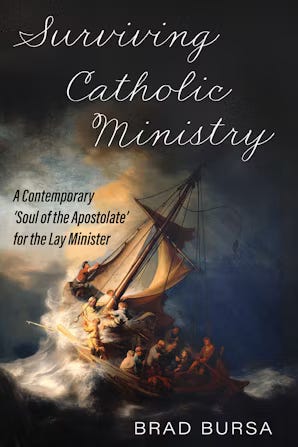
    My new book is out. It’s title: Surviving Catholic Ministry: A Contemporary ‘Soul of the Apostolate’ for the Lay Minister. Ironically, the earliest manuscript of this work emerged during a season of life when it seemed I didn’t survive ministry. I thought I’d share a bit of the backstory, here, for those interested in knowing about the book’s gestation.

    The manuscript’s first title was: The Jaded Catholic Minister. I drafted it, furiously, three years ago. At that time, it was a collection of disparate and disconnected thoughts — my own pensées — after almost fourteen years of full-time ministry. I’m not a quitter, my dad never allowed that growing up, but I had just pulled the plug on Church work. It was taking too great a toll on my family, and I was beyond burnt out. I was jaded. I was hurt. I had “made it” by reaching diocesan employment. There, I tried to take on the bureaucracy. What’s the line? Try to change the institution but the institution changes you. Something like that. It’s true. The red tape and politicking were too much for me. I was too young, too green, and too idealistic to deal with it well. So, I returned more familiar and friendly waters back in parish work. It felt like a demotion, like I had failed, but at least I could breathe again. Well, sort of. I returned during COVID and leaders often found themselves in one rock-or-hard-place situation after another. Some shifts on staff came the next year and suddenly I found myself in a situation where one of my projects after another was sabotaged. Triangulation. Gaslighting. Mockery. I was working three nights a week, plus Sundays, with six kids at home. My oldest three were at the parish school (yes, the parish where I was serving as director of evangelization), and I felt like I was trapped in a web. There was no escaping the parish. All my flailing just got me more tangled and hurt. My anxiety level was through the roof. (Actually, I ended up with shingles. I’m not sure if there’s a real correlation with stress and shingles, but I’ve heard that before.) So, I did what my dad told me not to do, but I did what I had to for the sake of my own sanity and for the good of my family: I quit. It was a “burn the ships” moment. I had no intention of returning.

    I tried my hand at digital marketing — learning all about websites, SEO, SEM, UX/UI design, Google, and the inner workings of those haunting display ads of those shoes you looked at last week that now appear on every other webpage you open. But, I couldn’t escape the specter of ministry. Just a few months into my new career selling marketing strategies and tools, I was already trying to salvage something of the years I spent in ministry through a cathartic writing experience that filled my now free nights and weekends. I was grieving, I think. I was groping for some golden nuggets in what seemed to be a heaping pile of failure. Fourteen years of experience and study (I had slogged through graduate studies during that time) out the window. Was it all a waste?

    I eventually strung together the seemingly random pensées into broad categories and tried publishing it. At the time, I don’t know why I tried to do this. I think I was motivated because my first book had just been published — the rewrite of the rewrite of my dissertation. Yes. It came out a few months after I quit. Talk about awkward. Years of work (seven, I think) published, and I tell just a few people. My inner circle. In any case, my pensées manuscript got shot down hard. I think I went 0 for 5. Without a name, a spot on the national speaking circuit, and a social media presence it’s hard to get a book published these days. Having exhausted my Catholic publishing connections, I thought about scrapping the manuscript altogether.

    But I didn’t.

    During the string of publishing rejections, I decided to return to ministry. I could never shake the feeling that I had left a lowercase “v” vocation just as I was kind of coming “of age.” With a clearer focus and a better set of expectations to preserve my family life, I was back. The year and experience away from ministry gave me a chance to put first things first again, and the manuscript aided in this process. Oddly enough, stepping away from ministry for a short time was a key part of my own survival in it (though, admittedly, it was a more radical step than is ideal).

    Returning to ministry breathed life into my rather dead writing project. Revisiting some of the rejection emails from publishers in my inbox to glean anything I could from the meager feedback, I returned to my piece of writing with renewed vigor and determination. I felt I did have something to say, it just needed to be more organized. Riffing on Dom Chautard’s classic, The Soul of the Apostolate, a book that had gotten me through so much over the years, I ran with an idea Lawain McNeil (over at The Call to Holiness) gave me — to write a kind of updated, more contemporary and accessible version of Chautard’s classic. So, I checked in with Jim Beckman, founder of the ImpactCenter, to see if I could take the “inside-out” schema he once taught me — also based on Chautard’s thought — as a basic structure for the book. He agreed, and I set to work completely rewriting the manuscript about a year after I wrote it the first time.

    With the rewrite came a new title (Surviving Catholic Ministry), a new subtitle (A Contemporary ‘Soul of the Apostolate’ for the Lay Minister) and renewed desire to get it published. In all honesty, the first manuscript was too ranty, too sarcastic. Probably a bit too much wounded pride oozing on the pages. The new manuscript was a genuine attempt to help people in ministry survive many of the challenges and pitfalls I’d experienced over the years — ones that ultimately led me to quit Church work for good (well, I thought it was for good). A few more tries with Catholic publishers produced nothing, so I went back to Wipf & Stock with my work. (As noted above, Wipf & Stock had published my dissertation under their Pickwick imprint in the Spring of 2022.) In the summer of 2024, Robin Parry received the manuscript with enthusiasm and said he would vouch for it before the editorial board. Within a few weeks, Wipf & Stock accepted the manuscript and let me know it would be published as a Cascade book.

    After another year of work on the text, I’m happy to announce the book is available for purchase. As with any book, there are plenty of limitations — more to be said, things that could have been said differently, etc. — but I do think the book offers something of a roadmap for ministry-minded people. Above all, it offers a framework by which one can build a foundation in life and ministry that can weather the storms that inevitably come. It’s a simple framework, too, illustrated by personal stories and insights — and I try to justify it with some solid theological principles and by aligning with the Catholic spiritual tradition. I think I did a fair job with that, though reviewers will have their own opinion.

    That said, I didn’t write it for reviewers. I wrote it for people who are tired of trying to do things on their own and who seem to be getting nowhere (see Jn 15:5). I wrote it for people who want to be more faithful and fruitful in their discipleship. I wrote it to say something to the real experience of many Church ministers — to provide some sort of light in what is often shrouded in hushed darkness. In all, the book aims to prevent ministry burnout, to help someone move from surviving to thriving. I think it can also serve as a pathway of healing for someone who is too far gone for prevention.

    More specifically, I’d say I went through the pain of writing and publishing for four types of people. First, I wrote it for my fellow lay ministers (whether volunteer or paid “professionals”). Lay ministry in the Catholic Church is a strange and interesting thing (maybe I’ll write about that more specifically in the future). I wanted to offer some frank thoughts on it and throw a line of support out there for those who feel like they’re floundering. Second, I wrote it for priests. Now, I know the subtitle doesn’t indicate as much, but I’ve shared ministry with enough priests over the years to know some of their struggles with burnout and jadedness, and I know the framework I present in the book can help them, too. And we desperately need our priests to survive and thrive in their ministry. Third, I wrote it for anyone seeking to do the Lord’s will and pursue holiness. That might sound too broad, but really, the inside-out framework can be applied far beyond ministry. Sure, my examples are rooted in my ministry experience. But the smart and intuitive reader will easily be able to take them as a springboard for considering his or her own life and calling. Finally, I wrote it for myself. As indicated, it was a kind of therapy session for me, part of my own healing from the grind of years of ministry trench work. Time will tell, but it may even end up being part of my own survival story.

  • A Sobering Report from the Ground

    A shorter version of this essay will appear in an upcoming bulletin for the parishioners of Stella Maris Family of Parishes. I think the topic of parish decline, parish renewal, and parish consolidation is interesting, so I thought I’d share a bit on Substack. Of course, it’s impossible to encapsulate this entire topic in a single post (or many posts). It’s a complex reality involving history, legacy, leadership, many lives, and a lot of affect. Still, I believe this humble contribution from the perspective of evangelization has something to add to the conversation.

    I’m not a numbers guy. But numbers are not nothing. And there are three sets of numbers that have been on my mind the last few weeks. These are pieces of the statistical data that are part of the story of the parishes at which I serve as the director of evangelization. When compared to broader studies and anecdotal data, they are representative of the trend lines of many parishes across the region (and country), so publishing this for a broader audience on Substack makes good sense.1

    Steadily Declining Mass Attendance

    Each year, the Archdiocese of Cincinnati conducts the “October count” to determine the average weekend Mass attendance at each church. People debate the value of the count, as a snapshot is, well…just a snapshot. Still, it offers some insight, however limited.

    For my family of four parishes, as a whole back in 2014, we averaged 2,329 people attending Mass. (I’m not sure what percentage of the registered parishioners that represented at the time, as I don’t have access to that data.) By 2019, pre-COVID mind you, that number had dropped to 1,884, before bottoming out in 2020 at 968. In 2021, we rebounded up to 1,285 but have essentially been a flat-line the last few years, coming in at 1,301 in 2024. When you do the math, our Mass attendance has been trending at a 44% decrease over ten years across the four parishes. For more specific numbers:

    • St. Bernadette in 2014 averaged 603 people a weekend and 366 in 2024 (39% decrease).

    • St. Mary in 2014 averaged 327 people a weekend and 165 in 2024 (49% decrease).

    • St. Peter in 2014 averaged 210 people a weekend and 125 in 2024 (40% decrease).

    • St. Thomas More in 2014 averaged 1,189 people a weekend and 645 in 2024 (45% decrease).

    Unfortunately, our path seems to travel roughly the same trend line as the rest of the country. As a priest friend of mine who was serving as the vocations director for my home diocese once said to me: “I’m less concerned about a priest shortage and more concerned there won’t be people in the pews.” Perhaps it’s a people crisis, not a vocations crisis. I would argue that this people crisis is, in fact, the most understated and significant contributor to our need for pastoral planning and consolidation in the first place.

    Steadily Declining Religious Education Numbers

    It was hard to gather data regarding our religious ed/PSR/CCD numbers in recent history, so here’s the best I’ve got (through 2024):

    • In 2013, St. Bernadette had 35 families involved in religious ed. This dropped to 18 families by 2020, and 10 in 2024 (a 71% decrease over 11 years).

    • In 2017, St. Mary had 34 families involved in religious ed. This dropped to 24 families by 2020 and 9 families in 2024 (a 73% decrease over 7 years).

    • In 2012, St. Peter had 65 families involved in religious ed. By 2020, this number had dropped to 14, and 7 families in 2024 (a 89% decrease over 12 years).

    • In 2013, St. Thomas More had 79 families enrolled in PSR. By 2020, the number declined to 42 and 23 families in 2024 (a 70% decrease over 11 years).

    The data is too sketchy and the periods too inconsistent to draw any significant conclusions other than the obvious ones about a negative trend line that began before COVID and never recovered.

    Rapidly Aging Core

    The most alarming piece of data, by far, comes with the Disciple Maker Index that was carried out by the Catholic Leadership Institute across our parishes in 2022. The DMI invites parishioners to complete a lengthy survey to reflect on “where they are on their journey of discipleship,” which then “enables parish leadership to make data-driven decisions to help parishioners grow in their faith.” Naturally, the most engaged parishioners would have been the ones to hear about this (announced at Masses and in the bulletin) and complete it. Of the 485 respondents, roughly 50% were 66 and older, and a whopping 75% were 56 and older. These staggering numbers indicate a rapidly aging core group of parishioners. When combined with the religious education data above, and the decline in weekly Mass attendance, the future begins to look rather grim. It’s a bit like a statistical nosedive heading straight for the bowels of the earth.

    So, what do we do?

    The internal decline coupled with the movement of the broader culture toward a post-Christian society and worldview makes for a formidable situation. What do we do? Well, we either keep our heads buried firmly in the sand and manage the steady decline, or we re-engage and innovate. We either stay in maintenance mode and let the status quo drive us into the grave or we somehow get missional.

    In the face of these circumstances, the 2012 Synod of Bishops document gives a solid directive:

    In facing these challenges, the Church does not give up or retreat into herself; instead, she undertakes a project to revitalize herself. She makes the Person of Jesus Christ and a personal encounter with him central to her thinking, knowing that he will give his Spirit and provide the force to announce and proclaim the Gospel in new ways which can speak to today’s cultures.2

    As far as I can tell, nobody at Stella Maris is exempt from such a call. From the clergy to the staff, and older parishioners to very young ones, all of us are called to encounter Christ anew and allow this conversion to move deep in our hearts, opening them to receive afresh the Holy Spirit. Renewal begins here, in our hearts. This has to be the starting point and any structural or strategic shifts must flow from the renewed encounter with Christ and the pursuit of holiness. Joseph Ratzinger, in The Ratzinger Report (1985), was clear about the need, above all, for saints. He says, “Saints, in fact, reformed the Church in depth, not by working up plans for new structures, but by reforming themselves. What the Church needs in order to respond to the needs of man in every age is holiness, not management.”3 When Ratzinger speaks of saints, as he is here, he’s not referring to canonized people, or even canonizable ones. He’s speaking, like St. Paul, about those who have been encountered by Christ and who are being transformed, and whose lives become like windows — allowing the light of Christ to pass through them and into the lives of others. Saints are reference points.

    All of this, plus some serious inspiration from Dom Chautard’s 1912 classic, The Soul of the Apostolate, stands behind what I call the “shock troop” approach to evangelization that is grounded in friendship.4 This person-first approach is the engine behind all our evangelization efforts — evangelization built on persons and friendship, not programs.

    Renewing Structures

    Ratzinger calls for saints — holiness — over and over again. This is where he puts the focus. It’s his urgent emphasis. We’re not going to strategize our way to success. As he notes:

    After the end of the apostolic age the early Church had as yet developed only relatively little in the way of a direct missionary activity as a Church, that it did not have any particular strategy for proclaiming the faith to the heathen, and that nevertheless this became the age of the greatest missionary success. The conversion of the ancient world to Christianity was not the result of any planned activity on the part of the Church but the fruit of the proof of the faith as it became visible in the life of Christians and of the community of the Church…The Church’s community of life invited people to share in this life in which was revealed the truth from which this kind of life arose. On the other hand the apostasy of the modern age rests on the disappearance of the verification of faith in the life of Christians…The new evangelization we need so urgently today is not to be attained with cleverly thought out ideas, however cunningly these are elaborated: the catastrophic failure of modern catechesis is all too obvious. It is only the interaction of a truth conclusive in itself with its proof in the life of this truth that can enable that particular evidence of the faith to be illuminated that the human heart awaits: it is only through this door that the Holy Spirit enters the world.5

    This said, he also recognizes the Church, in every age, needs structures and vehicles and vocabulary by which the faith can be communicated. Often, these structures ossify and become less effective. The assumptions they were built upon shift. They begin to smack of institution or bureaucracy. Programs become the end and not the means to a greater end. They stand in need of renewal. It’s not necessarily that the programs (or the people who facilitated them) have failed, but that culture changed. What once communicated the Gospel effectively isn’t so effect anymore. The Church — saints — have to accept this new reality and change approaches to successfully address it.

    As I noted in my July 20 bulletin article, we’re already seeing signs of new life around the Family of Parishes in adult formation and in spiritual response to those who are no longer practicing their faith. But we need to continue down the path of renewal, and the way I see it, we have two clear opportunities for structural renewal right in front of our faces. The first comes with the large number of retirees or soon-to-be retirees. In other words, people who have some time on their hands. From what I’ve found over the last two years, many of these people are looking for formation and ways to engage. Additionally, we need to find ways to engage effectively the current generation of younger parents. The Stella Maris Institute is an attempt to form and mobilize such parishioners.

    Next, due to good leadership combined with the EdChoice grant, our two parochial schools are full. The vast majority of school families are disengaged from the broader life of the parish and we’ve had an influx of non-Catholic families in the schools. In other words, our biggest catechetical apostolates are clear mission ground for evangelization. Plus, we have other young families who are committed to public education or homeschooling. To reach whole families with school-age children, and the school-age children themselves, we recently hired a coordinator of family evangelization and a coordinator of youth ministry. We will build on them and the teams they’ll form.

    Of course, many other elements stand in need of renewal. Some of these we know, and others will become clear in the future. Some we can prioritize now, others will have to wait given resource constraints. All told, the consolidation of resources through Beacons of Light opens possibilities that would likely remain elusive for any one of our parishes.

    The Risk of Renewal

    Renewal is risky. Plus, a Family of Parishes on the way to becoming one canonical parish is frontier territory. We’ve never done this before. None of us have. We’re a bit like a start-up, and start-ups are messy business. Still, we have an opportunity to respond to the Holy Spirit and innovate. Will new approaches result in immediate re-engagement with the Catholic faith? Maybe. But probably not. It’s likely going to be a slow burn, a long road. Will every attempt succeed? No. And this isn’t necessarily a bad thing. Why? In Range: Why Generalists Triumph in a Specialized World, David Epstein notes that:

    The more work eminent creators produced, the more duds they churned out, and the higher their chances of supernova success. Thomas Edison held more than a thousand patents, most completely unimportant, and was rejected for many more. His failures were legion, but his successes—the mass-market light bulb, the phonograph, a precursor to the film projector—were earthshaking.6

    Again, trying and failing isn’t necessarily a bad thing. We’ll hit the mark sometimes and miss more. But the worst thing would be not trying at all.

    1 To be sure, these are just three pieces of information within a broad and complex reality. So we can only place so much stock in the story they tell. Still, I think the stats I will present in this essay give credence to what most of us see and feel.
    3 Ratzinger, The Ratzinger Report, 53.
    4 It would be worth a post dedicated solely to the “shock troop” concept in the near future.
    5 Ratzinger, The Yes of Jesus Christ, 34–35.
    6 Epstein, Range, 288.
  • Another one from Dorothy.

    I suppose it is a grace not to be able to have time to take or derive satisfaction in the work we are doing. In what time I have, my impulse is to self-criticism and examination of conscience, and I am constantly humiliated at my own imperfections and at my halting progress. Perhaps I deceive myself here, too, and excuse my lack of recollection. But I do know how small I am and how little I can do and I beg You, Lord, to help me, for I cannot help myself. — Dorothy Day

    As the father of eight children and director of evangelization for four parishes, I can say with Dorothy: I have little to no time to take or derive satisfaction from my work. There is always more to do. So much more. And I will never be able to catch up to the heaping amount of it. In fact, I’m often discouraged by this. Still, perhaps it’s a grace. In what little time I have, my melancholy usually gets the best of me. Self-criticism kicks in. I become increasingly aware of my faults, my selfishness, my limitations. One cannot become humble but by humiliation. My imperfections and stops-and-starts on the journey provide a solid dose of that. Yet perhaps I’m just too busy and I use my busyness as an excuse to not be more recollected or more grateful. I am sorry. Through all of this, I know how small I am and increasingly so. I see how little I can know and do and in light of this, Father, I beg you to help me, for I cannot help myself.

    Dorothy’s quote/prayer reminds me of a similar one from Bl. Sara Salkahazi, a strong-willed journalist (like Dorothy) who became a religious sister and was killed during WWII for housing Jews:

    I am short-tempered, vehement, nervous, and passionate, but I still love you! I am disobedient, stubborn, and defiant, yet I love you! I am restless, hasty, and confused, but I love you! I am dark, envious, and making comparisons, but I love you!

    These women were not scandalized by their sin (or the sins of others, or of the Church). But with tax collector-like humility, they bowed before the Lord fully aware of their humanity a willing to surrender any holier-than-thou, smarter-than-thou, more-active-than-thou, more-synodal-than-thou, more-liturgical-than-thou attitudes. In other words, despite the constant gravitational pull, they remained focused on Jesus, the singular subject who is the object of our faith. They repented and kept moving.

  • Three Lessons from Dorothy Day

    As I put the bow on another year of ministry (about 17 years in all), I’ve been considering all the apparent failures along the way. Programs launched that seemingly failed. People who flaked. Times I overpromised and underdelivered. Ideas that seemed sound before going sideways. Ministry is a divine venture, to be sure, but a human one also. It wears human depravity on its sleeve, because it rubs elbows with it.

    As I’ve considered the ups-and-downs, I’ve been struck by three excerpts from Servant of God Dorothy Day. So here are three sayings for dealing with apparent failure:

    “I feel that I have done nothing well. But I have done what I could.”

    “What we do is very little, but it is like the little boy with a few loaves and fishes. Christ took that little and increased it. He will do the rest. What we do is so little we may seem to be constantly failing. But so did He fail. He met with apparent failure on the Cross. But unless the seed fall into the earth and die, there is no harvest. And why must we see results? Our work is to sow. Another generation will be reaping the harvest.”

    “I should know by this time that just because I feel that everything is useless and going to pieces and badly done and futile, it is not really that way at all. Everything is all right. It is in the hands of God. Let us abandon everything to Divine Providence.”

    The first one touches on effort. Feelings of failure are one thing, especially for a melancholic. But effort is another. Sometimes the outcome isn’t there, even when the effort is. In those cases, the effort is what you can hang your hat on.

    The second has to do, first, with littleness. When you think about what the little boy in the Gospel offered and what we have to offer, it’s a pittance. Fraught with sin and selfishness, even what little we offer, we often offer in a kind of guarded way — or with an eye to what we’re going to get in return. We offer so little and even that meager offering sometimes ends in failure, like the one who fed the 5,000 dying on the Cross. In the paradox of paradoxes, Christ’s apparent failure on the Cross was his triumphant victory over sin and death. With Jesus, things weren’t what they seemed, and perhaps our failures, united to his, aren’t what they seem either.

    I think about this a lot. I used to criticize DREs and youth ministers who had teeny tiny programs and who might have had unattractive personalities. All questions about their giftedness for ministry aside, they tried and they had a genuine desire to help young people and young families. On paper, they failed completely. Yet, despite this, they were there for those people — praying for them and sacrificing for them. Lord knows what role these sacrifices and humiliations, endured on their behalf, will play in their salvation.

    And this pushes into the third and final quote. All of ministry, like everything in life, is in God’s hands. Just because everything seems to be going to pot, it’s not. So long as we abandon ourselves and our efforts to Divine Providence, we can trust that he’s got it and he will bring it to completion in his time and in his way. (Both of which — his time and way — differ from how I’d handle things, but the good Lord hasn’t asked me for my opinion on that yet.)

  • A brief introduction to the Stella Maris Institute

    I thought I would take some time to let my readers in on our latest project at the Family of Parishes. As we respond to the Archdiocese of Cincinnati’s pastoral planning process, we are taking innovative steps to advance the mission of the Catholic Church in our region.

    For most adult Catholics, faith formation stopped at a rather young age. Why? Generally speaking, it stopped because catechesis has long been tied to receiving the Sacraments of Initiation. For most of us, these were completed somewhere in the ballpark of 8th grade. Interestingly, The Literacy Project has determined that the average American reads at about a 7th-8th grade reading level. A similar stat line must run through faith formation. Consequently, many Catholics “graduated” with a junior high understanding of the faith. This obviously doesn’t take into account the actual content of the catechesis, which is another topic of conversation.

    Of course some of us, like me, went to Catholic school all the way through high school. There, in Catholic school, religion was often bracketed off from the other subjects or tacked on as certain devotions or rote prayers uttered quickly so we could get on to lunch, the football game, or what have you. It was not integrated and infused into the entire educational experience.

    The vast majority of Catholics have not experienced the joy of a deep, abiding relationship with Jesus Christ — and ongoing formation in light of it.

    So when you take the formation experiences of most Catholics and combine it with the confusion caused by a post-Christian secular culture, we have a recipe for…the Stella Maris Institute. I am director of evangelization for the Stella Maris Family of Parishes just east of Cincinnati, Ohio, and we are founding a parish-based institute for adult formation this summer.

    Our Reasons

    Over the last few weeks, several people have asked me “why start an institute in the Family of Parishes?” I’ll respond, here, by way of a few points.

    First, we are responding to the Church’s call for adult formation. In his 1979 apostolic exhortation, Catechesi Tradendae, Pope John Paul II said, “I cannot fail to emphasize now one of the most constant concerns of the synod fathers…the central problem of the catechesis of adults. This is the principal form of catechesis, because it is addressed to persons who have the greatest responsibilities and the capacity to live the Christian message in its fully developed form” (§43, emphasis mine). In 1997, the General Directory for Catechesis described adult catechesis as the “chief form of catechesis. All the other forms, which are indeed always necessary, are in some way oriented to it” (§59). And, in 2020, the Directory for Catechesis notes that “accompaniment and growth in faith are necessary so that the adult may mature in…spiritual wisdom” (§259). Adult catechesis should be a primary focus for us, and the Institute, a “house” of adult formation, further concretizes this as a priority.

    The Stella Maris Institute will be a flagship effort in this area. The Stella Maris Institute will help adult parishioners encounter Christ, enter into abiding communion with him, and embrace the lay apostolate through solid catechetical programs. As a “house of formation,” the Institute will offer human, intellectual, spiritual, and apostolic formation for adults. It will organize and galvanize adult formation and spirituality efforts through the following initiatives:

    • Bible Studies

    • Book Studies

    • Talks

    • Courses

    • Workshops

    • Print and Digital Resources

    Second, we are forming adults of full stature in the faith (cf. Eph 4:13). The author of From Christendom to Apostolic Mission notes that our culture’s key battles are intellectual. The moral character of many of them can obscure this fact. The world doesn’t “think Christian” anymore, and none of us are immune to secular ways of thinking and being and acting. The author goes on to say we need to mount an “intellectual counterattack.” By this, he means we need “the sort of intellectual life that was characteristic of the Church in her early centuries, a life possessed to some degree by every Christian. It is not simply or primarily a matter of college degrees but of the conversion of mind to a Christian vision of reality and of readiness to live out the ramifications of that vision.”1 Consequently, the Institute aims to form adults who are not “tossed by waves and swept along by every wind of teaching arising from human trickery” (Eph 4:14) produced by today’s dictatorship of relativism. Interestingly, the etymology of “institute” means: “to cause to stand; to make firm.” This is exactly what we’re aiming to do — to help adults stand more firmly in their Catholic faith. We want to restore a Catholic “imaginative vision” — a Catholic way of viewing all of reality in light of Jesus Christ, the Word made flesh. Catholics don’t just see some things differently because of Christ, they see everything differently in his light.

    Next, I’d say we’re creating an organism, not an organization. The Institute won’t be a kind of stodgy, academic entity. We’re probably not going to give out certificates or anything like that. We’re definitely to steer clear of a bureaucratic quagmire. The Institute will be humble and it will be smart. It will be a place of encounter, or, better, a community of encounter — where people encounter Christ and each other by immersing themselves in the richness of the Catholic intellectual and spiritual tradition. And, in a digital age with no shortage of consumable content available with the click of a button online, we are going to prioritize incarnate, in person offerings — because community matters. Here, let me share with you our core values that make the Institute what it is:

    1. Christocentric — at the heart of catechesis we find the person of Jesus Christ. Therefore, all of our endeavors should not presuppose the Gospel, but propose it and an encounter with Jesus Christ.

    2. Faithful — the Institute is, at the bottom of it, a catechetical endeavor that seeks to faithfully communicate the teaching of the Church. We want to be simply Catholic.

    3. Personal — meaning relational. We aren’t just about teaching the masses, but about forming relationships with those who engage in the Institute. Additionally, we don’t want things to remain at the level of abstraction, but we teach through personal experience that shows how the faith really does “touch down” into daily life.

    4. Real — in an increasingly artificial world, we are trying to come into contact with what is really real, with the truth. This requires humility and docility to the Holy Spirit, as it inevitably means conversion.

    Finally, we are starting the Institute to cultivate growth in holiness. It exists to foster sainthood. Over the weekend, I was reading The Long Loneliness by Dorothy Day. She made the point that for many in the Catholic Worker movement, “the holy man was the whole man, the man of integrity, who not only tried to change the world, but to live in it as it was.”2 This strikes me as right and it aligns with the hope behind the Institute. We aim to grow as men and women of integrity who can make a gift of ourselves for the sake of the world. And in making this gift, we’re not going to flee from our brothers and sisters within our post-Christian culture. Instead, we are going to engage the culture as it is — “to build a new culture in the shell of the old,” “a society in which it is easier for people to be good.” We are hoping for an experience of what I’m going to call whole Catholicism in an increasingly fragmented world.

    Putting Adults in Communion with Christ

    The Institute exists to put adults into deeper communion with Jesus Christ. It exists in response to the Church’s call for adult formation, that adults might come to full stature in Christ, within a living community that encourages growth in holiness. It will be a critical piece of our evangelization efforts moving forward — the formational companion to The Surrender Initiative, which is our spiritual core. From here, we hope to see increased growth in the lay apostolate throughout southern Clermont County.

    1 From Christendom to Apostolic Mission (Bismarck, ND: University of Mary Press, 2020), 4.
    2 Dorothy Day, The Long Loneliness (New York: HarperSanFrancisco: 1997), 191.