Some Principles from Luigi Giussani on Authentic Education
In his 1973 TV short “There’s No Time for Love, Charlie Brown,” Charles Schultz issued one of my favorite critiques of contemporary, utilitarian education:
Linus: What’s wrong, Charlie Brown?
Charlie Brown: I just got terrible news. The teacher says we’re going on a field trip to an art museum; and I have to get an A on my report or I’ll fail the whole course. Why do we have to have all this pressure about grades, Linus?
Linus: Well, I think that the purpose of going to school is to get good grades so then you can go on to high school; and the purpose is to study hard so you can get good grades so you can go to college; and the purpose of going to college is so you can get good grades so you can go on to graduate school; and the purpose of that is to work hard and get good grades so we can get a job and be successful so that we can get married and have kids so we can send them to grammar school to get good grades so they can go to high school to get good grades so they can go to college and work hard…
Charlie Brown: Good grief!”
Education ought to be much more than the kind of utilitarian transactionalism we see today. What is education after all?
Clearly this is too big a topic to tackle here, but I can at least offer a few thoughts. To keep it manageable, I will take some cues from Luigi Giussani and his book, The Risk of Education.
Speaking of the nature of education, Giussani says, “the introduction into reality: this is what education is .”1 Education involves one helping another enter into the totality of what is real. What is is what is real, and what is real is what is truth. So, education deals with truth, the truth that sets us free (Jn 8:32).
Viewed this way, education must conform to reality outside of us, and it must also correspond to the truth of our humanity. “It is education of what is human, of the original element present in all of us,” and, therefore, “the primary concern of a true and sufficient education is that of educating the human heart as God made it.”2 Education is about accordance — being in harmony or conformity with what is really real, what is true, being of one heart with it, being heart-to-heart with the truth.
I find Giussani’s statement striking when I consider my own children. In light of my children, his line takes on exceptional tenderness. My children are my “image and likeness” and they are God’s “image and likeness.” There is something of me inside of them and there is, what we might call, a divine spark inside of them. Education, then, is about helping my children grow and mature, it’s about helping that spark to come alive inside of them. We must acknowledge this point, or else we fall into the temptation of thinking education is about stuffing a child with factoids and reducing it to utilitarian success metrics (i.e., “giving them what they need to succeed in this life” (see above)). When we view education as stuffing, it becomes transactional and utilitarian. But, if a child already has the spark within them, if a child is already logos-like because he or she is made in the image and after the likeness of the Logos himself, then education is about awaking something already in them. It’s about giving them what they need to come alive — to come into contact with themselves, with the world around them, and, ultimately, with the God who made all of it.
Giussani goes on to make three critical points about educating the human heart as God made it. These elements help introduce the student to the real:3
The past must be adequately proposed. Education roots a child in reality through the concreteness and clarity of a tradition. Without a sense of tradition, without that “given” working hypothesis, “young people grow convoluted or skeptical.” Giussani says that if young people are not given a tradition, they will make one for themselves — and this will always be shortsighted. Education largely exists to give the next generation an adequate sense of tradition. Giussani runs counter to postmodern thinking on this point. Postmodernity dismisses tradition more aggressively than modern thinking did before it. It is a detraditionalized way of thinking. Yet, without tradition, we become unhinged from reality and disconnected from truth. We become like untethered astronauts. As Joseph Ratzinger puts it, “whoever destroys tradition destroys man—he is like a traveler in space who destroys the possibility of ground control, of contact with earth.”4 Without tradition, we invite isolation and nihilism. Tradition, then, keeps us anchored, or, as Giussani puts it, “’suspended’ from the mystery that is the truth in the world.”5 To teach a tradition, one must immerse him or herself in it. The teacher must immerse him or herself in a tradition to hand it on effectively as a witness of it. Therefore…
The past, the tradition, must be proposed “within a present, lived experience” that shows the correspondence between the tradition and the needs of the heart. This is to say, the tradition must correspond to the heart “within a present experience that offers reasons accounting for itself.” The tradition has to be a living reality in the today of our lives. Said another way, what the teacher is teaching must correspond to how the teacher is living. What the teacher is teaching must correspond to what the teacher is cultivating. The tradition he is handing on should be alive and impacting the immediate culture of the school or what have you. Education is not an exercise of pure abstraction, but something borne out in real life. It must have a concreteness to it.
“True education must be education to criticism,” Giussani says. This is the “risk” of education Giussani talks about. It must face the risk of the freedom of the person, who ought to critically evaluate what he or she has been given as a “problem.” The pupil who has been receiving and receiving must, at a certain point, account for what he or she has been given. Criticism means taking stock of things. It means personally comparing that which I have been given (tradition) to the desires of the heart, wherein the ultimate criterion for judgment lies. “And the ultimate criterion,” Giussani says, “which is each one of us, is identical: it is the need for what is true, beautiful, and good.” For parents and teachers, this step can be unnerving. We must allow for the freedom of the child — and trust that they will hold fast to what they have been given.
Giussani concludes this section with a powerful statement that summarizes everything:
Tradition, present experience which proposes and provides reasons, and criticism: if any one of these elements is missing…young people become frail leaves, far removed from their branch…They become victims of the prevailing winds and their changeability — victims of a general public opinion created by the current power.6
In parish ministry, in schools, in the home, in the workplace, wherever, we have to be about an authentic education that helps people become more human by engaging tradition to enter into the totality of the real. In this way, we can stay above the transactional and utilitarian muck and mire so much of contemporary education has become.
1 Luigi Giussani, The Risk of Education, trans. Mariangela Sullivan (London: McGill-Queen’s University Press, 2019), 25.
I needed to fact-check a couple of points in my Ignatian Examen handout. Rather than head down to my office to get my tattered and taped Louis J. Puhl, S.J. 1951 edition of The Spiritual Exercises of St. Ignatius, I thought I could do a quick Google search and find what I needed. I was wrong.
Instead, I found a few websites featuring modernized versions of The Examen with no mention of sin. This isn’t shocking, given that talk of personal sin has fallen out of favor in plenty of circles, supplanted by social sins and whatnot.1 When you reimagine The Examen to get sin out of its scope and you end up with this vague “modern” take:
Become aware of God’s presence.
Review the day with gratitude.
Pay attention to your emotions.
Choose one feature of the day and pray from it.
Look toward tomorrow.
To departure from Ignatius’ own words and appease modern sensibilities, the website claims: “In the Spiritual Exercises, St. Ignatius suggests five parts to this prayer. But there are many versions adapted for different circumstances and experiences. There is no set form or ‘correct’ way to pray the Examen, only guidelines for you as you review your day with God.” This “new” version is still a review of the day and that’s about the only point of contact with the original. This is interesting. The problem of sin and Ignatius himself have been canceled from this vapid version.
Dissatisfied with my Internet search, I pulled my copy of the Exercises from my bookcase. The Examen appears within Week One of the Exercises, which, in Ignatius’ words, “is devoted to the consideration and contemplation of sin.”2 Not surprisingly, then, Ignatius’ version of The Examen deals explicitly with sin. And, it doesn’t read much like a set of “guidelines” with “no set form.” It’s about as set a form as you can get. Here it is:
Method of Making the General Examination of Conscience3
There are five points in this method
The first point is to give thanks to God our Lord for the favors received.
The second point is to ask for the grace to know my sins and to rid myself of them.
The third point is to demand an account of my soul from the time of rising up to the present examination. I should go over hour after another, one period after another. The thoughts should be examined first, then the words, and finally, the deeds.
The fourth point will be to ask pardon of God our Lord for my faults.
The fifth point will be to resolve to amend with the grace of God. Close with an Our Father.
Points 2 and 4 speak directly of sin. Point 3 demands an account, hour by hour, of sins in thought, word, and deed. And point 5 implies sin when it speaks of needing to amend your life with God’s help. In other words, The Examen exists to help the you confront your personal sin and to root it out of your life, and it does so in a rather prescriptive way. This makes sense given that Ignatius was a straightforward military man.
In the end, it’s helpful to compare these versions side-by-side. Things become clear. In this case, some are trying to correlate The Examen with a culture that doesn’t believe in sin. When you capitulate to the culture, when you pick-and-choose from the tradition based upon the inclusion ethos or whatever, you risk departing from meaning of the original altogether. The Exam is stripped it of its power to open one to repentance and transformation through God’s grace when you soften its intentionally sharp edges. I would argue that Ignatius’ original Examen still works—because sin still hasn’t gone out of style in the 500+ years since he drafted it.
1 The University of Mary’s The Religion of the Day takes this up, noting the location of the “source of the world’s evil” is “not in the individual human heart, but in fundamentally corrupted and therefore oppressive structures of human existence.” See The Religion of the Day (Bismarck, ND: University of Mary Press, 2023), 19.
2 Ignatius of Loyola, The Spiritual Exercises of St. Ignatius, trans. Louis J. Puhl, S.J. (Chicago: Loyola University Press, 1951), §4.
3 Ignatius of Loyola, The Spiritual Exercises of St. Ignatius, §43.
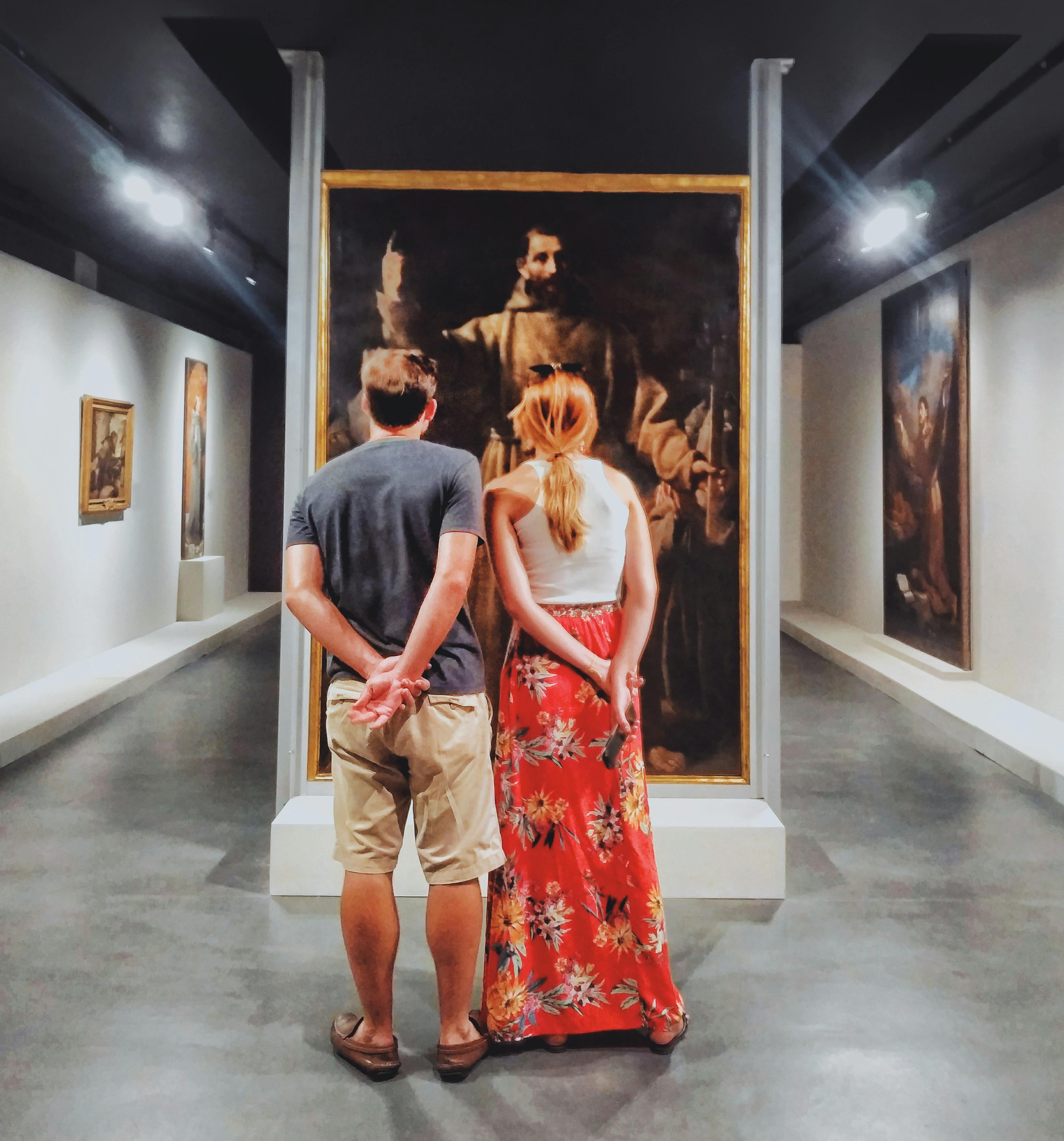
Picture this. You’re viewing a painting in an art gallery and you notice all sorts of things about the painting. Color. Form. Lines. Curves. You see brush strokes. You see the whole picture, a landscape for example, and you see minute details.
After a time, you notice the painting makes you feel things, too. You might feel open and at peace, or, something else altogether depending on the painting. Memories and desires emerge. When this happens, we’ll call it a second level of viewing—an interior level—you realize that you’re not simply engaging with a medium of art (i.e., the painting) in a transactional or aesthetic way, but you are engaging with a person, with the painter himself. You are engaging with an artist and his qualities and his story and his perspective. You are engaging not with something, but with someone.
Now, imagine that you’re standing there, taking in the painting, and someone stands next to you and begins pointing out elements of the painting you could have never perceived on your own. He begins explaining the meaning behind particular features of the painting, why the painting approaches the subject a given way and why it makes you feel a certain way. Naturally, you would ask how this person knows so much—not only about the painting, but about you, the viewer. Let’s imagine the person you’re talking to, this person who reveals more about the painting than you could ever have known on your own—and even more about yourself in relation to the painting—let’s imagine that person is the painter himself. The one who painted the image, with his artistic genius and ability to cut through reality and perceive its essence in such a way, he painted this image with you, his viewer, in mind. And you know this because he told you so.
This experience would radically change your understanding of the painting. Sure, it would deepen it. But, more importantly, perhaps, your relationship with the painting would change by degrees of magnitude. It’s one thing to encounter a painting. It’s another thing to encounter the painter and speak with him about his painting. It’s one thing to stand in front of a painting. It’s another thing to be in relationship with the painter himself.
Natural Revelation
These imaginings can serve as a kind of analogue for how the Church understands God’s revelation. With regard to God’s ways of revealing himself to us, we can say there is natural revelation and then, supernatural revelation. Both are ways of coming to know God, because he has provided us with these ways of coming to know him. Let’s consider each in turn.
Natural revelation has to do with perceiving the hand of the Creator in the world around us. This is like viewing a painting and trying to take in all its magnificence. The order we see in the world (and universe) outside ourselves is simply magnificent. The movement of the universe from a definitive point in time (literally when time began), the order written into the whole of the design, the inherent relationality that holds all of creation together, the sense of purpose and meaning behind even the smallest of details. An excerpt from a self-published book by an anonymous Orthodox priest captures this beautifully:
The cosmos is an icon, a picture. The man who looks upon this vast and beautiful creation sees a representation of God. But a good icon does more than merely represent: it in some way makes present the person who is depicted. And so the cosmos actually makes God present to us: it is transparent, so to speak, and God shines through…The cosmos is a sacrament, a visible, eternal sign (i.e., outside of and beyond ourselves) that God has made and given to us, by which He makes Himself powerfully present to us.
Science will never mine the mystery of the created order, nor can it explain why any of this is here to begin with. But faith can and does.
But not only that, if we can perceive the hand of God in the created order, we can also perceive God within us. We could liken this to how the painting elicited certain feelings and desires and brought about a deeper self-awareness. When I consider my own created being, I can perceive within myself an openness to beauty, a desire for moral goodness, the potency of freedom, the voice of my conscience, and a longing for infinite happiness that nothing in the world seems to satisfy. Through this self-awareness, I come to realize that the origin and destiny of my spiritual soul is God. It’s like the Maker of my very being gave me an internal homing device that will not quit, will not achieve its end, until it brings me to rest in God.
So, there you have it. Natural revelation is like looking at a painting outside of ourselves, while considering how the painting moves us internally, all the while coming to realize there is a painter behind this entire experience. God’s natural revelation in the created order (which includes us, human beings, his creatures) provides human beings with converging and convincing arguments for his existence. Natural revelation provides reasons, it shows us that it’s reasonable to hold to the existence of God.
Divine Revelation
You can see here how the Church exalts the gift of our intellect. The human mind is capable of perceiving God’s activity in the created order, his natural revelation, thus building up a reasonable case for the existence of God through intuition and logic. But, the Church also acknowledges that the human intellect is limited in its ability to perceive God. We are often distracted, we do not understand things, our senses fail us, our feelings can obscure reality, and sin darkens our intellect. We cannot fully fathom God. If we could, then he would not be God. So our knowledge of God is limited and our ability to speak about God equally so.
Natural revelation can take us pretty far, but we stand in need of help from God himself if we are going to have any real relationship with him. Knowing God exists is one thing. Being in an intimate relationship with him, a relationship we long for with all our heart, is another. And this requires a different order of revelation. We call this supernatural or divine revelation. Divine revelation refers to another order of knowledge, which we cannot possibly arrive at by our own powers. Divine revelation is an utterly free decision on the part of God to disclose parts of his own divine life to us that we otherwise would not know. You couldn’t look at the world around you or the world inside of you and intuit that God is a Trinity of persons, for example.
Go back to our painting analogy from the beginning. In that daydream, the painter himself revealed truths about his painting, you, and himself by speaking directly to you about these things. These are elements of knowledge you would not have accessed and would never have accessed if it weren’t for that encounter and the relationship the painter formed with you—if it weren’t for the gift of the painter’s revelation. Obviously the analogy is limited, but it does help us to get at how divine revelation works. Divine revelation is like having access to the Painter and what the Painter wants to say. Divine revelation is all about God’s words and deeds in time and space—what he did in the course of human history that only he could do, and what he said that only he could say—such that we have access to truths that far exceed our natural capacities, yet ones that expand our natural capacities.
There is only one source of Divine Revelation and that is God himself. That which God has revealed about himself is a sacred treasure, the contents of which go by the name “deposit of faith.” His revelation, this one, singular revelation, reaches us—even today—in a way that’s alive. God’s revelation cuts through time and space, it runs through the course of time via three streams, so to speak: Sacred Tradition, Sacred Scripture, and the Magisterium of the Church. God’s one revelation reaches us through Tradition and Scripture, distinct modes of transmission that have been entrusted to the teaching authority of the Church—the Magisterium.
Receiving God’s divine revelation goes by the name of faith. When we exercise faith, we believe in someone that what they are revealing is true. Think about the painter analogy—you came to trust the individual next to you such that when he revealed that he was indeed the painter, you believed him without a doubt. Faith is trust in God, the firm belief that what he reveals is true.
A Series of Alien Communications
I’d like to close with a story that might put divine revelation in perspective.1 In 1972 and 1973, NASA launched the Pioneer 10 and Pioneer 11 space probes respectively. These probes had the velocity to exit our own solar system and head far out into the universe. We’ve since lost contact with these probes. Before their launch, NASA, with the help of Carl Sagan, installed what have now been called Pioneer Plaques on both of the probes. These gold-anodized aluminum plaques contained a pictorial message about the origin of the spacecraft and some symbols of life found on earth. The thinking was that if the space probe happened to bump into intelligent life somewhere in a neighboring galaxy, the intelligent life would have key information about us and a means to navigate to us.
Now, this is interesting. On one hand, it sounds like a great idea. On the other hand, do we want that intelligent life to find us? Might have been a terrible idea. I’ve seen too many alien movies, perhaps. But, as I heard this story, I was more thinking that it would have to be practically impossible for that tiny space probe to actually happen upon intelligent life as it floated aimlessly out into the expansive universe. The odds would have to be essentially zero. And, even if it did happen to bump into intelligent life, there would be no saying the rudimentary pictures would be intelligible, or that our life forms would be compatible enough that a message would even be communicable.
Just think about this. It would be totally crazy, complete chance, for the Pioneer Plaque to actually communicate with intelligent life somewhere in the known universe. But if it did, it would all still happen within the universe itself—whether it was intragalactic or intergalactic—a message from one set of intelligent beings to another within the universe.
Okay, all of this may sound like science fiction, but, in fact, something like this has already happened.
We have received a series of communications not merely from outside our solar system, but from outside our galaxy. And not even from outside our galaxy but from outside the cosmos. These communications began arriving a few thousand years ago and not from an alien civilization but from a source that cannot be mapped on any grid of being. The source is entirely Other, completely alien. I am speaking of the Trinitiarian God who created the world and everything in it. This God is completely transcendent is outside time, outside the created universe, and outside the human mind’s ability to completely comprehend it. Well, almost. Being created in God’s image and likeness, the human mind is logos-like, and thus capable of receiving the seemingly alien communications from the Word (Logos) and understanding them.
When we stop and think about how far out divine revelation is, we might just have a better appreciation of God’s concern and care for those of us who inhabit this pale blue dot known as the planet earth.
A lesson from lectio on the importance of silencing the tongue.
She crinkled her brow. Disapproval.
We were sharing reflections while praying lectio divina as a small group of adults at the parish. We were praying with Matthew 11:28–30.
“Come to me, all you who labor and are burdened, and I will give you rest. Take my yoke upon you and learn from me, for I am meek and humble of heart; and you will find rest for yourselves. For my yoke is easy, and my burden light.”
“I have a question I’m wrestling with,” she said. “How can his yoke be easy and his burden light if his yoke and burden is the Cross? The Cross does not seem easy or light.”
Though she was not addressing her question to me, like an idiot, I, the fearless leader, felt the need to insert my voice in response. I blabbered for a bit. A few sentences in, I could tell it wasn’t connecting with her. Her face told me as much. I hurried to finish what I was saying and we entered into a brief time of contemplation, the fourth step of lectio.
After a closing prayer, I was about to move the group into the next part of our meeting when she raised her hand, stopping me, and said, “The Lord gave me my answer.”
“Well, what is it?” I asked.
“I can be at peace with the Cross because he is at peace with it. If he is at peace, I can be at peace. That’s what makes it easy and light.”
A pregnant silence filled the room. God had spoken in a way only God can speak, and he had spoken in contemplative silence.
This experience, one that happened just a few weeks ago, is a good reminder that:
Lectio is legit. Prayer is legit. And God really does speak to us. There’s no way this woman manufactured that answer on her own, nor was it premeditated. That one only had once source.
So often, we speak and extend our voices into space that’s not ours. We talk to much. I talk too much. I talked too much that day because I felt obligated to provide an answer. The ladder of humility reminds us of the importance of speaking less and using as few words as possible when we do need to speak.
God needs to have the floor. We need to let God speak. We need to give him the first word, because only giving him the first word corresponds to reality (see Jn 1:1–18).
Fr. Clement listened to me complain about all the families currently registered at the parish who were neither enrolled in the school, nor in any of our formation programs. I wasn’t done. I went on to express my concern about all the other families within the parish boundaries for which we had pastoral responsibility — including all the non-Catholics living nearby.
He listened.
Then, he said, “Jesus asks us to take care of the poor, not to end poverty. Nowhere in Scripture does Jesus say, ‘End poverty.’ Our job is to take care of the poor who come to us hungry.”
He was right.
Yes, a pastor, his collaborators, and parishioners bear a heavy pastoral responsibility. Yes, a parish is a geographical area, a region within which the pastor “is obliged to make provision so that the word of God is proclaimed in its entirety to those living in the parish . . . He is to make every effort, even with the collaboration of the Christian faithful, so that the message of the Gospel comes also to those who have ceased the practice of their religion or do not profess the truth faith” (Can 528 §1). But, we can’t get all humanistic about this, as if by our own devices we will solve the problem of non-engagement and non-belief down to its taproot. Our job isn’t to overpower non-belief and thereby end it wholesale. No. Our task is to announce the Gospel to those the Holy Spirit has prepared to hear it, those with a spiritual hunger — and to entrust all the rest to the God who alone can end poverty.
A Meditation on the Mission of Stella Maris Family of Parishes
I am director of evangelization for Stella Maris Family of Parishes in the Archdiocese of Cincinnati. At present, the Archdiocese is in the middle of what is called the Beacons of Light pastoral planning process. Beacons is a response to the declining number of Catholics across the Archdiocese over the last several decades. Beacons invites us to ask how to best arrange resources in the Archdiocese, to evangelize and to make disciples right now, and for years to come. Consequently, Beacons is all about growth.
Confronting what Beacons challenges us to confront…
Beacons challenges us to ask a hard question, namely: are our parishes optimally set up to evangelize and make disciples today? This tough question brings up another one, one that strikes at the very root: What is a parish in the first place? What is the purpose of a parish?
It’s worth reflecting on the word “parish.” The origins of the word are Greek. Here’s how it breaks down: para means “near” and oikos means “house.” So, a parish literally has to do with houses that are near one another—a neighborhood. In Latin, the word refers to “sojourners.” Here, we add in this element of those who are on a journey. The result is rather beautiful. A parish refers to pilgrims who are sojourning near each other on a common (though unique to each person) journey to a heavenly homeland.
We can take this further by reflecting on Canon Law. According to Canon Law, a parish “is to be territorial” (Can 515 §1); it is “a certain community of the Christian faithful stably constituted in a particular church, whose pastoral care is entrusted to a pastor” (Can 518). A parish is a geographical area, a region within which the pastor “is obliged to make provision so that the word of God is proclaimed in its entirety to those living in the parish . . . He is to make every effort, even with the collaboration of the Christian faithful, so that the message of the Gospel comes also to those who have ceased the practice of their religion or do not profess the truth faith” (Can 528 §1). It is incumbent on the pastor, with the collaboration of the lay faithful, that the Gospel be proclaimed within the parish.
When it comes to the why of a parish, then, things are fairly straightforward: the parish exists for Catholic parishioners and for all who live within its boundaries, that they might know the love of God in Jesus Christ and respond to it. Thus, the Great Commission provides the impetus for every parish and contextualizes the mission of each:
In Matthew’s Gospel, Jesus commissions his followers to “Go . . . and make disciples of all nations, baptizing them in the name of the Father, and of the Son, and of the Holy Spirit, teaching them to observe all that I have commanded you” (Mt 28:19-20).
In Mark’s Gospel, Jesus says, “Go into the whole world and proclaim the gospel to every creature” (Mk 16:15).
Acts of the Apostles contains a similar message: “You will receive power when the Holy Spirit comes upon you, and you will be my witnesses in Jerusalem, throughout Judea and Samaria, and to the ends of the earth” (Acts 1:6).
We might say each parish is a little part of “the whole world.” It is a certain pastor’s (and his people’s) “ends of the earth.” A corner of the vineyard. Each parish carries out its own “little commission” that helps make up the whole Great one Jesus talks about before the Ascension.
To summarize, a parish is a geographical region. Stella Maris consists of four such regions. When you combine the four parishes that comprise Stella Maris, our larger geographical region spans the southern third of Clermont County. This beautiful chunk of Clermont County our little piece of God’s commission, this is our mission territory.
Far from being superfluous rambling, this backdrop to Beacons, parishes, and the Great Commission matters. It matters because no parish or Family of Parishes really makes up its own vision statement or mission statement or what have you. These kinds of business branding and marketing strategies don’t apply here. Instead, the vision and mission been given a priori, so to speak, and they have been given in the form of the Great Commission. We can say each parish has a “little commission,” and it is one that must align with the Great Commission Jesus articulates. At the end of the day, all of this is really Jesus’ mission. We can only join in, participate in, what he is already doing. Instead of talking about vision statements and mission statements, and getting caught up in the analysis paralysis of committee work, using the word “commission” puts things in a more theologically accurate manner. It puts us in the “co-” role (as in “with”) and keeps us out of the “maker” space. It humbly situates us as those who respond and participate in a theandric manner, as Pope Benedict XVI describes: “God, who is always the beginning, also wants to involve our activity, so that the activities are theandric, so to speak, made by God, but with our involvement and implying our being, all our activity.”1
Articulating Our (Little) Commission at Stella Maris
All this said, fresh articulations of a parish’s (or Family of Parishes’) “little” commission can be helpful. Recently, we have articulated ours as follows:
Stella Maris exists to reclaim southern Clermont County for Christ through the unique missions of St. Bernadette, St. Mary, St. Peter, and St. Thomas More. Our objective is simple: encounter Jesus and help others do the same through beautiful liturgies, friendship, and education.
Nothing in here contradicts the Great Commission and all of it provides direction and focus for our circumstances amid Beacons of Light. In the space that follows, I would like to briefly explain the parts of what I’m calling our (little) commission.
A Reclamation Project
Our (little) commission states that we are setting out “To reclaim southern Clermont county for Christ.” One gets the sense that we’re on the frontier, or on the battle front. Either way, we’re taking ground and not retreating (cf. Mt 16:18–19). There’s something alive about this line. In truth, Beacons is a kind of frontier. Nobody in Cincinnati has done this before, or at least not to this degree and at this scale. It’s new for all of us. It’s also a frontier because the culture has changed. We no longer live in a Christendom era, wherein the culture and its structures are foundationally and functionally Christian, and wherein the Church is a key player in shaping society. Today, the Church has been pushed to the outer fringes of society, becoming less and less relevant when it comes to shaping the broader culture.
When situated within a broader Christendom culture, the parish can rely upon strong Catholic subcultures within society and within the home, and embrace a kind of maintenance mentality. However, we are no longer living in a Christendom situation. A maintenance mode is no longer effective. Our times demand an apostolic approach. Risking the ecclesial cliché, we need to move from a maintenance mindset to a missional one. The first line of our (little) commission captures this movement and positions Stella Maris in missional terms. We are moving. We are taking ground. We are growing again — after some time of decline. We are reclaiming a land and a people for Christ. Again, the word “reclaim” acknowledges our cultural reality and the shift away from a Christian culture into one that is post-Christian and even anti-Christian. This is the cultural “space” in which we are called to bring the light of Christ today and southern Clermont County is the geographical space.
Missionary Outposts
Based upon what I’ve said thus far, reframing the whole conversation in light of mission, one sees a mission field and every mission field needs missionary outposts. As God’s providence would have it, the four churches that make up Stella Maris (i.e., St. Bernadette, St. Mary, St. Peter, and St. Thomas More) are already strategically located throughout southern Clermont County. Each location and each community already has strengths that can be offered to the whole Family of Parishes and this reclamation project. Each location, functioning as a missionary outpost, offers a point of concrete encounter with Christ. It serves as a physical site of encounter — a place of renewal for our parishioners and a terminal of our mission into the community for the outsider.
Viewing our four church campuses in this manner helps us to keep the broader picture in mind. Southern Clermont County is our mission territory. Each campus is a kind of missionary outpost, strategically located in the region. To pursue our (little) commission, we need thriving and active outposts. The health of the whole depends upon the health of its parts. So, it will behoove us to ensure that all four campuses are healthy and whole.
A Mission of Encounter and Discipleship
Pope Benedict XVI famously said: “Being Christian is not the result of an ethical choice or a lofty idea, but the encounter with an event, a person, which gives life a new horizon and a decisive direction.”2 And prior to his election to the papacy, he explained that “to encounter Christ means to follow him. This encounter is a road, a journey.”3 Encounter is not a momentary thing, but a life-changing event (or, better, a series of events), that shapes the whole of life.
We become Christians not through our own efforts or ideas, but through the prior effort and initiative of the God who encountered us most profoundly by taking flesh so as to lift us up — to make us human again so as to, in his time and way, to make us divine. So, encounter is what Stella Maris is all about. Our fundamental mission, if you could boil it all the way down, is this: to encounter Jesus and help others do the same.
Note that this mission is twofold: there’s an inward and outward focus. First, for those who are already parishioners, those who are on staff, those who form the core of our parishes, our fundamental mission (before anything else), is to encounter Jesus. Yes. We need to encounter Jesus and keep encountering him. In other words, the reclamation project begins here, with us — with our staff members and parishioners. We need Jesus to reclaim our hearts, to reclaim those parts of our lives when we hide from him, those plans we keep to ourselves. We need him to reclaim our vocations for his purpose and reclaim our professional work as well. We need to live from the encounter with Christ and identify with it. The encounter with Christ needs to become the substance of our being before and during any attempts to help others encounter him. The first “turf” that needs to be reclaimed by Christ in southern Clermont County is that of our own hearts.
This echoes Mark 3:13-19 (cf. Luke 6:12-16), where the evangelist recounts Jesus’ calling of the Apostles. Mark introduces this account by noting that Jesus “went up the mountain.” Throughout scripture, mountains often indicate closeness with God. Luke is more explicit in this regard, saying that Jesus went to the mountain to pray and spent the whole night in prayer (Luke 6:12). Only after Jesus prays does he call the apostles, those whom he wants. We do not make ourselves disciples by our own power. God initiates. Discipleship is borne from the prayer of the Son—from his dialogue with the Father. The Father desires our discipleship. It originates not in our own willing, but in God’s willing. But look at what happens next. The Twelve are tasked with a dual responsibility: being with him and being sent by him to preach with authority (cf. Mark 3:13-15). Note the order, here. The disciple’s first mission is to be with Jesus. Before being sent by him, they have to be with Jesus and learn how to remain with him even when they are sent by him. The same is true for us. The encounter with Christ and living life in Christ is always the fundamental mission, for without him we can do nothing (cf. Jn 15:5).
Helping Others Encounter Christ
To be sure, encountering Christ can happen through various means. At Stella Maris, we are prioritizing three such means as what we’re calling privileged or strategic “areas of encounter.”4 These areas will function as strategic anchors as we direct resources to carry out our commission. I will explain the three areas of encounter here, albeit briefly, knowing that far more could be said about each.
Beautiful Liturgies
Liturgy, particularly the celebration of the Eucharist, is the source and summit of the Church’s life and mission.5 The Eucharistic encounter is a privileged encounter, and one we have been seeking to revive across Stella Maris.
To say we’re all about beautiful liturgies is to say we’re all about manifesting the beauty of Christ, for, in the liturgy, we encounter Beauty itself. Jesus makes the liturgy beautiful. We can never tire of saying this: it is Jesus who makes the liturgy beautiful, who makes the liturgy what it is. Pope Benedict XVI reflects on this fact in Sacramentum Caritatis:
Beauty reaches definitive fulfillment in God’s revelation in Jesus Christ: Christ is the full manifestation of the glory of God. In the glorification of the Son, the Father’s glory shines forth and is communicated (cf. Jn 1:14; 8:54; 12:28; 17:1). Yet this beauty is not simply a harmony of proportion and form; “the fairest of the sons of men” (Ps 45[44]:3) is also, mysteriously, the one “who had no form or comeliness that we should look at him, and no beauty that we should desire him” (Is 53:2). Jesus Christ shows us how the truth of love can transform even the dark mystery of death into the radiant light of the resurrection. Here the splendor of God’s glory surpasses all worldly beauty. The truest beauty is the love of God, who definitively revealed himself to us in the paschal mystery.6
And Jesus invites us to participate in reflecting the liturgy’s innate splendor in our reverence, sacred music, liturgical ministries, ushering, greeting, church décor, and so forth. “Beauty…is not mere decoration,” Pope Benedict says, “But rather an essential element of the liturgical action, since it is an attribute of God himself and his revelation. These considerations should make us realize the care which is needed, if the liturgical action is to reflect its innate splendor.”7 These considerations invite all of us into deeper liturgical catechesis and beckon us to enter more deeply into the liturgy.
When it comes to entering more deeply into the liturgy, we intend to make Lectio Divina a regular practice within the Family of Parishes. This divine or holy reading gives God the first word in our day, in our meetings, or what have you. And, when we pray Lectio Divina with the daily Mass readings, we believe the Holy Spirit will guide us in all truth and deeper into the mysteries celebrated in Holy Mass (cf. Jn 16:13).
Friendship
This is kind of a code-word for “evangelization.” We’re all about “friendship evangelization.” So we opted for the word “friendship,” as opposed to evangelization, for three reasons:
Culturally, both inside and outside of the Church, friendship is more disarming and, perhaps, a bit more intriguing.
It names the objective of evangelization, which is friendship with Christ — an encounter with Christ that leads to deep and abiding communion. We seek lead people into friendship with Jesus Christ, and to grow in that friendship ourselves, through the Sacraments, the interior life of prayer, and familiarity with the word of God principally through Lectio Divina.
It names the mode or means by which we feel called to evangelize in a post-Christian age. People are starving for friendship, for authentic relationships. And people are all over the place. Gone are the days of common cultural experiences. Gone are the days of one-size-fits-all approaches or “if you build it they will come” ministry. Our world is fractured and fragmented, and people’s lives are fractured and fragmented. We need a personal touch to meet people where they are and accompanies them on the Way. So, when asked about our method for evangelizing, we might respond: “coffee.” But, we could push deeper still. Friends sacrifice for each other. Our evangelization efforts will not neglect humble acts of friendship in offerings of oblation and reparation and surrender.
To summarize, the word friendship captures the end and the means of evangelization. It aptly names a relational (as opposed to programmatic) approach to evangelization.
Education
The University of Mary’s must-read book From Christendom to Apostolic Missionargues that we no longer occupy a society shaped by a Catholic worldview. Catholic sub-cultures have evaporated and the assumptions on which most of our current Catholic educational structures were built have vanished. This book claims that most peoples’ imaginative vision, their worldview, is no longer Christian. This imaginative vision is like a set of corrective lenses that enable you to perceive reality in a certain way. Like corrective lenses, you don’t consciously pay attention to the imaginative vision, though it shapes how you see and understand everything. An imaginative vision “gathers together an overall view such that the individual and the society are given a basis to move, to make decisions, to pursue one path rather than another.”8 The book goes on to explain that “its power is in its ability to hold together a world in a more or less compelling narrative. Those [influenced by the narrative] are under the influence of a set of first principles, often hidden away in their minds and acted from rather than discussed.”9
None of us are immune to the broader culture’s imaginative vision. It impacts and infects our way of perceiving the world around us and ourselves. It also impacts how we perceive God and his role in our lives. The broader imaginative vision impacts our Catholic educational institutions as well. It functions like an undiagnosed cancer that, left untreated, will wreak havoc (and has been) on the Body of Christ. Consequently, Catholics need to recover “a Christian vision of reality and of readiness to live out the ramifications of that vision.”10
So, we are doubling down on our educational endeavors. We intend to continue the process of strengthening the Catholic identity of our grade schools according to the principles laid out by Archbishop Miller in The Holy See’s Teaching on Catholic Schools. Over the summer of 2025, we will launch the Stella Maris Institute, a house of formation dedicated to offering our adults solid education and faith formation. We will engage in family accompaniment, to help young families navigate the treacherous cultural waters of our times. We will strengthen sacramental prep and build a marriage catechumenate.
Catholicism is serious business and it demands serious (intellectual) attention. As John Henry Newman put it, “Catholicism is a deep matter—you cannot take it up in a teacup.” Our educational endeavors need to reflect this fact and provide depth and reintegration across all areas of knowledge.
Conclusion
We will embark on carrying out our (little) commission with courage, firmly relying upon God and stepping forward in faith regardless of fear and doubt. To do so, we turn to Mary, Our Mother, as a model and guide. She was (and is) courageously faithful and humbly confident. In closing, then, we can take up the charge of Pope Benedict XVI and move forward, under Mary’s patronage, come what may:
Mary thus stands before us as a sign of comfort, encouragement and hope. She turns to us, saying: “Have the courage to dare with God! Try it! Do not be afraid of him! Have the courage to risk with faith! Have the courage to risk with goodness! Have the courage to risk with a pure heart! Commit yourselves to God, then you will see that it is precisely by doing so that your life will become broad and light, not boring but filled with infinite surprises, for God’s infinite goodness is never depleted!” — Benedict XVI, Papal Homily on 40th Anniversary of Close of Vatican II
3 Joseph Ratzinger, “Funeral Homily for Msgr. Luigi Giussani.”
4 Note that each of our missionary outposts function as places or locations in and through which people can encounter Christ in the various “areas” of encounter: liturgy, friendship, and education.
5 See Sacrosanctum Concilium, §10; Lumen Gentium, §11; CCC, §1324; and Benedict XVI, Sacramentum Caritatis, §3.
In The Wisdom of the Desert, Thomas Merton points out that the early monks who sought solitude in the wilderness “insisted on remaining human and ‘ordinary.’ This may seem to be a paradox, but it is very important. If we reflect a moment, we will see that to fly into the desert in order to be extraordinary is only to carry the world with you as an implicit standard of comparison. The result would be nothing but self-contemplation, and self-comparison with the negative standard of the world one had abandoned.”1 It is true. And it’s still true today. In our world, everyone seems to be fixated on being extraordinary. Everyone has something to do, say, or prove to corroborate their extraordinariness. But, if everyone is extraordinary, then no one is.
The monks wanted to be ordinary men, real human beings. This is a task placed before every generation, including our own. In this regard, Merton argues that “we must liberate ourselves, in our own way, from involvement in a world that is plunging into disaster. But our world is different from theirs [monks of the first generation]. Our involvement in it is more complete. Our danger is far more desperate…We cannot do exactly what they did. But we must be as thorough and as ruthless in our determination to break all spiritual chains, and cast off the domination of alien compulsions, to find our true selves.”2
Because the monks sought to become ordinary men, they longed to realize their humanity. This is to say, they wanted nothing other than to rediscover their dependence. Luigi Giussani calls this discovery the real mark of maturity in his classic The Religious Sense: “I do not make myself . . . I do not give myself being . . . I am ‘given.’ This is the moment of maturity when I discover myself to be dependent on something else.” The word “depend” literally means: to hang from, to be suspended by, to rely upon. In order to realize one’s dependence, everything extraordinary needs to be cleared away. It’s an excavation project. It’s a process of humility. Becoming humble. To become humble means to become human again, to become ordinary.3
St. Benedict’s Ladder
In his Rule, St. Benedict of Nursia proposes a ladder of humility. Really, it’s Jesus’ ladder. It’s simply a reflection on Luke 14:11, which says, “For everyone who exalts himself will be humbled, but the one who humbles himself will be exalted.” Contrary to ascending today’s ladder of success — which usually involves displays of ego, politics, utility, defamation, ingenuity, and excessive amounts of self-interest — to ascend St. Benedict’s ladder, the self must descend. Dom Pius Mary Noonan, OSB, explains:
Any spirituality that is not based on authentic humility and does not put all its trust in God, is only a form of pride, and if we climb that ladder, we will find ourselves at the bottom of the abyss of hell, whereas if we strive to go down in our esteem and in that of others, we will find that when we reach the last rung of the ladder, that we have actually risen to the greatest heights. And so it is clear that humility is not only for monks.4
Though St. Benedict’s Rule was written for monks and his ladder of humility has monks in mind, humility is not only for monks and the ladder has something to say to those who aren’t monks. The ladder is a kind of guide for the person who wants to be an ordinary human again — or who wants to remain human.
I want to preface my brief commentary on the ladder of humility by pointing out that the steps, rungs, degrees, or what have you, do not necessarily function in a perfectly airtight or linear manner. Like the “steps” of Lectio Divina, there is a fair amount of “play” within the ladder, which may not be traversed chronologically, so to speak.
Fear the Lord — This is about memory. It’s about remembering our proximity to nothingness (remember, God creates ex nihilo and “you are dust and to dust you shall return”). It’s also about remembering that our sin takes us lower still — below the “zero” of nothingness. Every sin displays some exercise in pride, which seeks to deny dependence and overcome our proximity to nothingness. Consequently, it fails to do so, because it betrays the truth, leaving us worse off. Fear of the Lord is about remembering God and the commandments and how “hell will burn for their sins those that despise him,” as St. Benedict puts it. Fear of the Lord calls us to keep the end in mind — heaven or hell — and the fact that every tick of the clock indicates we’re moving toward the end. We were made for heaven, not hell, so hell is a real threat about which we cannot afford a kind of eschatological amnesia.
Love the Will of God — Life isn’t about what I want or how I want to do things. It’s not about my dreams and plans, and doing whatever it takes to achieve them. Living life well means embracing God’s dreams and plans for my life, and allowing him to bring them to completion. It’s about understanding what he wants and how he wants me to do things. This rung challenges me to lay down my will and take up the Lord’s if I wish to attain the end for which I was created (please see the previous degree).
Submit to a Superior in All Obedience — The obedience called for in Step 2 is not a blind one. It takes on a concrete form in one’s superior(s). In religious life, this would be the abbot or abbess, prior or prioress. In marriage, it is one’s spouse in a reciprocal way. But we can think of many other instances of authority, and also the manner in which authority has been undermined, today, in favor of the self. The point here: God’s will comes to us in and through the concreteness of one’s superior who has legitimate authority and who mediates God’s authority for my life.
Persevere — Obeying God’s will, mediated by a superior, can be difficult at times. Or all the time. We can be tempted to run, to look for greener pastures, to give up. The fourth step invites us to “lean in.” It challenges us to not give up and to find what God has for us within these circumstances if we can just look past our own self-will. This step invites us to take the blinders off and see things differently, to see with God’s vision. It counteracts our distractible and distracted culture, where the first inkling of boredom or twinge of awkwardness causes us to pull out our portals to another world and virtually escape.
Expose Sinful Thoughts, Words, and Actions — The devil loves the dark. He is not afraid of it, though he does appreciate companions. Often, when we sin, we hide out of shame; we brood over our guilt. Sin loves darkness and hates light. This step counteracts the darkening effect of sin. It gets things into the light through Sacramental confession, to be sure, but it also invites accountability with a spouse, spiritual director, or trusted friend.
Accept Things As They Are — St. Benedict challenges us to embrace our circumstances, to “be content with the meanest and worst of everything.” Often we feel we are capable of greater responsibility, or that certain tasks are beneath us. We go hunting for affirmation, fishing for accolades, and searching for recognition. This rung says all of that is bosh. Don’t think too highly of yourself. Embrace the present moment and receive it as God’s gift, even if it involves your hysterical three-year-old screaming in your face, though you are the CEO of a Fortune 500 company.
Have a Low Self-Regard — This one opposes the education I received in the 90s. Most of that indoctrination had to do with inspiring a great self-esteem and handing out participation trophies to everyone as reinforcement. Here, St. Benedict says we need to believe in our heart that others are better than us and that we deserve what we have received in life. Talk about counteracting the FOMO social media culture — that envy that infects the minds of most people and causes anxiety and depression. This rung challenges us to let go of one’s cult of personality and realize that humiliation can even be good for us, because it puts us in our place and prevents pride from taking over.
Don’t Try to Stand Out — Cue the Thomas Merton quote from above, the one about being ordinary. Many of our efforts in life have to do with gaining recognition. We want to be noticed, to be seen. This step challenges us to ward off the desire to stand out. It invites us to take off our masks and building façades. Instead, we can just be ourselves.
Restrain Your Tongue — Talking too much often gets us into trouble, so this step invites us to talk less. Really, we should speak only when spoken to. No incessant need to offer unsolicited advice or to give commentary. Your opinion is not so important it has to explode out of your mouth this very instant. Instead, we can give other people room to talk by saying less and learning to listen more. We should embrace silence.
Avoid Laughter — This one isn’t so much about being a killjoy as it is about avoiding fits of laughter or laughing at everything (even when it’s inappropriate to laugh). Laugh when it’s appropriate and within measure. But, temper your laughter and don’t skim the surface of life, taking everything as a shallow comedy. Don’t miss the deeper realities of a life lived seriously, including a sense of deep sorrow for your sins.
Speak Few Words — Not only does St. Benedict challenge us to restrain our tongues and speak when spoken to (Rung 9, above), he now says that when you do have to speak, don’t say much. Noonan explains, “When the monk speaks, the words that come forth should have been matured in long prayer and contemplation. If they are, they need not be many. This demands lengthy, attentive listening to God’s word, it involves silencing oneself that, in the end, all that really matters is what God has to say.”5
Look the Part — By descending the entirety of the ladder, one should not only be humble, but look humble. In other words, body language also matters. How we carry ourselves matters, so we are to carry ourselves in a humble manner. Benedict goes on to talk about how we must always bear in mind our sins and our impending judgment. These realities alone are enough to keep us from carrying ourselves arrogantly, or from trying to be too fashionable, perhaps, thus attempting to cover over a multitude of sins.
That’s the ladder of humility in a nutshell. Ascending it by descending from the summit of one’s pride is no small feat. We must come down the mountain of self and ego to become who we are as God’s sons and daughters. In fact, the whole thing has to do with becoming and living more and more sons and daughters of God. It has to do with coming to a perfect love that drives out fear (cf. 1 Jn 4:18). This perfection in love marks a movement from a servile fear of the Lord in the first rung — fear of punishment for sin — to filial fear by the end. With filial fear, we don’t fear the punishment so much as the very possibility of offending our parents, we don’t fear God’s punishment for our sin so much as sinning and hurting that relationship in the first place. Note the shift away from self and the purification of motives in this movement from servile fear to filial fear. The shift from servile to filial fear is a movement from self love to true love. To reach such heights of love, you must go down. As John the Baptist says, “He must increase; I must decrease” (Jn 3:30).
A Way of Littleness
St. Thérèse’s little way captures the essence of St. Benedict’s ladder and filial fear. She does so, not with the analogy of a ladder, but that of an elevator. Let’s turn it over to the Little Flower and let her meditation stand as the final word here:
The good God would not inspire unattainable desires; I can, then, in spite of my littleness, aspire to sanctity. For me to become greater is impossible; I must put up with myself just as I am with all my imperfections. But I wish to find the way to go to Heaven by a very straight, short, completely new little way. We are in a century of inventions; now one does not even have to take the trouble to climb the steps of a stairway; in the homes of the rich an elevator replaces them nicely. I, too, would like to find an elevator to lift me up to Jesus, for I am too little to climb the rough stairway of perfection. So I have looked in the books of the saints for a sign of the elevator I long for, and I have read these words proceeding from the mount of eternal Wisdom: “He that is a little one, let him turn to me.” So I came, knowing that I had found what I was seeking and wanting to know, O my God, what you would do with the little one who would answer Your call, and this is what I found: “As one whom the mother caresses, so will I comfort you. You shall be carried at the breasts and upon the knees they shall caress you.” Never have more tender words come to make my soul rejoice. The elevator which must raise me to the heavens is Your arms, O Jesus! For that I do not need to grow; on the contrary, I must necessarily remain small, become smaller.6
My first year of teaching was a blur. This is is the case for most first year teachers. It’s just overwhelming, like trying to drink from a firehose. I don’t remember many of the details from that year, but I do know, taken as a whole, it was an intensely formative one. And while I don’t remember many specifics, one memory has stuck with me and still radically impacts everything I do in ministry. Here’s the story.
My seventh bell, the last class each day, was my biggest class. It consisted of thirty sophomores who wanted nothing more to get out of the school building by that time in the day. Quite honestly, I did too. These were not the kids you’d find at the top of the class rankings. So, by the they got to me, they were mentally checked out. This was all compounded by the fact that I knew nothing about classroom management. I had no idea how to control a bunch of rowdy and spent sophomores. I wasted a lot of time trying to figure out the right lesson plan, the right approach to get something across to them. But the execution was lacking. As the weeks wore on, I was feeling a shell of myself. Beaten down, I dreaded the 7th bell every day.
Luckily, Marc smoked at the time. Marc was my mentor teacher. Sometimes we would take rides during our overlapping free bell—the sixth of the day. He would smoke. I would secondhand. His Subaru Forester created the perfect mobile smoking lounge. It calmed me down.[1]
One day, as we were driving, I shared about this dreaded seventh bell and all of my failed attempts to teach them something. He must have sensed I was at my wit’s end.
He looked at me and said (I can still see him inhaling and then exhaling the smoke through his teeth as he talked), “You know, these kids aren’t going to remember most of what you tell them.”
“Well then why am I wasting my time doing this,” I retorted.
He repeated himself, “These kids aren’t going to remember most of what you tell them. But, they will remember you. So, teach yourself.”
This was Marc’s way of saying: be yourself in the classroom.
He went on, “It’s not about being egotistical. It’s about letting them come to know who God is through you and how God is moving in your life. They need to see how God has shaped your personality. They’re not going to remember most of the stuff you try to teach them, but if you teach yourself, they won’t forget you.”
Be yourself. Teach yourself. I took this as my marching order for 7th bell (and all the other bells). It worked. So, I carried it right into parish ministry and everything else. Be yourself. Teach yourself. And let them see through you to the One you’re teaching, the One who shaped your being. Let them see through you to Jesus himself.
Note: This is a slightly edited excerpt from my forthcoming book entitled Surviving Catholic Ministry: A Contemporary Soul of the Apostolate (Cascade).
[1] Please note that I am not recommending smoking as a solution for poor classroom management skills. I’m just setting the scene.
Prefatory Note: The Desert Fathers, the hermits who stand at the origins of monasticism, are known for their sayings. These pieces of wisdom were practical bits of common sense and they’ve been handed on from generation to generation. As Thomas Merton puts it, “The Fathers were humble and silent men, and did not have much to say. They replied to questions in few words, to the point…Their brevity is refreshing, and rich in content.” Though not Desert Fathers, I do believe God’s wisdom has also been expressed through wise people who have mentored me over the years and whose sayings echo through my mind. I ruminate on them year after year, situation after situation. Over the next few weeks, I will share a few of their nuggets of practical wisdom.
Once, probably about ten years into ministry, I was sitting with Fr. Dave Pivonka and chatting over dinner. I was working for the Archdiocese at the time and relating to him something about a huge need I had discovered — one that was not being met. I laid out for him the scope of the particular need, the gravity of the need, and my proposed solution for addressing the need. The solution would have involved a huge investment of my time and likely would have required starting a non-profit so as to be solely devoted to addressing the need.
Fr. Dave listened patiently as I bloviated. In all honesty, I was self-confident and looking for Fr. Dave, a mentor of mine and a kind of spiritual giant, to sanction my plans, thus kickstarting a career change I welcomed after a few years of bureaucratic mire.
When I finished speaking, he paused for a few seconds. Then, he said, “You know, Brad, just because there is a need does not mean you are called to do something about it. The Church has a ton of needs. People have a ton of needs. The real question isn’t ‘What is needed?’ but ‘What is God asking me to do?’”
Distinguishing between needs that exist and what I am called to do in response (if I am called to do anything) is essential.
I took his words to heart. After several days of prayer, I realized God wasn’t calling me to do anything about this particular need other than interceding for the right person to step up in response to their own calling to address it. And that is what I did.
Prefatory Note: In a previous post, I announced that I was beginning a year-long effort to articulate the gospel according to Joseph Ratzinger/Benedict XVI. This is the second installment in that series.
Growing up, my religious education refrained from talking about sin. Mine was a kind of vapid formation centered on God loving me. It was rinsed and repeated year after year. Cheesy workbooks and cheesy songs. Felt banners and the like. Feel-good faith formation.
Now, there is truth in the fact that “God loves me,” but the deeper implications of this were not explored, or I somehow missed them. Instead, things remained at the shallow level of “experience” and affection, with an added layer of obligation, duty, and morality detached from meaning (i.e., I never really understanding the “why” behind the Church’s moral teaching). Consequently, the whole concept of the Gospel as “good news” had achieved an unparalleled level of banality. I could easily dismiss it as meaningless amid the turbulence of my teenage years. And I did. I did not, and could not see how it had any real bearing on life. Catholicism was an outlier subject in Catholic school, the sacraments were hoops to jump through, and the Gospel an irrelevant message that must have been relevant a long time ago.
Unfortunately, my experience was not isolated. Following Vatican II, certain renewal movements within catechetics lost sight of Christ and neutralized the problem of sin (and, consequently, the real force of the Gospel) by overemphasizing human experience. Such currents relativized revelation by turning any and every human experience into a revelatory experience, thus losing sight of Christian revelation altogether. Explicit faith was no longer necessary. One could be a Christian implicitly and anonymously, just by “being a good person.” In its humanistic streak, a certain anthropocentrism reigned supreme and became susceptible to various secular influences (e.g., Marxism). This capitulation to the secular stripped the Gospel of its power to transform, and rendered it a mere tool for affirming subjective opinions and values of its adherents.
Within this context, it’s worth the time and effort to reconsider how Joseph Ratzinger conceives of and recovers the word “gospel,” before unpacking how he articulates the contents of the Gospel message for our times.
On the Word “Gospel”
Etymologically, the word “gospel” comes from the Old English word godspel. It’s literally good spell, with spel meaning a story or message. So, it’s a good story or a good message. The deeper origins of the word are found in the Greek euangelion (Latin: evangelium), which gets at a reward for bringing good news. In other words, it has to do with what happens as a result of the good news for both the evangel, the evangelist who makes the announcement, and for the announcement’s recipient. So, “gospel” has to do with the story or “good news,” itself, and that which results from the “good news.” In other words, euangelion “is not just informative speech, but performative speech—not just the imparting of information, but action, efficacious power that enters into the world to save and transform.”1 Gospel is not merely informative, but transformative. It is meant to change us. It is meant to make us joyful.
The Pre-Christian History of “Gospel”
The word “gospel” predates Christianity and its pre-Christian history provides insight into how the word would have been perceived in the earliest stages of Christianity.
Benedict XVI explains that Homer utilizes the word as an announcement of victory, “and therefore the announcement of good, joy and happiness.”2 The prophet Isaiah uses the word in reference to a voice that “announces joy from God, a voice that makes it clear that God has not forgotten his people, that God, who apparently had almost withdrawn from history, it is here, he is present” (see Isa 40:9).3 For Isaiah, “gospel” is one of “glad tidings” for the poor, for those who suffer for God’s sake.4
In the Roman Empire, Augustus took up the word and employed it as a message that comes from the Emperor. As such, it is a message that brings good, renewal to the world, salvation, imperial strength, and power.5 Here, the pre-Christian history of Gospel/evangelization reveals that this word bears significant weight, that it comes from an authority, that it announces that which is to be good for all, and, therefore, that which brings joy to all. It has a universal bearing and a gravitas that is more substantial than today’s consumerist marketing tactic of creating brand evangelists who about a good burger joint or a new Netflix original. The message from the Roman emperor was a saving message, “not just a piece of news, but a change of the world for the better.”6 It ushered in a kind of universal peace — the Pax Romana.
The pre-Christian history of “gospel” reveals that both the source of the message and its content matter—both the source and the content are significant. And not only that, it is a massage that transforms. At this point one can begin to feel the weight of the Christian “glad tidings.”
The Glad Tidings
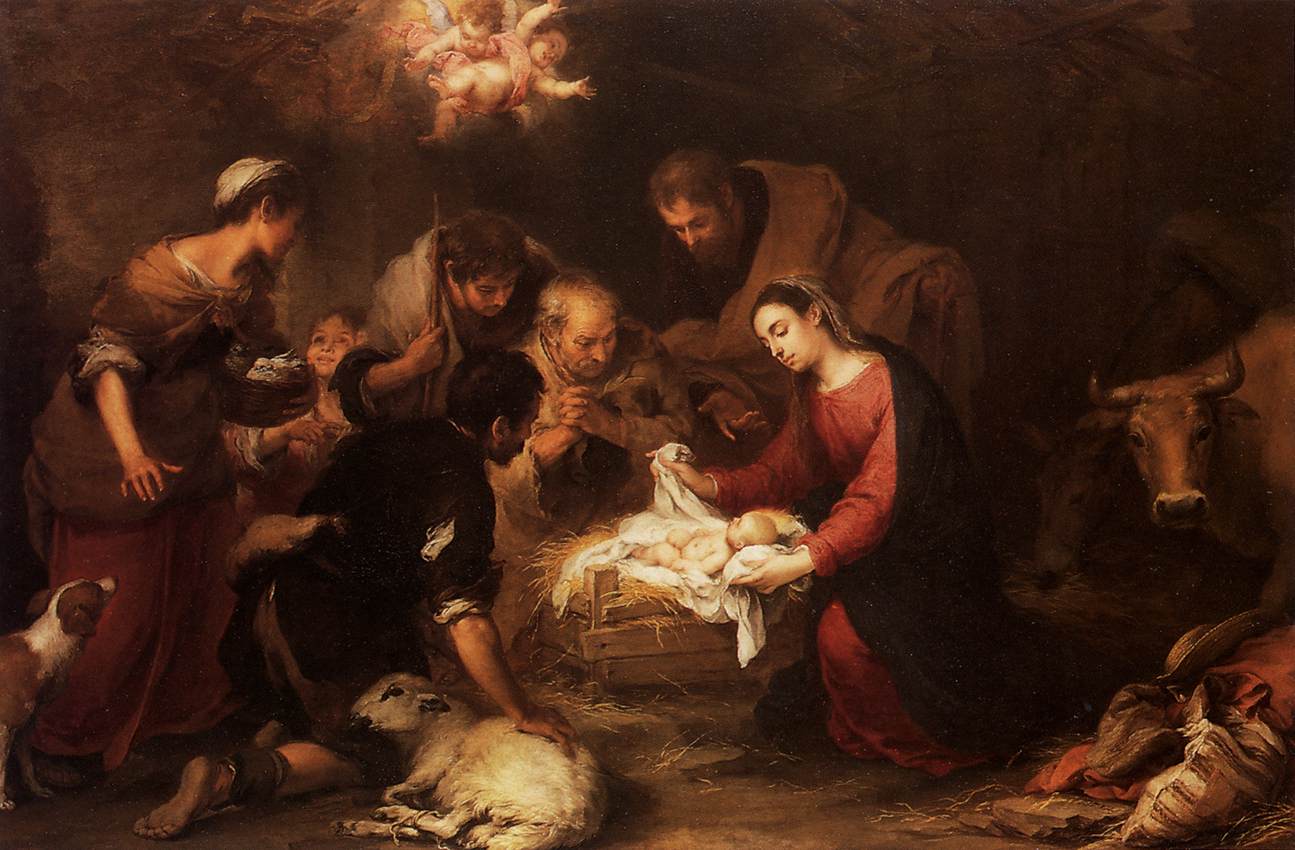
Without this pre-Christian backdrop, we miss out on just how countercultural the Christian Gospel was at the time and why it was perceived as a threat. Christianity didn’t arrive on the scene as some sort of feel-good belief system that fit right into the religion of the day. No. It challenged all of it, and even today continues to oppose worldly wisdom. The advent of the Christian Gospel even affronted the emperor. Augustus had named himself “savior” and “god.” The Gospels claim the real Savior (Lk 2:11) and peace-bearer (Lk 2:14) appears, not in the Roman emperor with all his earthly power, but in the apparently powerless Christ child. Therefore, Benedict XVI says, “St. Luke explicitly compares the Emperor Augustus with the Child born in Bethlehem: ‘Evangelium’ — he says — yes, it is the Emperor’s word, the true Emperor of the world. The true Emperor of the world has made himself heard, he speaks to us” (cf. Lk 2:1).7 The true Emperor was not seated on a throne in Rome, but lying in a manger in Bethlehem.
Fittingly, the glad tidings of Christianity first ring out with the word “rejoice” (Lk 1:28). This is how the angel Gabriel greets the virgin Mary in Nazareth: “Rejoice, favored one! The Lord is with you.” Such begins Gabriel’s annunciation to Mary, that she is to bear in her womb and give birth to the Son of God. Note that angel does not employ the typical Hebrew salutation shalom, but the Greek chaĩre. We usually translate chaĩre as “hail,” though the truer meaning is “rejoice!” The word appears once again when the angel announces to the shepherds: “I proclaim to you good news of great joy” (Lk 2:10). Ratzinger comments, “the whole text is saturated, as it were, with a feeling of joy, of a fresh beginning that will make all things new.”8 “Rejoice!” This is the word that resounds throughout history of Christianity. This is the word that highlights what the Gospel does — it causes proclaimers and hearers to rejoice.
As a final point, Benedict XVI notes the importance of the angel’s announcement being made in Greek, as it “opens the door to the peoples of the world: the universality of the Christian message becomes evident.”9 The Gospel brings joy, not to an exclusive group, but to one and to all.
But, what exactly do we mean by joy? What is joy after all?
1 Joseph Ratzinger, Principles of Catholic Theology, trans. Sister Mary Frances McCarthy, SND (San Francisco: Ignatius Press, 1987), 76. Other points in this paragraph are also drawn from Benedict XVI, Jesus of Nazareth: The Infancy Narratives, trans. Philip J. Whitmore (New York: Image, 2012), 26–27.
2 Benedict XVI, Jesus of Nazareth: The Infancy Narratives, 27.
3 Benedict XVI, Oct. 8, 2012 Meditation, accessed at vatican.va. See also Joseph Ratzinger, Gospel, Catechesis, Catechism (San Francisco: Ignatius Press, 1997), 38–39.
6 Benedict XVI, Oct. 8, 2012 Meditation. See also Ratzinger, Gospel, Catechesis, Catechism, 39; Benedict XVI, Jesus of Nazareth: From the Baptism in the Jordan to the Transfiguration, trans. Adrian J. Walker (San Francisco: Ignatius Press, 2007), 46–47.