• I grew up on grunge. The raw emotion, rough vocals, evasive lyrics, and diversity of sounds fascinated me. I suppose in my emo adolescence, it soundtracked the drama of my life.

    I don’t listen to grunge much anymore, but I was recently reintroduced to Nirvana’s “Something in the Way” through Stephen Wilson Jr’s cover of it. I hadn’t heard the song in decades. It’s sad and spooky. Oddly enough, it became a kind of anthem for my Lenten journey. I spent a lot of time praying with the song and mulling over the lyrics throughout Lent. Admittedly, they are weird lyrics: 

    Underneath the bridge, tarp has sprung a leak

    And the animals I’ve trapped have all become my pets

    And I’m living off of grass, and the drippings from my ceiling

    It’s okay to eat fish ’cause they don’t have any feelings

    Something in the way, hmm-mmm

    Something in the way, yeah, hmm-mmm

    Something in the way, hmm-mmm

    Something in the way, yeah, hmm-mmm

    Something in the way, hmm-mmm

    Something in the way, yeah, hmm-mmm

    I know what you’re thinking. You’re thinking you need to get on YouTube and take a listen. Go for it. Check out the MTV Unplugged version. But, fair warning, the song’s going to get stuck in your head. 

    Now, let’s take a closer look at the meaning.  

    On the surface, the song is clearly about a poor man living in a tarp under a bridge. His only friends are animals he’s trapped. He eats grass. Wet and cold and hungry, he copes by justifying eating fish because they can’t feel. This is an obvious lie he tells himself as he does anything for a bite. Then the haunting line: something in the way. All the imagery in the song is down, and when he manages to look up, he sees something in the way. He can see the possibility of a new life, but something blocks the path — something inside. So he’s stuck. 

    Rumor had it that Kurt Cobain wrote the song as a reflection on his own experience of homelessness. The Internet debates the truth of this claim. Regardless, the deeper themes have been etched deep into my mind over the last six weeks. The sense of angst. Abandonment. Living on the fringe as an outcast. The way in which things seem to go wrong. Fail. Self-inflicted wounds. What we scrounge to try to fill the God-sized hole in our hearts. The ways we justify things and lie to ourselves. The sense of being stuck. Seeing a new way of life but finding ourselves practically paralyzed, like St. Paul wondering why he does the things he doesn’t want to do, and doesn’t do the things he ought to do (see Rom 7:13–25). There’s a better life, but something’s in the way — sins, vices, wounds, lies. 

    Aren’t these the problems of humanity in our fallen state? It’s your story. It’s my story. All the discord, disharmony, discontent, disunity, disorder. All of it leaves us stuck and alone and fearful. Homeless. Made for a heavenly home that we can begin to live in right here, yet we settle for life underneath the bridge. Something’s in the way. Sin is in the way. Death is in the way. 

    But today, Easter Sunday, we hear that great news: that Jesus Christ has broken the prison bars of death. He breaks the bondage caused by sin. He smashes the something that was in the way and opens up the way. It’s a narrow way one enters through the Cross before the path widens our minds and hearts to embrace divine love.  In the face of what always seems hopeless, Jesus’ Resurrection gives us hope and shows us that a new way of living life is not only possible, it is here. The Easter liturgy tells us that now, if anything’s in the way, it’s Jesus Christ, the truth, life, and way to the Father (cf. Jn 14:6).

  • Lectio divina is an ancient practice that dates all the way back to the earliest stages of the monastic movement. The spirit of it can be found in St. Antony the Great (251-356), though many credit St. John Cassian (360-435) with bringing the practice to the West from the East.

    Regardless of its earliest origins, St. Benedict of Nursia (480-547) established it as a pillar of western monasticism in his Rule that became the standard for monastic life in the West.

    I’ve already noted that lectio divina is a Latin expression meaning “divine reading” or “sacred reading.” It’s a reading of holy things, holy content. Reading that’s set apart. A different kind of reading.

    The word lectio does not translate cleanly in contemporary English. Most simply, it means “reading.” But, nowadays, reading seems too superficial or uninvolved. Reading for information is too commonplace and nonchalant in our day and age that’s drowning in words. Skimming is standard, so “study” might be more accurate, as it gets at a kind of reading with deeper intention. However, study implies more rigorous intellectual activity than the spiritual work of lectio divina demands. It is not a scholarly exercise as we conceive of scholarship today. “Meditation” gets closer, but the contemporary usage of the word in psychology and New Age spiritualities muddies the water. The Latin word lectio gets at depth. It’s deep reading that is deep work. Lectio means deeply consuming a reading or teaching (more than simply perusing a piece of text).[1] It is reflective and ruminative reading. Wil Derkse puts it this way:

    Lectio divina is about a very slow reading of a text, preferably aloud, that the words may really be mouthed and tasted. This is reading till a word or phrase touches you, till you listen to something that as it were sticks to you. This word or phrase is then repeated aloud, regurgitated, as it were. The Latin term for this process is ruminatio—simply what you see cows doing in a quiet place, preparing the product of the first digestive process for the following phase…transformation.[2]

    Derkse’s emphasis on mouthing the words takes us further. Lectio means “hearing” and hearing implies “listening.” To this point, let’s listen to Jean Leclercq, OSB (1911–1993), the great French Benedictine scholar on lectio divina:

    With regard to literature, a fundamental observation must be made here: in the Middle Ages, as in antiquity, they read usually, not as today, principally with the eyes, but with the lips, pronouncing what they saw, and with the ears, listening to the words pronounced, hearing what is called the “voices of the pages.” It is a real acoustical reading; legere means at the same time audire. One understands only what one hears…No doubt, silent reading, or reading in a low voice, was not unknown…But most frequently, when legere and lectio are used without further explanation, they mean an activity which, like chant and writing, requires the participation of the whole body and the whole mind.[3]

    Lectio is whole-person, whole-body reading or listening. It’s not an exercise for the mind alone but brings in broader aspects of life. The fact that lectio involves listening means it involves obedience. Again, all of this means lectio is work. More on this later, but for now let’s turn our attention to the meaning of divina.

    The adjective divina means “divine.” It’s of God or belonging to God. That lectio is divine means, on the one hand, we are talking about reading whose principal object is God’s word (i.e., Scripture) or highly regarded spiritual classics. The grounds lectio divina in an objective content. Fr. Michael Casey, OSCO points out that “binding prayer to the Scriptures is an effective means of overcoming the obstacle of subjectivism and finding a way out of what had become a blind alley of blank spiritual experience.”[4] I take Casey to mean the experience had by anyone who prays: What am I hearing? Anything? Is what I’m hearing from me? God? Someone else? Tethering prayer to Scripture gives prayer a concrete foundation and a solid sounding board.  

    On the other hand, lectio being divine implies a subjective element. God and his word are alive. This means I’m not the only one reading when I’m engaged in lectio divina. No. This is reading done by two people — God and me. It’s co-reading. I might be reading God’s word, but God’s word reads me, so to speak. It pierces my core, given that it’s sharper than a two-edged sword, piercing between bone and marrow, and discerning (i.e., reading) the reflections of the heart (see Heb 4:12). Lectio divina, then, is a way of being with God in Scripture — encountering Christ in and through the sacred page. Fr. Charles Cummings, OSCO explains:

    In this practice we meet God through the instrumentality of the divine word…The process is a gentle one. The Lord does not come in an earthquake but in a soft, whispering sound…The encounter takes place without drama…The encounter is real without being extraordinary or spectacular.[5]

    Lectio is hearing God and responding — it is dialogical, conversational — and this is what prayer is — relating to God. St. Augustine speaks of this when he says, “when you read the Bible, God speaks to you; when you pray, you speak to God.”[6] The Church Fathers repeat this idea: “If we speak to God in prayer, it is because God already speaks to us first in the reading.”[7] This is why Leclercqdefines lectio divina as “prayed reading.”[8] And why Louis Bouyer (1913–2004), the French Lutheran minister who converted to Catholicism and became a priest, describes it in terms of assimilation. He says lectio divina is a “personal reading of the Word of God during which we try to assimilate its substance…in a spirit of obedience and total surrender.”[9] In his apostolic exhortation on the Word of God, Pope Benedict XVI calls lectio “a prayerful approach to the sacred text.”[10] The Catechism of the Catholic Church (CCC) describes lectio similarly, saying it’s “where the Word of God is so read and meditated that it becomes prayer” (§ 1177).

    To bring this initial chapter to some conclusion, I believe I can say that lectio is linchpin of prayer and work. In lectio, we see “ora et labora” converge. Pray and work — the Benedictine motto does not present two discreet things but holds prayer and work together. It stresses the unity of life. Lectio divina cultivates this unity. It is spiritual work. It is reading for the heart and reading by heart.

    After all this, lectio divina emerges as a mysterious, multivalent, multifaceted reality. It doesn’t evade definition altogether, but it’s certainly something that one learns through experienced. It’s more caught, than taught (which makes writing about it tricky). 


    [1] Karen Dwyer, Lawrence Dwyer, Wrap Yourself in Scripture, 2nd Ed (Omaha: The Institute for Priestly Formation, 2013), 9.

    [2] Wil Derkse, The Rule of Benedict for Beginners: Spirituality for Daily Life, trans. Martin Kessler (Collegeville, MN: Liturgical Press, 2003), 37.

    [3] Jean Leclercq, The Love of Learning and the Desire for God (New York: Fordham University Press, 1982), 15.

    [4] Michael Casey, Sacred Reading (Liguori, MO: Liguori, 1995), vii.

    [5] Charles Cummings, Monastic Practices (Kalamazoo, MI: Cistercian Publications, 1986), 8–9.

    [6] Quoted in Benedict XVI, Verbum Domini, §86.

    [7] Mariano Magrassi, Praying the Bible: An Introduction to Lectio Divina, trans. Edward Hagman (Collegeville: The Liturgical Press, 1998), 16.

    [8] Magrassi, Praying the Bible, 18.

    [9] Magrassi, Praying the Bible, 18.

    [10] Benedict XVI, Verbum Domini, §86.

  • My wife gifted me (us) tickets to the first stop on Stephen Wilson Jr.’s Gary the Torch tour in Columbus, Ohio last week. I’ve been listening to Stephen Wilson Jr. for, I don’t know, eight months or so. Overall, I’d say he’s wrecked me. There’s something about the depth of the poetry combined with grungy guitar that etches his songs in the deep caverns of my psyche.

    I’m a fan of music. Always have been. But something shifted for me somewhere between Coldplay’s Viva la Vida and Mylo Xyloto. Sounds became more electronic and artificial. EDM lurked about everywhere. Lyrics seemed vapid. Music, like everything else, more primed for mindless, consumptive entertainment (superficial pleasure) than a deep, human artistic expression. Now, I’m painting with a broad brush, and, to be fair, we had a lot of kids between 2008 and now. So, it’s not like I’ve had a ton of time to go digging for real artists. In fact, I didn’t go digging for SWJ. A dear friend introduced me to his music. I think I listened to “Grief Is Only Love,” “I’m a Song,” and “Stand by Me” in rapid succession. My wife was gone with our kids and she came back to the rare sight of me with music on in the kitchen. I told her she had to listen to this and we’ve been listening ever since. In fact, it’s been hard for me to listen to anything else. (Hence the “wrecked” reference above.)

    Stephen Wilson Jr. grew up in Seymour, IN. His parents divorced when he was a child. His father, a boxer, raised him as one, too, while his mother bounced between abusive relationships. He pursued science in college as a way out of his fundamentalist town and religious upbringing, a kind of middle-finger to the whole church thing. Though church did give his music a start in the worship band. Before taking up a research job in microbiology with Mars, Inc. Stephen Wilson Jr. was the lead guitarist and songwriter for indie rock band AutoVaughn. In 2016, he left Mars, Inc. to pursue songwriting in Nashville. In 2018, his father died suddenly at age 59. Before his death, Stephen Wilson Jr.’s father was constantly encouraging his son to sing his own songs instead of writing them and giving them away. At a songwriter festival in Deadwood, South Dakota, Stephen Wilson Jr. took the stage and sang his cover of Ben E. King’s “Stand by Me” as more of a plea than a song. That was the moment his artist was born.

    I’d like to share five brief observations from Friday’s show that provide meaningful insight into this meaningful singer/songwriter:

    • His whole life is on stage with him. Stephen Wilson Jr.’s official bio on his website says, his “journey from the hollers of southern Indiana to Nashville, Tenn. has been a winding road that’s taken many detours.” That may be true, but each detour has been meaningful. So, it’s interesting to see him bouncing around the stage, wiping his face with a towel, and returning to his corner like a boxer. It’s interesting to see elements of a praise and worship concert creep into exorcistic songs like “the devil.” It’s interesting to listen to listen to a self-described stenographer on stage, articulating universal truths after years of careful observation and listening to humanity — his own and that of others. It’s interesting that he has a massive Our Lady of Guadalupe backdrop as reminder of the miraculous and a reversal from his prior dismissal of religion. Past and present are part of an organic whole, like the notes of a melody flowing one into the other in such a way that eliminating even one of them impacts the whole. Along this line, Matthew Crawford notes that “moments interpenetrate one another, and can be isolated from the whole only by abstract thought. Time is not discreet, it is something that flows, with the past having a continuing influence on the future.” Each of SWJ’s detours mattered and all of it comes out on stage in a way I couldn’t have imagined just by listening to the music. He appreciates all of them and memorializes all of them in some way. All of this isn’t quite as transparent on the album (though it might be pretty close), but it is on stage. It’s something you have to see to get. And I saw that SWJ is himself and okay with it.
    • He and the band made music. They didn’t just play songs. There was a sense throughout the night that the concert was happening and the crowd was swept up in the making of music. While I’m sure the band spends countless hours rehearsing, there was plenty of improv going on, and a sense that this show was completely unique, like all of them must be. It took on a life of its own and only the people there got to experience that.
    • It was a human experience and not only because humans were there listening. No. SWJ is very human and he plays through his humanity. There was a sense that he was sharing this particular experience with us and he wanted us to share it with him, and ourselves with him. This became clear after the show, when he didn’t leave the stage and vanish into celebrity, but came down and greeted people, snapped photos, and made a point to be in touch with several wheel-chaired concert-goers. He expressed palpable appreciation for everyone being there.
    • He slowed down, throughout the show and at the end, and took time. This was not something to rush through.
    • He’s clearly an artist. Artists are kind of weird. Artists are human. Artists are real. Artists are not scandalized by the gray mess of life, it’s apparent absurdity. They have the gift (and burden) to reach deep down into it, pull out beautiful truths, and help us to see something we could not see before. In the same grungy way, SWJ reminds me of authors like Flannery O’Connor, Evelyn Waugh, and Matthew Crawford. Theirs is a pursuit of the real in all the nooks and crannies of life, even the dark and dusty ones. I’m convinced Stephen Wilson Jr.’s pursuit is the same. This is what art is and why beauty will save the world (Dostoevsky) — and, by extension, why music will save the world.1

    The day after the concert, as my wife and I prayed Lauds, she prayed for Stephen Wilson Jr. and for his work. I do think his work as an artist is important, right now, at this time of increasing artificiality. I do think the realness of his work can wake our humanity in a way it needs to be woken up, and I pray that, in the spotlight, he will stay “Gary” humble in carrying the torch.

    1. As a theologian, I’d be remiss to not point out Dostoevsky’s deeper reference. Actually, Joseph Ratzinger does this in the conclusion of his excellent article, “The feeling of things, the contemplation of beauty”: “Is there anyone who does not know Dostoevsky’s often quoted sentence: ‘The Beautiful will save us’? However, people usually forget that Dostoevsky is referring here to the redeeming Beauty of Christ. We must learn to see Him. If we know Him, not only in words, but if we are struck by the arrow of his paradoxical beauty, then we will truly know him, and know him not only because we have heard others speak about him. Then we will have found the beauty of Truth, of the Truth that redeems. Nothing can bring us into close contact with the beauty of Christ himself other than the world of beauty created by faith and light that shines out from the faces of the saints, through whom his own light becomes visible.” ↩︎
  • Battle for Peace

    Battling for peace is an oxymoronic truth.

    The find the origins of the word “peace” in the common Hebrew greeting shalom. Shalom refers to being intact, complete, and whole, to soundness and welfare. It expressed harmony and communion with God that resulted from the covenant. Shalom refers to communion with God that brings peace, and this communion has a covenantal form. 

    Translators of the Bible reinforced this emphasis on peace-as-communion as they utilized the Greek word eirēnē (harmony, concord, tranquility) for shalom, and opted for the Latin pacem (nominative pax) when the Bible was translated again. The root of pacem is pag-, which means “to fasten” — like forming a pact, contract, or, more profoundly, a covenant that forges peace.

    St. Augustine would go on to define peace as the “tranquility of order” in Book XIX, chapter 13, of his monumental work City of God. In his own words: “The peace of the Heavenly City is a perfectly ordered and perfectly harmonious fellowship in the enjoyment of God, and a mutual fellowship with God; the peace of the whole universe is the tranquillity of order.”[1] When things are so arranged that justice is done to each and each can work toward the good according to capability, the harmony that arises can properly called “peace.” Notice how, for Augustine, the fundamental order is not spatial or temporal, but relational. In other words, peace does not fundamentally depend on our time or spaces being in order (though these might be the natural outworkings of a rightly ordered life), but on our relationships being in order — beginning with the relationship with God. He echoes the shalom that results from covenantal communion and fidelity to the covenant. Again, we can recall Pope Benedict’s line, “Man is a relational being. And if his first, fundamental relationship is disturbed – his relationship with God – then nothing else can be truly in order.” If the relationship with God is disturbed, there can be no peace no matter how orderly the rest of life appears on the surface.

    Elsewhere, Ratzinger defines harmony in terms of joy and binds both relationally. He describes joy as the peace or harmony I experience within myself when I accept myself. The problem is, for a whole host of reasons, I do not accept myself. I do not love myself as I ought. Instead, I sin (against God, others, and myself), I believe lies about myself, I am disgusted with certain behaviors and attitudes, and so forth. To accept myself, I have to be accepted by another. Someone else needs to love me in order for me to believe I am loveable. And others do love me. However, no human love fully satisfies the ache of the human heart for an infinite, eternal love. All human loves fall short—a fact that is punctuated by the grave. Yet, when the time had fully come, God sent his Son, born of a woman, to redeem us, that we might be adopted as sons, brought into the new covenant, and abide in the peace and harmony of a rightly ordered relationship with God that allows us to call him “Abba! Father!” (see Gal 4:4–7). In light of God’s love for me, I can love myself and others and God. In light of God’s love for me, I can be peaceful and joyful.[2]

    The enemy, the nāhāš, the ancient serpent and dragon, tries to steal this peace. The enemy tries to disrupt and disorder our lives. Life’s battle involves striving to maintain our peace of heart against the enemy who tries to snatch it away. “Very frequently, spiritual combat consists precisely in this: defending one’s peace of heart against the enemy who attempts to steal it from us,” Fr. Jacques Philippe says.[3] To be sure, the whole of the Christian life is a battle (see CCC §409). But you really come under attack when you set out to more faithfully live your vocation as a husband and father. Rooting Yourself in your baptismal identity is the key to winning the battle for peace and the first step in protecting your family from the sneaky snake who tries to steal peace. It’s hard to be an agent of peace for your family when you’ve lost your own peace.

    We can think about this with an allegory. Snakes dwell in low areas, awaiting their prey, ready to pounce. One does not find snakes in mountainous regions high above sea level. These low-lying creatures do not like altitude and cannot endure the elements. Hence, they remain below a certain altitude. This is the invisible “snake line” above which you will not find snakes and below which you will. For the sake of our families, we, as husbands and fathers, need to remain well above the nāhāš line and help our families do the same.

    If you are interested in taking these principles and applying them to your own life, I’ve put together some reflection questions and an application worksheet.


    [1] Augustine of Hippo, City of God, trans. Henry Bettenson (Penguin, 2003), 870.

    [2] Here, I am summarizing a magnificent passage from Ratzinger’s Principles of Catholic Theology, 79–81.

    [3] Jacques Philippe, Searching for and Maintaining Peace, trans. George and Jannic Driscoll (Society of St. Paul, 2002), 11.

  • Crushed

    In today’s Gospel from Mark 3, we read:

    Jesus withdrew toward the sea with his disciples.
    A large number of people followed from Galilee and from Judea.
    Hearing what he was doing,
    a large number of people came to him also from Jerusalem,
    from Idumea, from beyond the Jordan,
    and from the neighborhood of Tyre and Sidon.
    He told his disciples to have a boat ready for him because of the crowd,
    so that they would not crush him.
    He had cured many and, as a result, those who had diseases
    were pressing upon him to touch him.

    As I was praying with this passage, I thought of the many times I’ve felt as though I’m being crushed by my responsibilities, my anxieties — good things and not-so-good things. Jesus readies a boat that he might not be crushed by the crowd (which was seeking him out of their desire for healing) by floating on peaceful waters. This got me thinking about the waters of Baptism and the call to abide (cf. Jn 15) in the Lord. By abiding in the new relationship with God established by Baptism and in our baptismal identity, we remain on those calm, peaceful waters despite whatever threatens to encroach upon our peace and crush it.

    Though a different image, this reminds me of a passage from my book Surviving Catholic Ministry:

    Snakes crawl on their bellies, low to the ground. Scraping the earth. They dwell in low areas, awaiting their prey, ready to pounce. In the mountains and regions high above sea level, one does not find snakes. These low-lying creatures do not like altitude, they cannot withstand the elements of the heights. They remain below a certain line. This is the invisible “line,” a certain altitude, above which you will not find snakes and below which you will. People refer to this phenomenon as the “snake line.”

    Beyond camping or hiking, we can apply the snake line to spiritual matters. For in our spiritual lives, we should strive to remain above the snake line. We are to avoid those base areas of temptation, those valleys of secretive darkness, and the confusion caused by self-doubt. Below the snake line, lying in wait, we find the devil, “a murderer from the beginning,” who “does not stand in truth, because there is no truth in him. When he tells a lie, he speaks in character, because he is a liar and the father of lies” (John 8:44). He is the accuser, diabolos, one who rips apart and tears asunder.

    Identity crises, that is forgetting we are beloved sons and daughters of God, often lie at the heart of our dip beneath the snake line. When this happens, we are susceptible to attack. Our forgetfulness of our identity, our lack of awareness of communion with God, is an apt description of concupiscence, that inclination to sin that remains even after original sin is washed away in Baptism. In the Fall, the Catechism says, “Man, tempted by the devil, let his trust in his Creator die in his heart and, abusing his freedom, disobeyed God’s command. This is what man’s first sin consisted of. All subsequent sin would be disobedience toward God and lack of trust in his goodness” (§397). Concupiscence is tied to original sin. Original sin was not an outright rejection of God, but a break in filial relationship with him. In the original sin, Adam and Eve stopped believing that God was their loving Father and they stepped out of relationship. They had fallen below the snake line, jeopardizing and eventually losing the sense of their identity.God calls us to remain above the snake line. “Remain in my love,” he says (John 15:9). It’s as if he’s saying, “Hold fast to your identity as my son. Hold fast to your identity as my daughter. Don’t forget that I see you, that I know you, that I’ve chosen you. I adopted you. You are mine.”

  • Forty

    I turn forty today. 

    They say, “You’re middle age,

    Hope you didn’t waste your youth.”

    I do see years wasted. 

    I see moments missed. 

    I look back on regrets, mistakes, and sins.

    Yet I see more light than darkness,

    Dawn breaking on a dark horizon. 

    I see gifts, grace, and virtue. 

    I have hope for the future,

    And I pray: Come, Holy Ghost,

    Spirit of eternal youth.

    Keep my soul young and joyful.

    Do not let humor die, 

    As I join with Francis and say,

    Let’s begin again, for till now

    I’ve done little or nothing.

  • Over the last few years, I’ve been blessed to contribute to the National Eucharistic Revival by writing for the blog/newsletter. I thought I would compile all the pieces in one location:

  • Pursuing Oblation

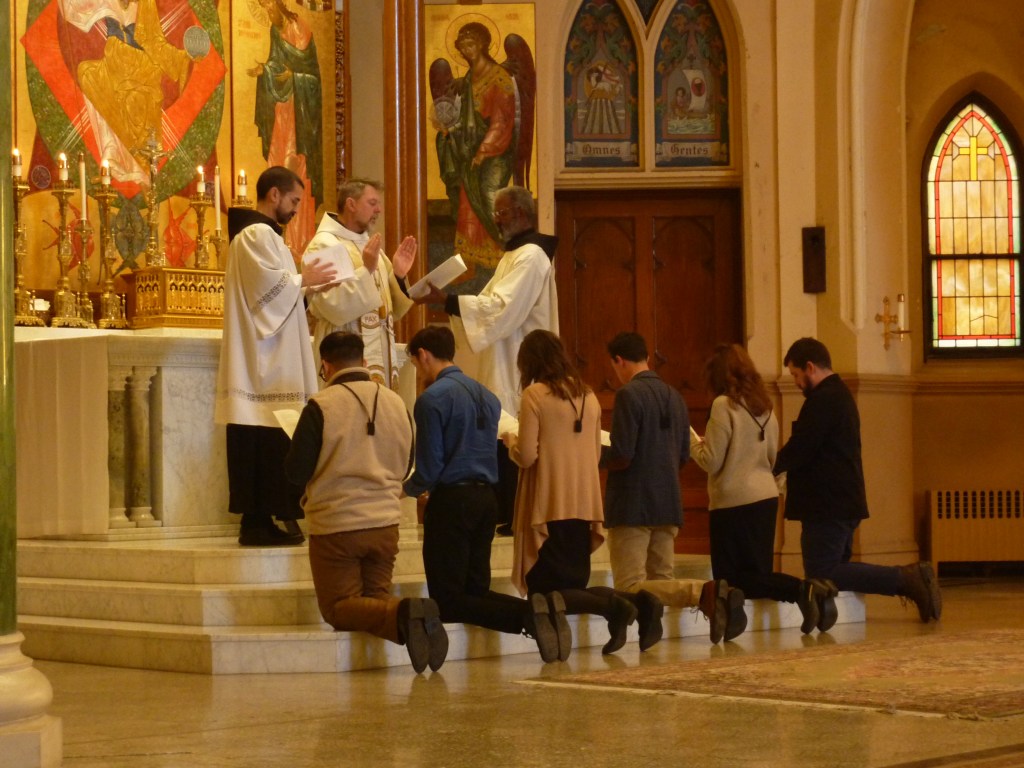
    I am a novice oblate of the Benedictine Monastery of the Holy Cross in Chicago, Illinois. My wife is, too. God willing, we will make our final oblation on Nov. 8, 2026. Benedictine oblates live the monastic way of life insofar as their state in life permits — they are, we might say, “everyday monks.”

    Rite of Investiture as an oblate novice at the Monastery of the Holy Cross on Nov. 16, 2025.

    Becoming a Benedictine oblate is the culmination of at least two significant spiritual movements for me over the last several years.

    The first movement consists of a desire for a more contemplative life — a more attentive life. As a husband and father of eight, with a very full-time job, it’s easy to lead a distracted life. It’s easy to miss what God is trying to do right in front of my face. So, this first desire boils down to a desire to seek God (cf. RB 58:7). I want to seek God in the ordinary circumstances of my life, and to do so in a way that’s been tried and proven true: the monastic way. To aid this search, we engage in certain spiritual practices, receive formation, and contribute to and receive from the spiritual good of the monastery.

    The second movement is communal. I am not sure how to raise a Catholic family in these times. It can feel discouraging at times and quite often we feel we’re spinning out of control. In the Fall of 2024, we read John Mark Comer’s The Ruthless Elimination of Hurry. This surfaced a number of important insights for us, but when we finished the book, we weren’t exactly sure how to act on it. It seemed like we would just make up something else, another strategy we’d try that might work, but probably not. It was then that I stumbled upon a little book by Fr. Dwight Longenecker entitled St. Benedict for Busy Parents. Honestly, I don’t even know how I saw it. It was in one of the pamplet book racks in the back of the church that I’d flown by 100,000 times before. This little book explained the Benedictine charism according to the monastic vows of stability, obedience, and conversion of life, and the pillars of daily monastic living (prayer, study, and work). It did all of this with the family in mind — making simple connections from the monastery to the home — and pointing out how the home can become a “school of the Lord’s service.” Here’s the money paragraph from Fr. Longenecker that pulled together my desire for deeper contemplation along with a richer family life:

    Benedict’s Rule gives us a foundation for the Christian home as well. The discipline in the home is established to form all who live there into more Christ-like people. The home, like the monastery, should be a school for the Lord’s service. It is the place where together, we learn how to come closer to God. Our relationships with one another, our schedules, the shape of our busy lives should all contribute to this one aim: that our home may be a place where we learn how to love God, and therefore become more like Him. 

    Or, this one from GA Simon’s Commentary for Benedictine Oblates:

    The Benedictine spirit is essentially a family spirit. To be faithful to the spirit of the Rule, therefore, the Oblate to whom Providence has entrusted the care of a family should love his home and maintain there that profound union which can come only from supernatural charity, grouping all the souls, so to speak, in one and the same search for God.

    Now, people have asked me why I need to pursue oblation in order to pray (honestly, many of the exact same prayer practices I had previously employed) or work on my family’s communal life. The honest answer to the honest question goes something like this: I’m tired of trying to figure things out on my own. I get tired of being anchored inside my own head, and thinking and re-thinking things. I need some sort of anchor outside of my head, a real tether to something concrete outside of my home, a bar or standard that won’t shift based upon how I’m feeling or what have you. I need to be linked to something more solid that me and my home in the midst of this world. The parish can provide this to a degree, but I wanted something even more intentional than parish life. I want a Rule of Life and something that won’t be subject to my own fickleness. St. Benedict’s Rule is this.

    Really, I think there’s another, more mysterious third reason I’m pursuing this: St. Benedict himself. I think St. Benedict has been quietly pursuing me for a long time. I was introduced to the Liturgy of the Hours as a sophomore in college. I first visited one of his monasteries on a mountainside in Spain (Our Lady of Montserrat Abbey) as a junior, and I first wore his medal as a senior in college. Early in my time of youth ministry, a friend gave me a St. Benedict medal crucifix, which has been on my wall ever since. When my wife and I went on a makeshift honeymoon after our wedding, we ended up on property in northern Colorado that was adjacent to St. Walburga Abbey, which was where we celebrated the Solemnity of Mary Mother of God back on Jan. 1, 2009. Pope Benedict XVI has been a spiritual father to me throughout my entire time of trying to live as an intentional disciple, and I firmly believe he did more for the Church as a hermit than he would have had he not retired. I’ve always thought of our Christian home as something of a monastery — that somehow some principles from monastic life should be able to help us. Reading Rumer Godden’s In This House of Brede only solidified this conviction. I think Rod Dreher’s The Benedict Option is onto something, but I found the whole concept too idealistic so I didn’t know what to do with it. It needed to be tethered to something real (I think oblation does this in a unique way). My great uncle stole away from home as a young man and entered the Benedictine abbey of St. Meinrad in remote southern Indiana. His story has haunted me most of my life and I’ve prayed at his tomb. Yes. I think St. Benedict has been after me.

    Monastery of the Holy Cross

    One becomes an oblate of a particular monastery. The Order of St. Benedict is not a universal order like Franciscans, Dominicans, or Jesuits. It’s a collection of monasteries united by the Rule, but each with its own customs and Benedictine flair. Choosing to be a Benedictine oblate is one thing, of which monastery is another. We have discerned to pursue oblation at the Monastery of the Holy Cross in Chicago, and the monks there have mutually discerned to accept and support our pursuit. The whole process has been marked by mutual discernment and an attentiveness to a certain “spiritual affinity” — an affinity between the spirituality of the monastery and our spiritual journey. Michael Casey, OCSO describes this reality:

    A monastic vocation cannot be forced. Will-power is not enough. There needs to be some pre-existing affinity that guarantees that growth in monasticity is also growth in authentic selfhood.
    This connaturality means that often a candidate is attracted to a particular monastery without quite knowing why. It may be the scenic location, the sense of silence and calm, the quiet industry, the disciplined freedom, the generalized aura or contentment, the sound of the chant, or the understanding smile of a member of the community. Some trivial aspect of daily life awakes a deep inner resonance within that signals to inquirers that this is not only a place where they can seek and serve God, it is also the possibility for them to be and become themselves.

    I think the connaturality with the Monastery of the Holy Cross, for us, comes from the following:

    • The palpable Christocentricity of the community
    • The seriousness with which they take prayer and the liturgy
    • The location in the middle of a big city — silence in the city
    • Their appreciation of the Eastern rites and spirituality
    • The fact that the founders were very active missionaries in Latin America who realized the purely active life was empty to some degree, and desired a richer communal and liturgical life (Katie and I had a similar experience with very full-time ministry and realizing a need for a deeper family and prayer life)

    Numerous times a day, I recall the monks at the Monastery.1 I recall our “family” in Chicago, and our “home” there. I think of what GA Simon says: “The thought of our monastery, with its vision of fervor and peace, contributes to [the sense of building a spiritual enclosure]. In the midst of the world we tell ourselves: I am the brother of the monks, I belong to the monastic Order; I am no longer of the world.”

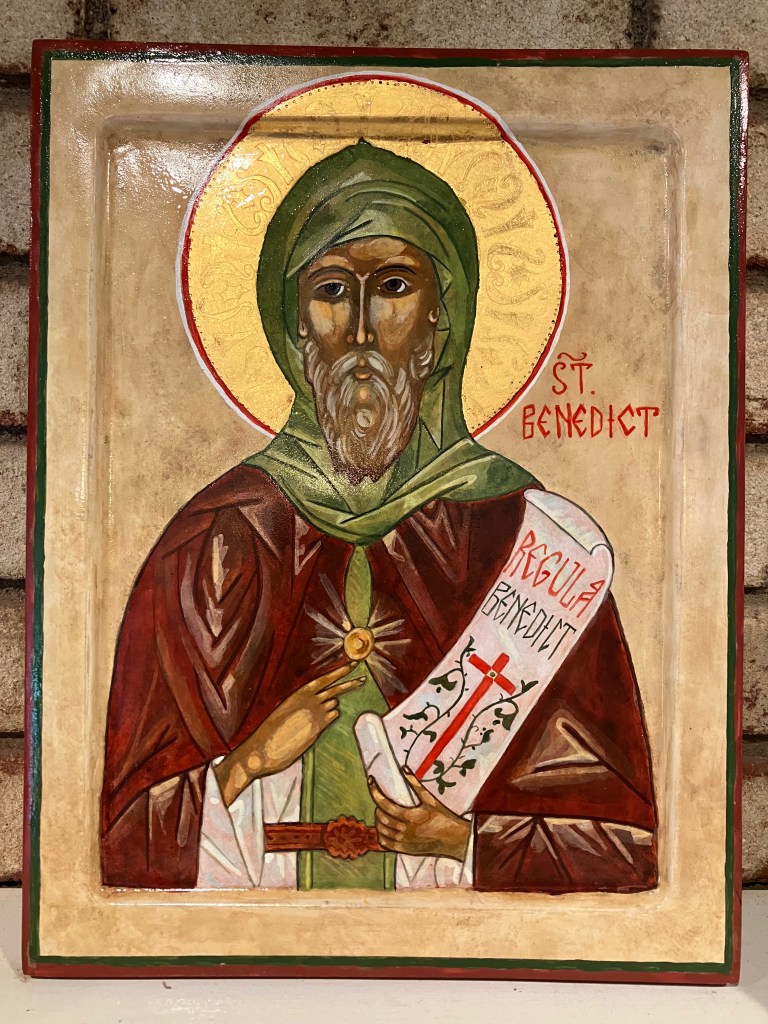
    An icon we had written by a local iconographer. It is a replica of the icon of St. Benedict that appears on the deisis triptych in oratory of the Monastery of the Holy Cross.

    We are novices. We have a long way to go and much to learn as we head down the well-trodden monastic path. Even after final oblation next November, we will still be novices and probably always be novices to some degree. I’m glad St. Benedict had me in mind when he wrote his little Rule for beginners (cf. RB 73:8).

    1. We’ve added some incarnational elements to our home that help us remember the monastery. A beautiful pencil drawing of the Monastery, various symbols of the Benedictine order (e.g., Benedict medal), an icon of St. Benedict, mugs from the Monastery, and so forth. ↩︎
  • Silence and Discretion

    Recently, I had a bad cough. You know, the type that causes your chest and throat to burn and gives your once-six-pack-abs a good workout? Yes, that kind. The kind of cough that lingers as an evil tickle in the back of your throat. One false word, one false breath will cause it to explode and send you red-faced and running out of the room with tears in your eyes as you try to hold it in. That terrible type of a cough.

    As the days wore on, I found myself growing more and more silent. I could speak, but if I spoke, I knew it would hurt and I knew it could cause me to start coughing. Consequently, I had to weigh each word. Was it worth saying what I was about to say? Was it worth the cost? Was it worth the cough? Generally, as I thought through what I would say and if it was necessary, I found that most of the time, it wasn’t necessary and if it was, I could say whatever it was in fewer words — a fraction of what I would have said had I not thought deeply about how I should say it.

    While it may have been for a kind of medical precaution, this experience made me realize silence is a precondition for discretion. Said another way, it’s hard to exercise discretion if you’re distracted and jabbering away all the time. 

    In chapter 64 of his Rule, St. Benedict calls discretion the “mother of all virtues.” He says this regarding the qualities of an ideal abbot, who ought to be “discerning and moderate,” and “must so arrange everything that the strong have something to yearn for and the weak nothing to run from.”

    Discretion has to do with making the right choice to achieve an intended outcome in a given set of circumstances. Far from being a strict rule, it is truly a virtue carrying with it the flexibility of the virtuous choosing-of-the-good in whatever the circumstances — choices which may shift and change depending upon those circumstances.

    The Benedictine practice of discretion grew out of a long tradition of monastic discernment of spirits. Discernment focuses on making a choice for God and against the world, flesh, or the devil. It has to do with choosing God and his way regardless of the circumstances and precisely within those circumstances. For example, one of the sayings of the Desert Fathers goes like this: “Abbot Ammonas said: One man carries an axe all his life and never cuts down a tree. Another, who knows how to cut, gives a few swings and the tree is down. This axe, he said, is discretion.”1 Don’t use the axe in one instance (especially if you don’t know how), and use it on the other (if you do know how). Both men exercise discretion.

    By the time the tradition reaches St. Benedict, discernment/discretion refers to moderation, being a balance at an equilibrium, not tipping the scale too far in one direction or the other. Discernment of spirits has moved beyond a spiritual gift or even a virtue, to, as Joseph Lienhard, SJ says, “a control on other virtues, the fine intuition into his subjects’ strengths and weaknesses that allows the abbot to guide them and foster their growth without straining them or letting them become lax. Even so, the trail leading back from Benedict to the deserts of Egypt has not been obscured.”2 Discretion guides the exercise of the other virtues, hence why Benedict calls it the “mother” of all virtues. Along this line, Sister Therese Haydel, OSB, of Sacred Heart Monastery in Alabama, describes discretion and its importance as follows:

    But why does St. Benedict consider discretion the mother of virtues? The likely answer to this question is because discretion lets us know what actions are appropriate based on the desired outcome, even if the action itself is unpleasant or undesirable in itself. Curbing one’s speech when one would rather defend one’s own opinion can form us in the virtues of humility and obedience. Speaking up about an unjust situation when one would rather not draw attention to oneself can promote the cultivation of honesty, courage, and integrity. Accommodating a sister or brother so that she or he may be at peace when we would prefer to do things our own way might help us to grow in the virtue of patience.

    I think we can see that silence and silencing the tongue are a kind of prerequisite for a fruitful exercise of discretion. But the converse is also true. Discretion guides the exercise of silencing the tongue. St. Benedict himself indicates this in chapter 6 of the Rule:

    Let us follow the Prophet’s counsel: I said, I have resolved to keep watch over my ways that I may never sin with my tongue. I have put a guard on my mouth. I was silent and was humbled, and I refrained even from good words (Ps 38[39]:2-3). Here the Prophet indicates that there are times when good words are to be left unsaid out of esteem for silence.

    The value of silence warrants discretion and the curbing of words — even good ones. GA Simon, author of the Commentary for Benedictine Oblates, says that discretion results from the love of silence.3

    Discretion serves silence, as silence fuels and makes possible discretion. The two go hand-in-hand. There is no true discretion without some interior silence, and discretion makes interior silence possible by limiting external and internal noise.

    In sum, if you want to make better decisions, be quiet. And if you want to be quieter, make good decisions that will cultivate that spirit of silence in your life.

    1. Thomas Merton, The Wisdom of the Desert, 43. ↩︎
    2. Joseph T. Lienhard, “On ‘Discernment of Spirits’ in the Early Church,” 528. ↩︎
    3. GA Simon, Commentary for Benedictine Oblates, 81. ↩︎
  • Make Space not Plans

    I was doing some late-night reading a few days ago, perusing the latest edition of The Catholic Worker, the bi-monthly newspaper from New York City that still serves as an organ of the movement. A man named Trevor Brannigan contributed an article documenting his time at Peter Maurin Farm, located in Marlboro, NY (50 miles north of NYC). I enjoyed reading about squash, pureed watermelon, and canning. Then I got to his last paragraph:

    This year at the farm we’ve had a saying that we aren’t going to make plans, we’re going to make space…Where we make space, and for what, and for whom is a never-ending question, but we contemplate it just the same.

    I enjoyed thinking about hippie (or at least pseudo-hippie) organic farmers sitting around a fire sipping herbal tea and uttering such lines. It’s a kind of romanticized embrace of youthfulness, a going-where-the-wind-blows mentality because I have no real responsibility. It seems a silly sentiment to resonate with a middle-aged man with a big family, but it did resonate. It resonated because it speaks a fundamental truth. To be a Christian means I am no longer in charge of my life. It means my plans are truly the silly sentiments.

    This year, rather than all sorts of plans and New Year’s resolutions, my plan is to make more space for God in my life. I plan to cut down on time on my phone which causes so much distraction and inattentiveness. I plan on more family time and deeper surrender of my deepest concerns. I’m going to make space and not a laundry list of my own plans. I’m going to make space and let God make the plans.